
Custom Lipid-Polymer Conjugation Service
Lipid-Polymer Conjugates Introduction
Lipid polymer conjugation (LPC) refers to the covalent connection of lipid components (such as fatty acids, phospholipids, sterols) with synthetic or natural polymers to create a hybrid biomaterial that combines the unique properties of the two components. Lipid have been used as microcarriers and nanocarriers for hydrophobic or hydrophilic molecules. However, classical lipids are biodegradable and can be rapidly cleared out, making them unsuitable for particular pathways like oral and systemic routes of drug delivery. Complexation with polymers is one way to get over this problem, and the polymers are termed lipid complexes. Polymers can enhance the stability of liposomes in terms of pH, chemicals, enzymes and the immune system. Studies have been conducted to modify the liposome structure and the physicochemical properties using natural as well as synthetic polymers for the main aim of clarifying the usage in target delivery, controlled release and stable drug and vaccine application. These properties depend on the type of polymer, crosslinking agent, interactions and bonds that are involved in the complexation process.
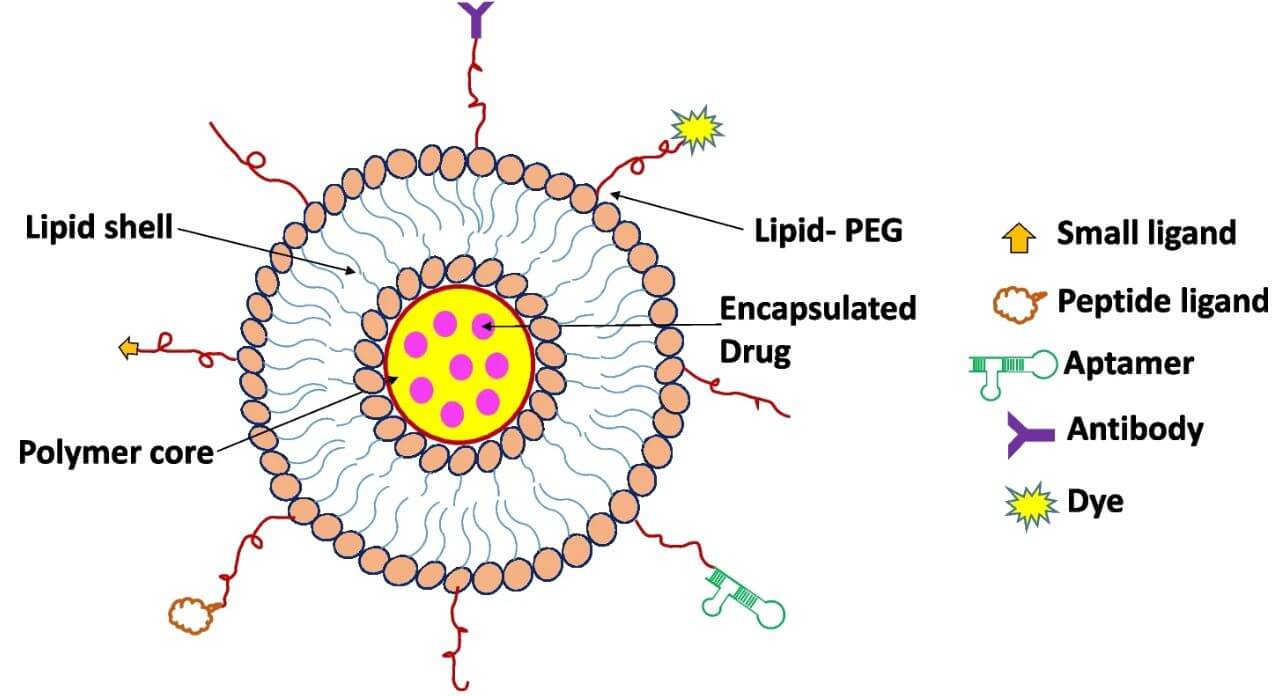 Figure 1 Schematic representation of multifunctional LPHNPs comprising structural components and various possible functionalities.1
Applications of Lipid-polymer Conjugates
Active Targeting: Polymer chains act as spacers, providing a functional platform for further coupling of targeted ligands such as antibodies, peptides, aptamers, and small molecules. This is a crucial step in transitioning from passive EPR orientation to active, specific orientation.
Drug Delivery: Advanced polymers other than PEG can be combined to endow "intelligent" release capabilities. Polymers that are sensitive to specific physiological triggers, such as low pH (e.g. in the endosome or tumor microenvironment), redox potential (high glutathione in the cytoplasm), or specific enzymes, can be used.
Diagnostic Imaging: By combining imaging agents such as fluorescent dyes or radioactive isotopes with LPHNP, it can be used as a contrast agent for medical imaging. Their controllable size and adjustable surface properties enable them to accumulate at the target site through enhanced permeability and retention (EPR) effects, providing high-resolution images for disease diagnosis and monitoring.
Advantages and Limitations of Lipid Polymer Conjugates
| Advantages | Limitations & Challenges |
|---|---|
| Prolonged Circulation Half-life: Shields from MPS, reducing clearance. | Accelerated Blood Clearance (ABC): Repeated dosing can induce anti-PEG antibodies, leading to faster clearance. |
| Enhanced Solubility: Improves aqueous solubility of hydrophobic cargoes. | Potential Immunogenicity: PEG and other polymers can, in rare cases, elicit immune responses. |
| Reduced Opsonization & Immunogenicity: Minimizes unwanted protein adsorption. | Complex Manufacturing: Conjugation and purification add steps to the production workflow. |
| Improved Stability: Prevents nanoparticle aggregation during storage and in biological fluids. | Hindered Cellular Uptake: The steric barrier can sometimes inhibit desired interaction with target cells. |
| Platform for Functionalization: Provides a handle for attaching targeting ligands and other moieties. | Batch-to-Batch Variability: Requires stringent quality control to ensure conjugate consistency. |
Overview of What Creative Biolabs Can Provide
Creative Biolabs provides end-to-end services for the design, synthesis, purification, and analytical characterization of customized lipid polymer conjugates. We offer:
- Customized Conjugate Synthesis
Customize the conjugation of your chosen lipids (DSPE, DOPE, ceramides, etc.) with various polymers (PEG of different lengths and functions, smart polymers, polyzwitterionic polymers).
- Functionalized polyethylene glycol lipids
a large number of pre-fabricated and customized maleimide NHS、DBCO、 Polyethylene glycol lipids capped with azide, biotin, and carboxyl groups.
- Liposome formulation and testing
We provide comprehensive service support by integrating our conjugates into stable monodisperse liposomes and LNP, followed by comprehensive in vitro and in vivo testing.
- Liposomal incorporation
In addition to selecting the most suitable polymers, crosslinkers, and lipids based on customer research needs, Creative Biolabs can also conduct standard evaluations to observe interaction patterns and their impact on the physicochemical properties of liposome complexes.
Our Service Workflow
Our collaborative service workflow aims to achieve maximum efficiency and customer satisfaction:
- Project Discussion: Contact our technical support team to discuss your project requirements, goals, and any specific challenges.
- Proposal and Quote: Our scientists will prepare a detailed customized proposal outlining the project plan, timeline, and cost.
- Conjugate Design and Synthesis: After approval, our team will initiate the design and synthesis of your LPHNP and provide regular progress updates.
- Quality Control and Analysis: The synthesized conjugate undergoes strict quality control to ensure that it meets the agreed specifications.
- Result Delivery: We deliver the final, well documented product, as well as a detailed report on synthesis, characterization, and quality control data.
What Makes Creative Biolabs Your Top Choice
Transparent Communication
In addition to the quality of our work, we also believe in building trust through transparency. Throughout the entire process of biological coupling, we maintain open and honest communication, and regularly provide detailed updates.
Lot-to-Lot Stability
Consistency is crucial in biological coupling, especially in the LPC amplification process. Our strict quality control measures ensure stability between batches, including LPC biophysical evaluation and functional testing, maintaining high performance for each batch.
Comprehensive Discovery Services
We provide a wide range of discovery phase services for rapid LPC development, including bioconjugate chemistry, adapter optimization, LPC plasma stability testing, lysosome-based payload release assessment, as well as in vitro biological assays.
Frequently Asked Questions
Q: What are the key differences between liposomes and lipid polymer hybrid nanoparticles?
A: Liposomes are only composed of lipid bilayers, while LPC has a solid polymer core surrounded by lipid monolayers. This core endows LPC with excellent structural stability and allows for more precise control of drug release kinetics.
Q: How are lipid conjugates synthesized?
A: Lipid conjugates are synthesized through chemical or enzymatic reactions, carefully designed to maintain the function of lipids and attached biomolecules.
Q: Can you help with in vivo testing of the binding compound?
A: Yes, it is. Our in vivo team conducts pharmacokinetic (PK) studies (changes in serum drug levels over time), biodistribution (tissue uptake through imaging or MS), and efficacy studies (tumor growth inhibition, gene silencing) in mouse models and larger animals (rats, rabbits) (if necessary).
Q: Can Creative Biolabs encapsulate small molecules and nucleic acids in LPC?
A: Yes, it is. Our advanced formulation method allows for the co encapsulation of various payloads, including small molecule drugs and nucleic acids such as siRNA or mRNA, providing a multifunctional platform for combination therapy.
Reference
- Gajbhiye K R, Salve R, Narwade M, et al. Lipid polymer hybrid nanoparticles: a custom-tailored next-generation approach for cancer therapeutics. Molecular cancer, 2023, 22(1): 160. https://doi.org/10.1186/s12943-023-01849-0 Distributed under Open Access license CC BY 4.0, without modification.