
Custom Small Molecule-Liposome Conjugation Service
At Creative Biolabs, we empower your research and drug development by providing bespoke small molecule-liposome conjugation services tailored to your specific therapeutic goals, helping you accelerate your drug development programs and achieve your research milestones.
Background of Small Molecule-Liposome Conjugation
Traditional liposomes passively accumulate in tissues via the enhanced permeability and retention (EPR) effect. In contrast, surface-engineered conjugates enable active targeting capabilities. Surface modification of liposomes with functional small molecules can improve their properties.
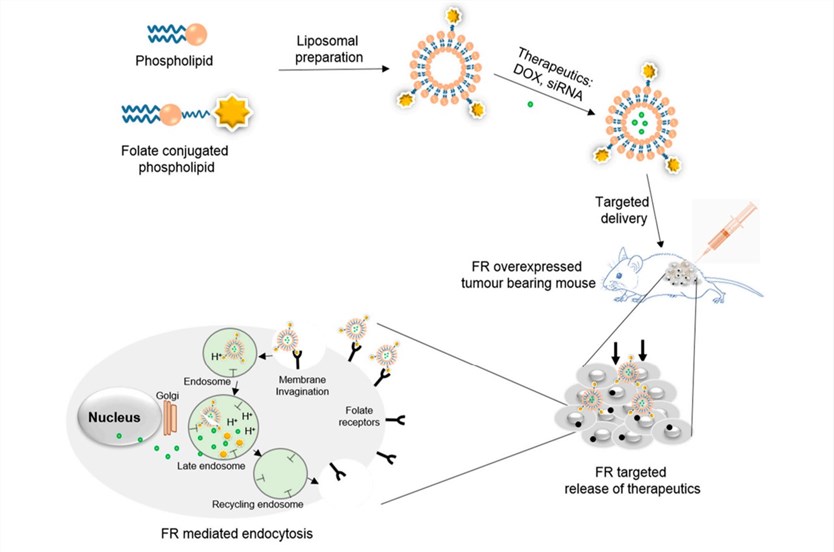 Fig.1 Schematic representation of the preparation of folate-conjugated liposomes and their targeted delivery of therapeutic agents.1
Methods of Small Molecule-Liposome Conjugates
The conjugation of small molecules to liposomes typically involves covalent bond formation, such as:
- Amine-carboxyl coupling (e.g., EDC/NHS chemistry)
- Thiol-maleimide coupling
- Click chemistry (e.g., CuAAC, SPAAC)
- Hydrazone bond formation (pH-sensitive)
- Disulfide bond formation (redox-sensitive)
Applications of Small Molecule-Liposome Conjugates
- Folic Acid Conjugation: Folic acid receptors are often overexpressed on various cancer cells (e.g., ovarian, lung, breast cancer). Folic acid-conjugated liposomes are designed to target these tumors, enhancing drug delivery to malignant tissues.
- Mannose Conjugation: Mannose receptors are present in macrophages and dendritic cells. Mannose-conjugated liposomes can be used for targeted delivery to these immune cells, for applications in immunotherapy or treating intracellular infections.
- Galactose Conjugation: Asialoglycoprotein receptors, which recognize galactose, are predominantly found on hepatocytes. Galactose-conjugated liposomes are a strategy for liver-specific drug delivery.
- Glucose Conjugation: Glucose transporters are upregulated in certain tissues, including some tumors and the brain. Glucose-conjugated liposomes can exploit these transporters for enhanced uptake.
Our Services
Creative Biolabs offers a comprehensive suite of services to meet your specific conjugation needs, from initial molecule design to the final characterized conjugate.
- Small Molecule Synthesis and Modification
We can synthesize your small molecule of interest if it's not commercially available or if you require a specific analog. We'll then design and conjugate appropriate reactive groups (like amines, carboxyls, thiols, azides, or alkynes) and linkers (such as PEG spacers or cleavable linkers) to the small molecule. This facilitates subsequent liposome conjugation and helps control release properties.
- Formulation Customization of Liposomes
The liposome carrier is a critical component, and we tailor its properties to suit your therapeutic agent and delivery goals. We select from a wide range of phospholipids (like PC, PE, PS, PG, PI), cholesterol, and functionalized lipids (e.g., DSPE-PEG, maleimide-PEG-lipids) to achieve the desired charge, stability, and surface chemistry. Additionally, we incorporate lipids with reactive headgroups (such as maleimide, NHS-ester, carboxyl, or amine) to enable efficient covalent conjugation of small molecules.
- Small Molecule-Liposome Conjugation
This is the core service where your small molecule (or its modified version) is covalently attached to the custom-formulated liposomes. We perform rigorous purification of the final conjugate (e.g., dialysis) followed by comprehensive characterization.
Workflow: From Concept to Conjugate
Our process is transparent and collaborative, designed for clarity and efficiency.
-
Required Starting Materials: To initiate your project, we typically require:
- The small molecule candidate (structure, quantity, relevant physicochemical properties).
- Detailed information on the desired therapeutic application and target (e.g., cell type, tissue).
- Any preliminary data or specific formulation requirements you may have (e.g., preferred lipid composition, particle size).
- Key Steps Involved:
| Steps | Description | Expected Outcome |
|---|---|---|
| Initial Consultation and Project Scoping | We begin with a thorough discussion to understand your project objectives, target product profile, and specific challenges. This allows us to define the scope, deliverables, and optimal conjugation strategy. | A mutually agreed project plan and initial strategy. |
| Small Molecule & Linker Strategy (If applicable) | If your small molecule requires modification or if a specific linker is needed for conjugation, our chemists will design and synthesize/procure the necessary components. This may involve introducing reactive groups for efficient conjugation. | Functionalized small molecule and/or selected linker ready for conjugation. |
| Liposome Formulation Development & Characterization | We develop the liposomal formulation based on your requirements. This includes selecting appropriate lipids, preparing liposomes with desired characteristics (e.g., size, charge, lamellarity), and thorough characterization. | Characterized liposomes tailored for your small molecule and application. |
| Conjugation and Purification | The selected small molecule (or its derivative) is conjugated to the prepared liposomes using optimized chemical methods (e.g., covalent attachment to surface-exposed functional groups). The resulting conjugate is then meticulously purified to remove unreacted components. | Purified small molecule-liposome conjugate. |
| Analytical Characterization and Quality Control | The final conjugate undergoes comprehensive analysis to confirm successful conjugation and assess drug loading/conjugation efficiency, particle size, and other critical quality attributes as defined in the project scope. | Fully characterized conjugate with a detailed analytical report. |
-
Final Deliverables: Upon project completion, you will receive:
- The custom-synthesized small molecule-liposome conjugate that meets the agreed-upon specifications.
- A comprehensive project report detailing the preparation methods and complete characterization data (e.g., conjugation efficiency and particle size analysis).
- Technical support for any questions regarding the handling or application of the delivered conjugate.
- Estimated Timeframe: The typical timeframe for our Custom Small Molecule-Liposome Conjugation Service ranges from 6 to 12 weeks. This duration can vary depending on the complexity of the small molecule, the need for custom synthesis, the intricacies of the liposome formulation, and the extent of analytical characterization required.
Why Choose Creative Biolabs?
Choosing Creative Biolabs for your small molecule-liposome conjugation needs means partnering with a team dedicated to scientific excellence and client success. Our key advantages include:
- Deep Scientific Expertise: Decades of collective experience in lipid chemistry, bioconjugation, nanoparticle formulation, and drug delivery.
- Customized Project Architectures: Eschewing generic methodologies, each project is uniquely architected to align with the specific molecular entity, designated biological target, and overarching therapeutic objectives of our clients.
- Advanced Laboratory Infrastructure: Creative Biolabs operates from laboratory environments furnished with sophisticated instrumentation essential for synthesis, precise formulation development, and comprehensive analytical characterization of conjugates.
- Robust Quality Systems: Stringent quality control measures are embedded in every step of our process, ensuring reliable and reproducible results.
- Integrated Partnership Model: A service philosophy emphasizing transparent scientific dialogue and close integration with client research teams underpins our collaborative engagements.
Customer Reviews

Dr. Jia*** P:
"Using Creative Biolabs' Custom Small Molecule-Liposome Conjugation Service in our preclinical oncology program has significantly improved the delivery to tumor tissues while reducing systemic exposure."
[March 2025]
Dr. Ste*** B:
"The galactose-conjugated liposomes developed by Creative Biolabs for our liver imaging project demonstrated superior accumulation and signal intensity compared to the free agent. The technical support throughout was also invaluable."
[October 2024]
FAQs
1. Q: What types of small molecules can be conjugated to liposomes using Creative Biolabs' service?
A: We can work with a wide array of small molecules, including therapeutic drugs, diagnostic agents, and targeting ligands. The feasibility depends on the molecule's chemical structure and the presence of (or ability to introduce) suitable functional groups for conjugation. We encourage you to discuss your specific molecule with our experts!
2. Q: How does small molecule-liposome conjugation improve targeted drug delivery?
A: Conjugation allows for the attachment of targeting moieties (like folic acid, antibodies, or specific peptides) to the liposome surface. These moieties can then bind to receptors overexpressed on target cells (e.g., cancer cells), leading to preferential accumulation of the liposome and its payload at the desired site, thereby enhancing efficacy and reducing off-target effects. Let's explore how this could benefit your specific target!
3. Q: What are the storage conditions for conjugated liposomes?
A: Conjugated liposomes are available in two formulations. Liquid formulations can be stored at 4°C for 1-2 months, while lyophilized formulations can be stored at 4°C for 4-6 months.
Ready to discuss how our expertise can benefit your project? Our scientific team is available to answer your questions and guide you through the process. We look forward to partnering with you! Contact us for more information.
Reference
- Kumar, Parveen, Peipei Huo, and Bo Liu. "Formulation strategies for folate-targeted liposomes and their biomedical applications." Pharmaceutics 11.8 (2019): 381. Under open access license CC BY 4.0, without modification.