
Custom Lipid-Fluorescent Dye Conjugation Service
Lipid-fluorescent dye conjugation is a technique that uniquely combines the critical structural and signaling properties of lipids with the sensitivity and convenience of state-of-the-art fluorophores. Creative Biolabs has developed this highly specialized bioconjugation chemistry into a quality-guaranteed service to give researchers across the globe custom-made, high-functioning probes to study the hidden mechanisms of life and disease.
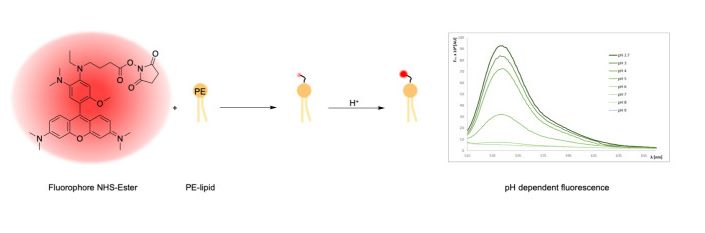 Figure 1 Synthesis of lipid-conjugated pH sensors based on amine-reactive fluorophore esters and the aminophospholipid phosphoethanolamine (PE).1
Fluorescent Dye Basics
Fluorophore dye is a fluorescent compound that can re-emit light when excited by light. Fluorophore dye usually contains multiple aromatic groups combined, or planar or cyclic molecules with multiple pi bonds. Fluorophores are sometimes used alone, as tracers in liquids, as dyes to stain certain structures, as substrates for enzymes, or as probes or indicators. More generally, they are covalently bonded to macromolecules and used as labels for affinity or biologically active agents.
Types of Fluorescent Dyes
The vast array of fluorescent dyes available to researchers can be broadly categorized based on their chemical structure, physical properties, and applications. Each type offers distinct advantages and disadvantages:
| Dye Type | Examples | Advantages | Disadvantages |
|---|---|---|---|
| Organic Dyes | Fluoresceins (FITC), Rhodamines (TRITC), Cyanine Dyes (Cy3, Cy5), Coumarins, BODIPY Dyes | Wide range of tunable spectral properties, readily available, versatile chemistries for conjugation, good brightness (especially Alexa Fluor & BODIPY), suitable for various imaging modalities. | Fluoresceins are susceptible to photobleaching and pH sensitivity. Some organic dyes may have limited photostability compared to QDs. |
| Quantum Dots (QDs) | CdSe, CdTe nanocrystals | Exceptionally bright, highly photostable (minimal photobleaching), broad absorption spectra, narrow and symmetric emission peaks (tunable by size). | It is often restricted to in vitro or fixed-cell studies due to toxicity, though advancements are being made. |
| Fluorescent Proteins (FPs) | GFP, RFP, YFP, CFP | Genetically encodable (expressed in situ in living cells), non-invasive labeling of proteins/organelles, enables dynamic studies over long periods. | FPs have limited spectral diversity compared to synthetic dyes, generally lower brightness and photostability than synthetic dyes |
Fluorescent Dye Conjugation Methodologies
- Amine coupling - Amine coupling is the formation of amide bonds between amino groups and carboxylic acid groups. In order to accelerate the reaction rate and simplify the purification process, N-hydroxysuccinimide ester or isothiocyanate is usually used to activate carboxylic acid groups and react with amino groups.
- Thiol coupling - Thiol groups are another commonly used coupling functional group. During the coupling process, maleimide is used for Michael addition reaction. The reaction process is faster, easier, and more selective.
- Click on Chemistry - Copper catalyzed azide alkyne cycloaddition is an efficient and commonly used coupling method. There are reports that coupling can be achieved through a catalyst free reverse electron addition reaction, which can efficiently couple two molecules under mild conditions.
Key Reagents for Lipid-Fluorescent Dye Conjugation
Successful lipid-fluorescent dye conjugation requires a carefully selected repertoire of high-quality reagents. These include:
Lipid Derivatives with Reactive Moieties
- Amine-functionalized lipids
- Carboxyl-functionalized lipids
- Thiol-functionalized lipids
- Azide/Alkyne-functionalized lipids
Fluorescent Dyes with Complementary Reactive Groups
- NHS-esters of dyes
- Maleimide-activated dyes
- Azide/Alkyne-functionalized dyes
- Hydrazide/Hydroxylamine-functionalized dyes
Crosslinkers and Linkers
- PEG (Polyethylene Glycol) Linkers
- DCC/DIC (N,N'-Dicyclohexylcarbodiimide / N,N'-Diisopropylcarbodiimide)
Lipid-Fluorescent Dye Conjugation Services at Creative Biolabs
Creative Biolabs offers custom lipid-fluorescent dye conjugation services for a wide array of research initiatives. Leveraging our deep expertise and state-of-the-art resources, we are able to provide you with superior quality lipid-dye conjugates, functionally optimized for your project.
How to Design a Lipid-Fluorescent Dye Conjugation Project?
Choice of the Fluorophore
Fluorescent groups must contain amine reactive functional groups, such as NHS - or STP esters, to allow coupling with the ethanolamine head group of lipids. In addition, the characteristics of the fluorescent group must be suitable for future use of labeled lipids, such as pH range, to induce changes in fluorescence emission.
Choice of Lipid
The lipid head group must contain ethanolamine groups to allow coupling reactions with amine-reactive dyes. Lipid chains can change. Some researchers use dioleoyl and dipalmitoyl phosphatidylcholine.
Choice of Analysis Method
The method for verifying the successful formation of labeled lipids is high-resolution mass spectrometry (MS), as it can reliably detect small amounts of substances. Two potential methods are MALDI-TOF MS (matrix assisted laser desorption/ionization time of flight analysis MS) and ESI MS (electrospray ionization MS).
Our Advantages
- World-Class Expertise: Our experts have many years of experience solving difficult bioconjugation problems with innovative, award-winning techniques.
- Cutting-Edge Technology: We strongly commit to the latest instrumentation and technology that enables us to create, optimize, and validate methods for producing and accessing even complex lipid-dye conjugates.
- Personalisation and Adaptation: We recognise that each project is specific in its nature. This is why we offer you a deeply individualized conjugation strategy and service model, entirely based on your own research needs and scheduling.
Creative Biolabs' end-to-end professional service with consultation, high-purity reagent-based synthesis, HPLC/MS-based purification/characterization and delivery of custom conjugates allows Creative Biolabs to be your one-stop shop for the synthesis of custom conjugates. We excel at providing you with PhD-level expertise, our extensive lipid/dye library, advanced facilities, stringent QC and tailored solutions for even your most complex projects. We are with you every step of the way to ensure you have the robust, high-performing tools you need to illuminate lipid biology and advance discovery in biomedicine. If you are interested in our service, please feel free to contact us for more details.
Reference
- Wiesner W, Kühnel R M, Pomorski T G. Synthesis and Purification of Lipid-conjugated Fluorescent pH Sensors[J]. Bio-protocol, 2023, 13(11): e4694. 10.21769/BioProtoc.4694. Distributed under Open Access license CC BY 4.0, without modification.