
Custom Lipid-siRNA Conjugation Service
What is Lipid Conjugation?
Chemical or enzymatic lipid modification allows lipid molecules to bind to other small molecules, peptides, proteins, fluorescent dye or nucleic acids. This can be done by using the hydrophobicity of lipids to change the physicochemical and biological properties of the binding molecule. Reasons for lipid binding to other molecules include that it helps make the target molecule more soluble, stable, and able to be absorbed by cells. Lipids can bind to drugs or medications to make them bioavailable or to target their delivery to the desired tissues. Treatment can even be more effective with lipid binding by prolonging the half-life of biomolecules in the blood, and being able to be incorporated into liposomes or micelles.
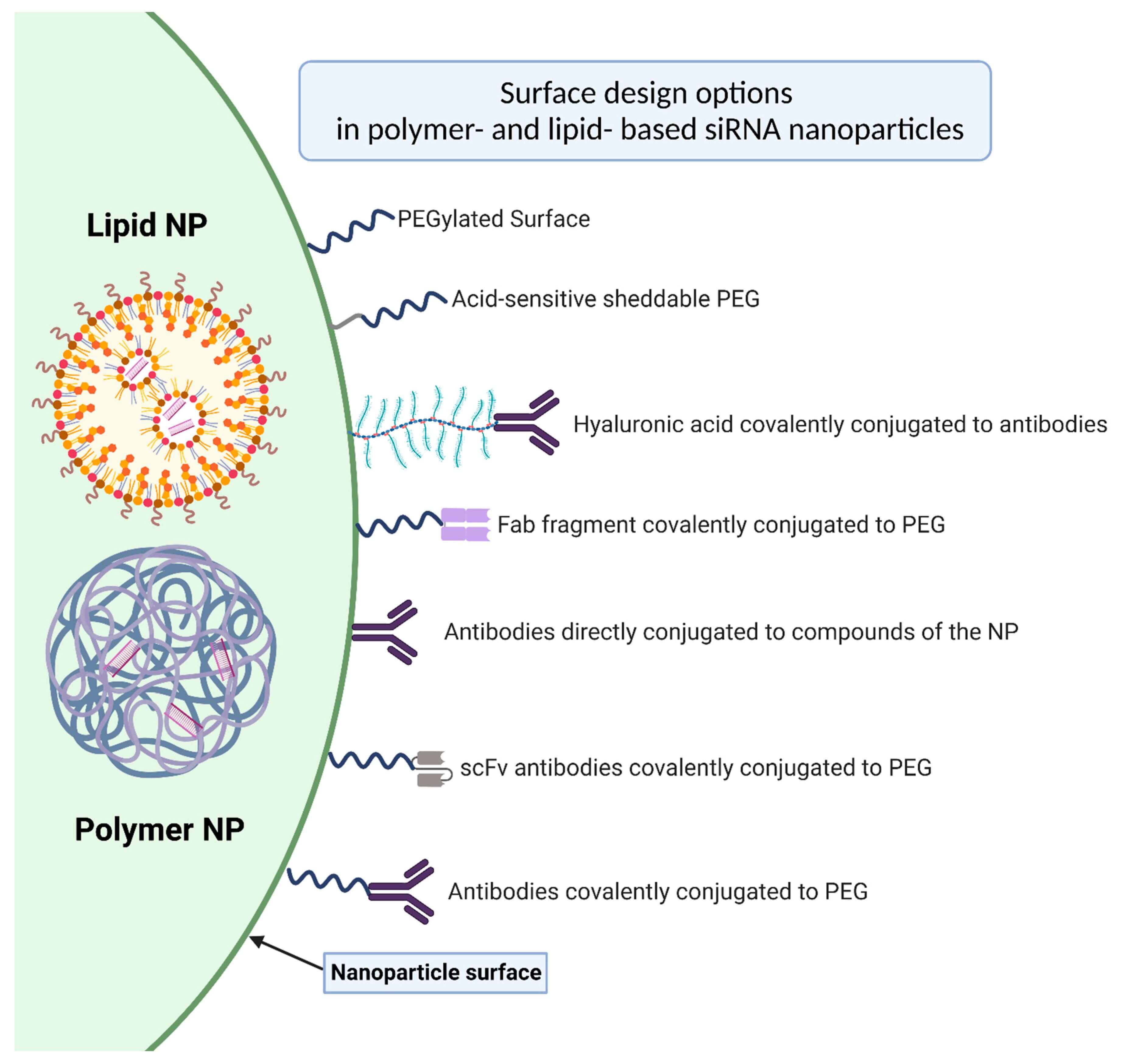 Figure 1 The schematic illustration shows possible surface design options in polymer- and lipid- based siRNA nanoparticles.1
Lipid Conjugation Mechanism
The coupling of lipids to siRNA in lipid siRNA bio coupling generally involves covalent linkage of functional groups present on siRNA with reactive head groups of lipids. Click chemistry, EDC/NHS chemistry and maleimide thiol reaction are all common conjugation chemistries. As an illustration, maleimide functionalized lipids can be reacted with thiol modified siRNA to produce stable thioether bonds. Selection of a coupling chemistry for lipid siRNA depends on the structures of both lipid and siRNA and the desired stability and release properties of the resulting conjugate. The lipid siRNA conjugates obtained can then self-assemble into different nanostructures including liposomes, micelles or solid lipid nanoparticles for improved delivery.
siRNA-Loaded Solid Lipid Nanoparticles
Solid lipid nanoparticles (SLNs) are a complex and highly promising siRNA delivery system. Unlike liposomes with liquid cores, SLN has a solid lipid matrix at room temperature and body temperature. This sturdy core has several advantages:
Enhanced stability: Solid matrix protects encapsulated siRNA from enzymatic degradation and physical stress, thereby extending shelf life and improving in vivo stability.
Controlled release: By adjusting the composition of the lipid matrix, the release of siRNA from SLN can be precisely controlled, thereby achieving sustained therapeutic effects.
High encapsulation efficiency: SLNs can effectively encapsulate hydrophilic and hydrophobic drugs, making them an excellent choice for complex molecules such as siRNA.
Classification of Conjugated Lipids
| Lipid Types | Descriptions |
|---|---|
| Phospholipid | Phospholipids contain phosphate groups and are an important component of the cell membrane. |
| Glycolipid | Glycolipids are linked to the sugar moiety and play a role in cell recognition and immune response. |
| Lipoprotein | Lipoproteins are composed of a protein component that participates in lipid transport in the blood. |
Overview of What Creative Biolabs Can Provide
Creative Biolabs' customized lipid siRNA bio coupling service provides an end-to-end solution to overcome the primary challenge of siRNA delivery. This service includes the rational design and chemical synthesis of novel lipid components, as well as their precise, site-specific binding to target siRNA sequences.
- Customized lipid synthesis: We can synthesize various new lipids with customized physical and chemical properties.
- siRNA modification: We provide chemical modification services for siRNA to promote conjugation and improve stability.
- Biocoupling: We use various chemical substances to provide robust and efficient coupling services.
- Nanoparticle formulation: We can formulate the obtained lipid siRNA conjugates into various nanostructures, including liposomes, SLNs, and micelles.
- Characterization: We provide a wide range of characterization services, including DLS for particle size, zeta potential analysis, and TEM for morphology.
Rational Design of Cationic Lipids for siRNA Delivery
Cationic lipids are lipids which are positively charged at physiological pH. Positively charged lipids can be paired electrostatically with negatively charged siRNA to form complexes. These complexes can protect siRNA from degradation as well as promote cellular uptake of siRNA by endocytosis. Reasonable design of cationic lipids is an important approach to siRNA delivery carriers' design. Several structural parameters can be tuned for optimization:
✅ Head Group: The cationic head group type (quaternary ammonium, primary amine, etc.) determines the net positive charge of lipids and their interactions with siRNA and cell membrane.
✅ Linker: The linker between head group and hydrophobic tail can be either stable or biodegradable. Biodegradable linkers (ester bonds for example) allow siRNA to be released inside cells.
✅ Hydrophobic Tail: The length and saturation of the hydrophobic tail can tune the accumulation of lipids and the stability of the resulting nanoparticles.
Workflow of Our Services
Payload design, synthesis, screening
- siRNA sequence design & synthesis
- Modification strategy
- Candidate sequence screening
Carrier design, synthesis, screening
We perform custom lipid synthesis (if necessary), modify siRNA with appropriate reaction handles.
Conjugation and product identification
We covalently link lipids and siRNA, and then formulate the product into stable nanoparticles.
In vitro/In vivo efficacy and PD/PK
- In vitro: knockdown efficiency, IC50, stability, off-target effects, toxicity
- In vivo: knockdown efficiency, PD/PK
What Makes Creative Biolabs Your Top Choice

Conjugation Needs
- Random or site-specific binding
- Customizable conjugate sites, linkers, and DAR values

High Quality Ensures
- High purity and batch consistency
- Verified targeting and effective gene silencing

Conjugation & Validation
- Oligo/lipid synthesis
- Full characterization and efficacy testing
Customer Review

"Creative Biolabs provides an excellent customized lipid siRNA conjugate for our cancer treatment project. The highest product quality, responsive team, and extensive knowledge. We are able to achieve significant gene silencing in preclinical studies, which would not have been possible without their expertise."
—Dr. Eleanor Vance, R&D Director
Reference
- Gabel M, Knauss A, Fischer D, et al. Surface design options in polymer-and lipid-based siRNA nanoparticles using antibodies. International Journal of Molecular Sciences, 2022, 23(22): 13929.https://doi.org/10.3390/ijms232213929Distributed under Open Access license CC BY 4.0, without modification.