Yam-derived Exosome Research & Application
Overview Advantages Research Potentiality Services FAQs
The Compelling Rationale for Investigating Yam-derived Exosomes
Exosomes are nanoscale mediators of intercellular communication, renowned for their capacity to transfer bioactive cargo—proteins, lipids, and nucleic acids—between cells. The emerging field of plant-derived exosomes has garnered significant scientific momentum, presenting a paradigm shift from traditional human or animal sources.
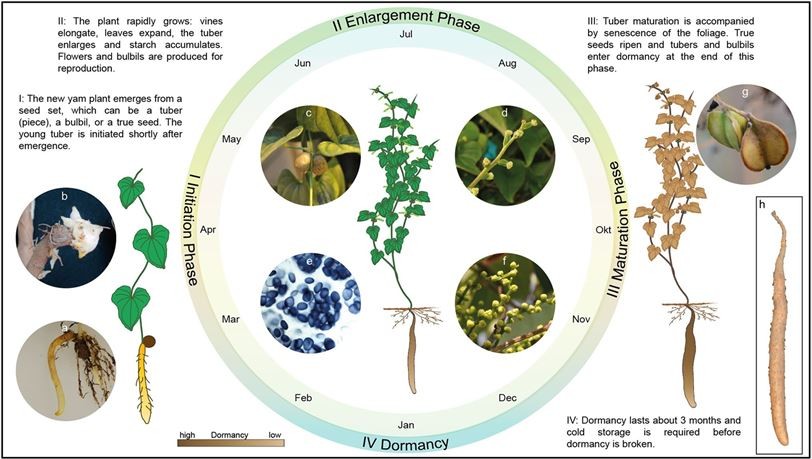 Fig.1 Growth cycle of Chinese yam.1,2
Within this exciting domain, yam-derived exosomes (YDEs) stand out, fueled by the long-established nutritional and pharmacological profile of the Dioscorea species. Yam, a staple food and traditional medicine, is a natural reservoir of health-promoting compounds:
|
Key Bioactive Components in Yam
|
Potential Benefits
|
|
Essential vitamins & minerals
|
Support general health and metabolic functions
|
|
Polysaccharides
|
Immune modulation and antioxidant effects
|
|
Unique saponins
|
Anti-inflammatory, anti-aging, and metabolic regulation
|
|
Other phytochemicals
|
Potential synergistic therapeutic effects
|
The rationale for rigorous investigation into YDEs stems from the idea that they can encapsulate and deliver these inherent bioactive molecules in a protected, highly bioavailable format. This naturally engineered delivery system offers:
-
Protection from systemic degradation that often affects free therapeutic agents.
-
Enhanced cellular uptake for improved efficacy.
-
A safe, plant-based alternative for nanomedicine and cosmeceuticals.
As a dedicated biologist with over two decades of expertise in exosome development at Creative Biolabs, I recognize that the scarcity of studies in this area is not a limitation, but rather a significant opportunity to pioneer a groundbreaking field. YDEs promise a novel, safe, and cost-effective source for next-generation therapeutic and cosmetic applications.
Unlock the Potential of Yam-Derived Exosomes – Connect with Our Experts Today.
Unique Characteristics and Biological Versatility of YDEs
The utility of YDEs in biomedical applications is underpinned by several intrinsic advantages, making them particularly attractive over animal-derived exosomes:
Exceptional Biosafety and Biocompatibility
As derivatives of a common food source, YDEs exhibit inherently low immunogenicity and excellent systemic biosafety. Studies, as detailed below, have confirmed a lack of organ toxicity upon administration, a critical factor for translation.
Oral Bioavailability
Critically, YDEs have been demonstrated to survive transit through the harsh gastrointestinal (GI) tract, enabling efficient absorption through the small intestine. This opens the door to non-invasive, oral administration of therapeutics, a transformative advantage for patient compliance, particularly for chronic conditions.
Scalability and Cost-Effectiveness
Compared to the complex and expensive manufacturing processes for mammalian-cell-derived exosomes, isolating exosomes from abundant plant material like yams offers a highly scalable and economically viable source for large-scale production.
Diverse Bioactive Payload
Yam's richness in antioxidants (Vitamins E and C), complex polysaccharides, and other active ingredients suggests that the YDEs payload is naturally diverse and pharmacologically potent. This complexity provides a multi-target therapeutic approach that can be superior to single-compound drugs.
Partner with us to explore the therapeutic potential of yam-derived exosomes.
Summary of Current Groundbreaking Findings on YDEs
Current scientific literature, while nascent, provides compelling evidence for the therapeutic efficacy of YDEs, primarily focusing on bone health and dermatology.
Bone Regeneration and Osteoporosis
A pivotal study investigated the effect of YDEs on bone health, demonstrating their potential as a natural, orally effective agent for osteoporosis. Key findings include:
 Osteoblast Activation
In vitro data confirmed that YDEs significantly stimulate osteoblast proliferation, differentiation, and mineralization, evidenced by increased levels of bone differentiation markers.
Signaling Pathway Elucidation
The osteogenic activity was not attributed to common yam saponins like diosgenin, but rather to the activation of the BMP-2/p-p38-dependent Runx2 pathway. This molecular precision highlights the specific function of the YDEs cargo.
In Vivo Efficacy and Safety
In an ovariectomy-induced osteoporosis mouse model, oral administration of YDEs led to a significant improvement in bone regeneration, bone volume density, and bone strength. Systemic biosafety was confirmed, demonstrating the potential for dietary intervention in bone health maintenance.
Cosmeceuticals and Skin Care
Another study explored the potential of YDEs isolated from Yam Bean for topical applications:
High Biocompatibility
The YDEs exhibited low cytotoxicity, maintaining high cell viability in Human Dermal Fibroblast (HDF) cells.
Dermatological Benefits
Experiments showed that YDEs promote cell migration (relevant for wound healing) and increase collagen expression, suggesting anti-aging and skin repair properties.
Anti-Melanogenic Effect
Importantly, the study observed a promising anti-melanogenic effect in zebrafish models, positioning YDEs as a potential, natural alternative for depigmentation and skin whitening treatments.
Unlock the power of yam-derived nanovesicles — connect with our experts to discuss your project.
Diverse Therapeutic and Functional Applications
The demonstrated biological activity of YDEs suggests a broad spectrum of future applications, extending far beyond the initial discoveries:
Advanced Osteoporosis and Bone Disease Treatment
Leveraging the proven BMP-2/Runx2 pathway activation to develop a next-generation, orally delivered therapeutic.
Anti-Aging and Regenerative Cosmeceuticals
Formulating high-performance skincare products that utilize YDEs to deliver antioxidants and collagen-boosting compounds for wrinkle reduction, improved skin elasticity, and texture.
Metabolic and Anti-Fatigue Therapies
Given the yam's traditional benefits, future research could focus on YDEs' role in blood glucose regulation (polysaccharides) and alleviating fatigue (amino acids and minerals), developing agents for diabetes management and energy restoration.
Immune Modulation
Investigating the potential of YDEs to enhance the body's resistance and regulate overall bodily functions, consistent with yam's historical use for promoting metabolism and overall health.
Targeted Drug Delivery Systems
The inherent stability and oral bioavailability of YDEs make them ideal natural nanocarriers. They can be engineered to load specific small molecule drugs or nucleic acids (e.g., siRNA, miRNA) and modified to target other tissues beyond the bone, transforming drug delivery across the blood-brain barrier or to tumor sites.
Collaborate with us to accelerate your exosome-based innovation. Request a custom consultation.
Creative Biolabs' Comprehensive One-Stop Research and Development Support
Creative Biolabs is the trusted partner at the vanguard of plant exosome research, providing an end-to-end, customized service suite to accelerate your YDEs discovery and development program. Our commitment to high-impact science ensures that all projects meet the rigorous standards necessary for high-impact publication.
Precision Isolation and Characterization
Advanced Exosome Profiling
In Vitro and In Vivo Functional Research
Exosome Engineering for Optimization
Utilizing advanced techniques, we guarantee the procurement of high-purity YDEs. Rigorous characterization follows, employing nanoparticle tracking analysis (NTA) for size distribution and transmission electron microscopy (TEM) for definitive morphological analysis.
Advanced Exosome Profiling
To fully unlock the therapeutic potential, we offer comprehensive cargo analysis, including Exosomal Proteomic Detection, RNA Sequencing, and Lipidomics/Metabolomics Services. These services are crucial for identifying the specific bioactive molecules driving observed effects.
We provide a full spectrum of functional assays, including cell proliferation, differentiation (e.g., ALP activity, calcium deposition), oxidative stress, and inflammatory response assays. For translational studies, our in vivo services include motor system disease model construction (e.g., osteoporosis) and specialized bone-targeted exosome modification services to ensure robust and reliable efficacy evaluation.
Our expertise in exosome loading services and disease-targeted exosome modification services allows for the customization of YDEs, enhancing their natural properties for specific therapeutic applications and maximizing targeting efficiency.
Transform your research with our yam exosome expertise. Let's design your next breakthrough together.
Premium Yam-derived Exosome Materials for Research and Industry
Beyond comprehensive services, Creative Biolabs is poised to supply the burgeoning market for high-quality YDEs materials, essential for both fundamental research and industrial formulation.
01Research-Grade YDEs Exosomes
We offer highly purified, characterized YDEs suitable for sophisticated scientific research into molecular mechanisms, target engagement, and pharmacological studies. These are invaluable for researchers aiming to replicate and extend the published findings.
02Cosmeceutical and Functional Ingredient Products
Leveraging our large-scale isolation platform, we provide YDEs products formulated for use as active raw materials in skincare and nutraceutical industries. These products deliver the natural antioxidant, anti-aging, and regenerative properties of the yam in a stabilized, nanovesicular format, enabling the development of premium, science-backed consumer products.
Tell Us Your Customization Needs.
FAQs
Q: How does the composition of yam-derived exosomes differ from the whole yam extract?
A: The difference is in the delivery system. The YDEs nanovesicles selectively package a subset of the yam's bioactive components (e.g., specific miRNAs, proteins, and lipids) into a stable, membrane-protected structure. This packaging shields the cargo from degradation and facilitates direct cellular uptake, often resulting in a far more potent and targeted biological effect than a bulk extract, which contains many free molecules that degrade quickly or have low bioavailability.
Q: Given the scarcity of published studies, what are the primary challenges in Ye research?
A: The main challenge is the lack of standardized isolation and characterization protocols across different plant sources and laboratories. Reproducibility requires overcoming batch-to-batch variability, ensuring high purity from plant contaminants, and establishing scalable manufacturing. Creative Biolabs addresses this with our validated, robust isolation platform and multi-modal characterization, guaranteeing the high-purity and consistency required for translational studies.
Q: Can Creative Biolabs modify YDEs to target specific tissues other than bone?
A: Absolutely. Our disease-targeted exosome modification services are designed for this purpose. We can engineer the surface of the YDEs, for example, by conjugating specific targeting ligands (peptides or antibodies) to the exosomal membrane. This allows us to reroute the natural tropism of the YDEs to achieve efficient accumulation in tissues of interest, such as the liver, skin, or tumor microenvironment.
Ready to advance your exosome research? Speak with our scientific team today.
Reference
-
Epping, Janina, and Natalie Laibach. "An underutilized orphan tuber crop—Chinese yam: A review." Planta 252.4 (2020): 58. Distributed under Open Access license CC BY 4.0, without modification. https://doi.org/10.1007/s00425-020-03458-3
For Research Use Only. Cannot be used by patients.
Related Services: