Are you currently facing challenges in overcoming drug resistance, achieving high-specificity tumor targeting, or requiring improved therapeutic penetration in complex tissues? Our Creative Biolabs Bispecific sdAb Generation Service helps you enhance therapeutic potency and overcome compensatory disease pathways through innovative Single-Domain Antibody (sdAb) engineering and optimized linker design for multivalent, multispecific drug candidates.
Bispecific Single-Domain Antibodies (BsSdAbs) represent a crucial advancement in therapeutic biologics. These agents are built upon the single-domain antigen-binding fragment derived from the heavy-chain-only antibodies naturally found in camelids. The core innovation lies in engineering two distinct single-domain fragments-each binding a different target or epitope-into a single, compact molecule. This design allows the BsSdAb to simultaneously engage dual antigens, thereby enabling complex biological functions and highly specific cellular control unattainable by conventional monospecific drugs. The intrinsic structural characteristics of these nanoscale components, including their small size, exceptional thermal stability, and modular architecture, allow for facile engineering into multispecific formats, enhancing neutralizing potency and therapeutic efficacy across a wide range of diseases, including complex oncology and chronic inflammation.
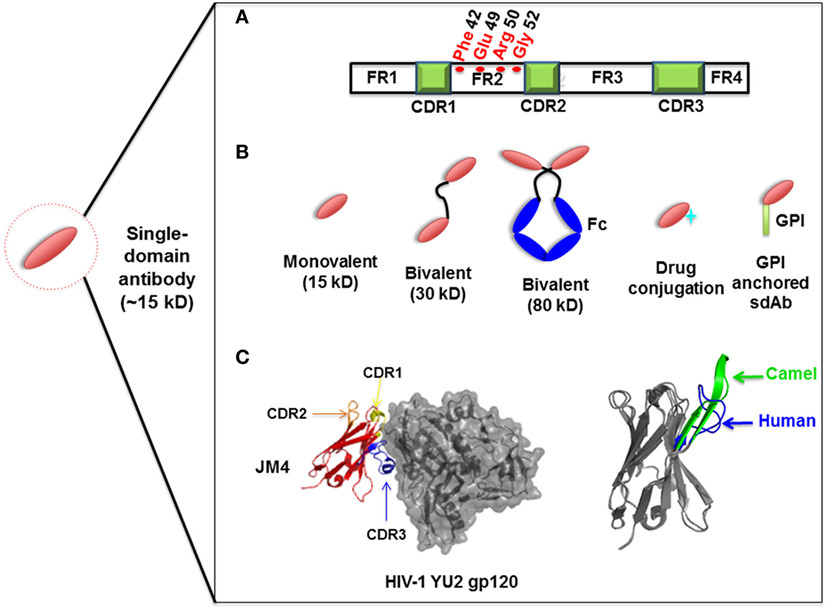 Fig.1 Representation of single-domain antibodies (sdAbs) and their characteristics.1

Contact our team to get an inquiry now!
Creative Biolabs combines cutting-edge display technology with engineering expertise, making us the premier partner for developing next-generation biologics. We focus on BsSdAb stability and high-yield manufacturability from the outset, de-risking your therapeutic program.
Experience the Creative Biolabs Advantage - Get a Quote Today
A: A BsSdAb is a single, highly stable molecule engineered to execute a dual-target mechanism with high precision, often resulting in synergistic potency where combination therapy may only be additive. Furthermore, producing one molecule is generally more cost-effective and simplifies manufacturing and clinical logistics compared to co-administering two separate drugs.
A: We select highly stable monovalent single-domain fragments and meticulously design the inter-domain linker sequence to ensure proper folding and minimal aggregation risk. For therapeutic applications, we often integrate an Fc domain (BsIgG format) to not only extend the serum half-life but also enhance the overall molecular stability of the sdAbs.
A: Unmodified monovalent sdAbs are subject to rapid renal clearance. Our standard therapeutic approach is to mitigate this by fusing the BsSdAb to a serum albumin-binding domain or an Fc domain (BsIgG-like format). This engineering step successfully extends the molecule's serum half-life from hours to several days or weeks, making it suitable for clinical development.
A: Absolutely. This is known as a biparatopic design. Targeting two non-overlapping epitopes on the same antigen (e.g., a receptor) can prevent target shedding, induce stronger receptor clustering/downregulation, or circumvent drug resistance mechanisms resulting from point mutations on a single binding site. This dual engagement often delivers a more robust functional outcome.
A: Start with a Project Consultation. We specialize in de novo discovery and can manage the entire process, starting with camelid immunization and library construction against your target antigens. Our experts will help you design the optimal immunization and screening strategy to ensure high-affinity binders for your bispecific project.
Reference
Welcome! For price inquiries, we will get back to you as soon as possible.
INQUIRY





SERVICES
PRODUCTS
PLATFORMS