Are you currently facing challenges in antibody development, difficulty in protein expression and purification, or long drug development cycles for complex bispecifics? Creative Biolabs' scFv based BsAb Fragments (scFv-CH1/CL, scFv-CH3, Miniantibody) Generation Service helps you accelerate drug discovery and develop highly specific antibodies through innovative protein engineering techniques and advanced recombinant DNA technology.
Contact our team to get an inquiry now!
The Single-Chain Variable Fragment (scFv) is a compact fusion protein, uniting an antibody's VH (Heavy Chain Variable) and VL (Light Chain Variable) domains via a short, synthetic peptide linker. This bridge is specifically engineered to be rich in glycine and serine/threonine to ensure maximum flexibility and enhanced solubility, allowing the domains to fold correctly and retain full antigen-binding function. As the core building block for bispecific antibodies (bsAbs), the scFv format is highly valued for its inherently small size and superior tissue penetration, enabling rapid access to solid tumor microenvironments. Creative Biolabs' service directly addresses these key limitations through rational engineering and linker optimization, maximizing the therapeutic potential of these complex molecules.
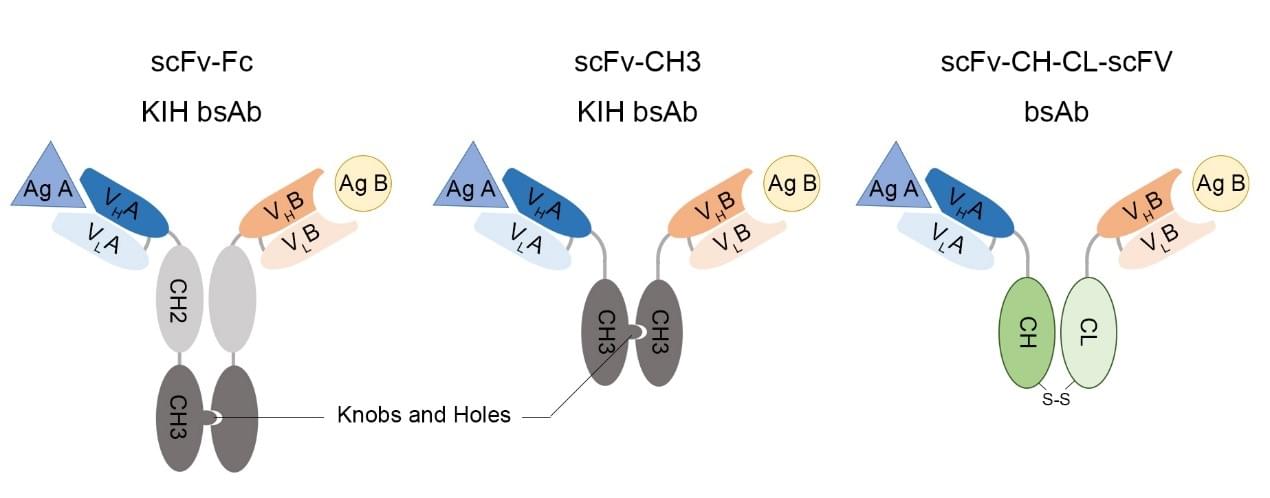 Fig.1 Forms of ScFv fragments BsAbs.
This arrangement involves two distinct scFv modules, each targeting a specific antigen. These modules are covalently fused to the constant domains CH1 and CL (scFvA-CH1 and scFvB-CL). The resulting heterodimeric structure is stabilized by the natural dimerization tendency of the CH1/CL domains, further secured by a native inter-chain disulfide bridge. This construct maintains a 1+1 binding stoichiometry and an approximate molecular mass of 75 kDa. Its relatively small size leads to accelerated systemic clearance from circulation, a crucial factor for applications where fast elimination is desired.
The scFv-CH3 construct utilizes the CH3 segments of an IgG constant domain as a dimerization scaffold. The final molecule requires co-expression of two chains scFvA-CH3 and scFvB-CH3) to form an asymmetric, bivalent entity. Controlled heterodimerization is achieved through purposeful amino acid substitutions within the CH3 interface, leveraging established methods like 'knobs-into-holes' or optimized charge pairs. The strategic inclusion of the CH3 domains is paramount, as it grants enhanced serum persistence and a prolonged half-life when compared to simple variable domain fragments.
Defined as a dimeric antibody fragment, the Miniantibody is composed of two scFv units, each capable of unique antigen recognition (1+1 binding stoichiometry). The scFv components are connected by an intervening, flexible hinge region. Dimerization is mediated by intra-chain disulfide linkages specifically engineered into this hinge structure. With a molecular weight of roughly 50 kDa, this format's highly reduced scale provides superior penetration into solid tissues, making it highly valuable for targeted therapeutic research and clinical diagnostic imaging applications.
Creative Biolabs' scFv based BsAb Fragments Generation Service is built on the expertise required to manage the unique, non-standard challenges of fragment engineering, ensuring your therapeutic leads are robust and commercially viable. Our systematic approach to controlling multimerization, enhancing stability, and optimizing non-traditional purification sets us apart.
Experience the Creative Biolabs Advantage - Get a Quote Today
A: We tackle the core problem first: stability. Our primary goal is to deliver a highly stable scFv core, which is the prerequisite for successful half-life extension. We can then either integrate this core into a full Fc-fusion format (using heterodimerization technology) or fuse it to an albumin-binding domain in a subsequent project. A stable fragment is essential for any long-term solution.
A: The advantage lies in the enforced mechanism of action, known as cellular bridging. A diabody physically links two distinct targets (e.g., a T-cell and a tumor cell) in a precise, geometric orientation that cannot be achieved by merely combining two separate mAbs. Our service guarantees the controlled dimerization necessary for this powerful, synergistic function.
A: We specialize in non-Fc affinity purification. Depending on the target and host system, we develop highly efficient, multi-step protocols utilizing: 1) Immobilized Metal Affinity Chromatography (IMAC) via an integrated Histidine tag, or 2) Protein L affinity, which binds to the kappa light chain variable region. Both methods are scalable and provide high purity (≥95%) for pre-clinical materials.
A: Our guarantee is built on a multi-stage quality control process. We employ Targeted Domain Optimization and advanced biophysical screening (including Dynamic Light Scattering and SEC-MALS) from the earliest stages. We only proceed with candidates that demonstrate high thermal stability and a low propensity for aggregation under defined formulation conditions.
A: Immunogenicity risk is mitigated by two factors: 1) Host Selection: E. coli is a cost and speed option for scFv expression, and we also usually used HEK293 or CHO cells for BsAb expression. 2) Sequence Humanization: If the parental binders are not fully human, we offer an integrated Affinity Maturation service (a related service) to humanize the framework regions and further reduce the potential for an unwanted immune response.
Welcome! For price inquiries, we will get back to you as soon as possible.
INQUIRY





SERVICES
PRODUCTS
PLATFORMS