Are you currently facing light chain mispairing, persistent homodimer contamination, and costly purification challenges in your bispecific antibody (BsAb) development? Our Charge pair BsAb Generation Service helps you streamline the path to clinical trials and obtain high-quality, therapeutic-grade bispecific antibodies through our innovative Charge Pair Engineering and electrostatic steering mechanism.
Contact our team to get an inquiry now!
Bispecific antibodies (BsAbs) offer the immense potential of synergistic therapeutic mechanisms, such as simultaneously engaging a T-cell and a tumor antigen. However, manufacturing full-length IgG formats is structurally complex, requiring the correct assembly of four distinct chains (two different Heavy Chains and two different Light Chains). This random assembly leads to a high fraction of non-functional mispaired species, often yielding functional product purities below 85%.
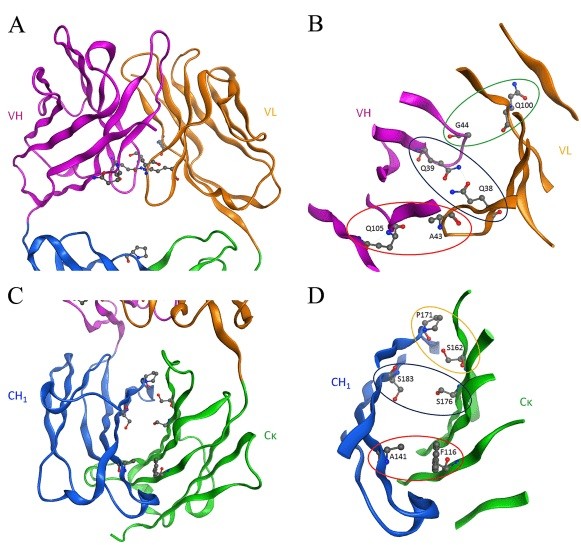 Fig.1 Residues at VH-VL and CH1-CL interfaces for substitutions are buried, conserved, and spatially close.1
The Creative Biolabs Charge pair BsAb Generation Service addresses this challenge by employing advanced electrostatic steering at both the CH3 and the LC-HC interfaces. The Charge Pair Technique works by engineering complementary, oppositely charged amino acid residues into these critical domains. Specifically, strong electrostatic 'magnets' are placed in the CH3 domains to drive the exclusive heterodimerization of the two Heavy Chains. Crucially, additional targeted charge residues are strategically placed at the Heavy Chain-Light Chain interface to lock each Light Chain to its intended partner, a step that decisively overcomes the common issue of LC mispairing. This dual-action technology enforces near-perfect heterodimer assembly, resulting in clinical-grade purity and superior stability.

The Creative Biolabs Charge pair BsAb Generation Service is built on the technological maturity required to achieve true clinical-grade results that exceed the limits of first-generation engineering. While the landscape of BsAbs is structurally diverse, our focus remains on delivering the most desirable format—the stable, full-length IgG.
Our technology fundamentally solves the problem of Light Chain mispairing, which is the "purity killer" in many traditional formats. By implementing electrostatic steering at both the CH3 domain and the LC-HC interface, we ensure a homogeneous product directly from expression.
A: Our Charge Pair technology is engineered to solve both Heavy Chain and Light Chain mispairing simultaneously. While older methods often struggle to exceed 85% purity due to light chain errors, our typical final product purity is >95%, making it significantly more efficient and cost-effective for clinical development.
A: No, the mutations are specifically positioned to enforce pairing while carefully preserving the critical binding sites for the neonatal Fc receptor (FcRn) and Fc gamma receptors (FcγRs). This ensures that the BsAb maintains a long serum half-life and retains desired Fc effector functions (ADCC/CDC) if required by your TPP.
A: Knobs-into-Holes primarily addresses Heavy Chain homodimer formation but is vulnerable to Light Chain mispairing, leading to significant non-functional product. Our Charge Pair approach adds a powerful electrostatic steering mechanism to also enforce correct Light Chain pairing, yielding a purer, more homogeneous product with higher functional yield.
A: Yes, our engineering platform is versatile and can be applied to common therapeutic subclasses, including IgG1 and IgG4. We can also integrate additional Fc modifications, such as LALA or NAGA mutations, to modulate effector function as required for your specific therapeutic goal.
A: Delays are rare but typically stem from the initial Variable Domain sequences requiring extensive Affinity Maturation or optimization due to inherent instability. Providing highly optimized and stable VH/VL sequences upfront helps us stay firmly within the 10-14 week estimated timeframe. If you have any concerns about your starting material, please reach out to us for a pre-project consultation.
Experience the Creative Biolabs Advantage - Get a Quote Today
Reference
Welcome! For price inquiries, we will get back to you as soon as possible.
INQUIRY





SERVICES
PRODUCTS
PLATFORMS