Are you currently facing long drug development cycles, difficulty in protein expression and purification, and challenges in developing highly specific, stable antibodies? Our IgG-scFv BsAb Generation Service helps you accelerate drug discovery, develop highly specific antibodies, and obtain high-quality recombinant proteins through our Structure-Guided Constant Region Redesign and Linker Optimization technologies.
Contact our team to get an inquiry now!
Bispecific Antibodies (BsAbs) are engineered proteins capable of simultaneously targeting two distinct antigens, offering superior therapeutic potential over monospecific drugs by enabling novel mechanisms of action, such as engaging two different surface receptors for increased specificity or bypassing resistance pathways. The IgG-scFv format is a leading design, combining the inherent benefits of the native IgG scaffold—including its long serum half-life mediated by FcRn recycling and its simplified Protein A purification ease—with a flexible, high-affinity single-chain variable fragment (scFv). This hybrid architecture is highly versatile and clinically validated for critical applications such as T-cell redirection (e.g., through anti-CD3 engagement to bridge immune cells to tumors) and complex signaling blockade (e.g., clustering multiple receptors for enhanced inhibition), truly leveraging the full potential of advanced biologics development.
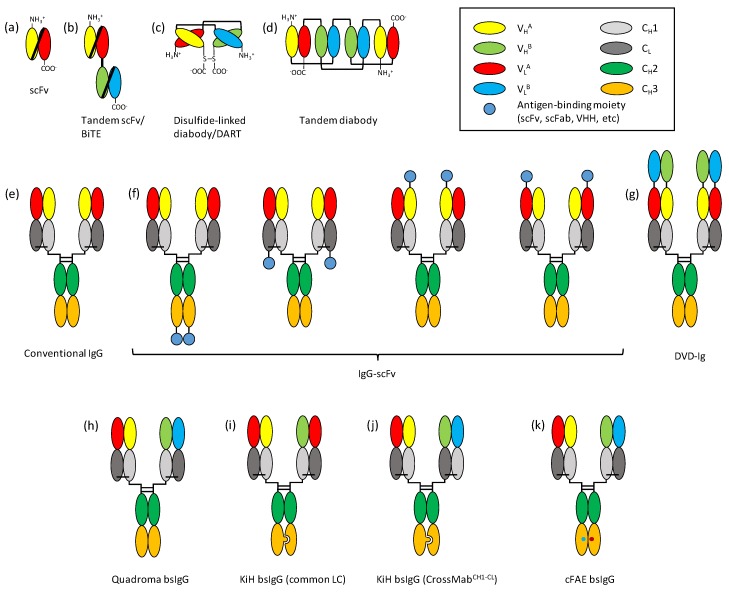 Fig.1 Bispecific antibody (bsAb) formats discussed in this article.1
The IgG-scFv BsAb architecture is a promising method for developing next-generation therapeutics. This bispecific construct is created by conjugating a stabilized single-chain variable fragment (scFv), often disulfide-linked, onto an existing monospecific IgG backbone. This molecular design is optimized for high-yield production within standard mammalian cell culture systems and enables streamlined purification to a highly homogeneous final product via conventional Protein A chromatography. The scFv segments incorporated into this structure can target either the same or distinct antigens, significantly expanding therapeutic applicability. Furthermore, positioning the appended antibody variable domains at either the amino or carboxy end of the IgG's light or heavy chains allows for the creation of multiple structural configurations:
Creative Biolabs is positioned at the intersection of genetic engineering and structural biology, making us the ideal partner for your next-generation biologic development. We deliver not just a molecule, but a manufacturable therapeutic candidate.
Exclusive Advantages and Differentiators
Experience the Creative Biolabs Advantage - Get a Quote Today
A: The intact Fc domain in the IgG-scFv format enables FcRn-mediated recycling, which significantly extends the serum half-life, often reducing the frequency of dosing required in the clinic. If maintaining efficacy over a longer duration is key to your therapeutic strategy, the IgG-scFv is the superior choice. Do you know which PK profile best suits your targets?
A: We use our proprietary Structure-Guided Constant Region Redesign technology, introducing strategic mutations into the IgG constant domains (CH1/CL and CH3/CH3 interfaces). This forces the correct Heavy/Light chain pairing and the desired heterodimer formation, consistently yielding high-purity product pools suitable for preclinical use. Contact us to learn about the specific engineering required for your targets.
A: Yes. Our engineering platform specializes in flexibility and high valency. Quadrivalent structures, which bind up to four targets, are crucial for mechanisms requiring maximal tumor-cell engagement or complex receptor modulation. We meticulously optimize the linker and fusion points to ensure these highly complex molecules maintain structural integrity. Discuss your valency needs with our design team.
A: Aggregation is a critical concern with fusion proteins. We address this using Linker Optimization & Stability Engineering. This involves meticulous design of the scFv linker length, sequence, and composition, informed by in silico modeling, to minimize steric hindrance and maintain the thermal stability of both the IgG backbone and the appended domain. Would you like to review our thermal stability data for previous constructs?
A: While T-cell redirection is driven by the dual-binding arms, the Fc region offers two distinct benefits: simplified, robust Protein A purification for large-scale manufacturing, and the potential for improved ADCC/CDC function via immune cell recruitment, which can offer a potential synergistic anti-tumor mechanism.
Reference
Welcome! For price inquiries, we will get back to you as soon as possible.
INQUIRY





SERVICES
PRODUCTS
PLATFORMS