Facing long drug development cycles and complex bispecific antibody purification challenges? Our Fab-arm Exchange (FAE) BsAb Generation Service, powered by the innovative Controlled Fab-Arm Exchange (cFAE) technology, helps you accelerate drug discovery and obtain high-quality, clinical-grade BsAbs. This highly scalable and platform-compatible approach ensures high yield, native IgG architecture, and superior in vivo stability, streamlining your path from candidate selection to clinical trials.
Contact our team to get an inquiry now!
The Fab-arm Exchange (FAE) technique, specifically the Controlled FAE (cFAE) method, addresses the complexity of generating highly stable and homogeneous IgG-like bispecific antibodies (BsAbs). This is particularly vital as traditional co-expression often leads to unwanted homodimers and complex purification challenges. It is an in vitro process where two parental IgG1 antibodies, each containing a single, point mutation in the CH3 domain, are mixed under precisely controlled redox conditions. These precisely engineered mutations specifically weaken the non-covalent CH3 interaction in the original homodimers, allowing the heavy chains to dissociate. The subsequent re-oxidation drives the highly efficient and unidirectional exchange of half-molecules to form a strongly favored heterodimeric BsAb. This sophisticated approach successfully generates a full-length BsAb with native IgG1 properties—including the crucial wild-type hinge and preserved Fc function—making it critical for predictable pharmacokinetics and simplified downstream manufacturing processes during clinical development, supported by Published Data demonstrating high homogeneity.
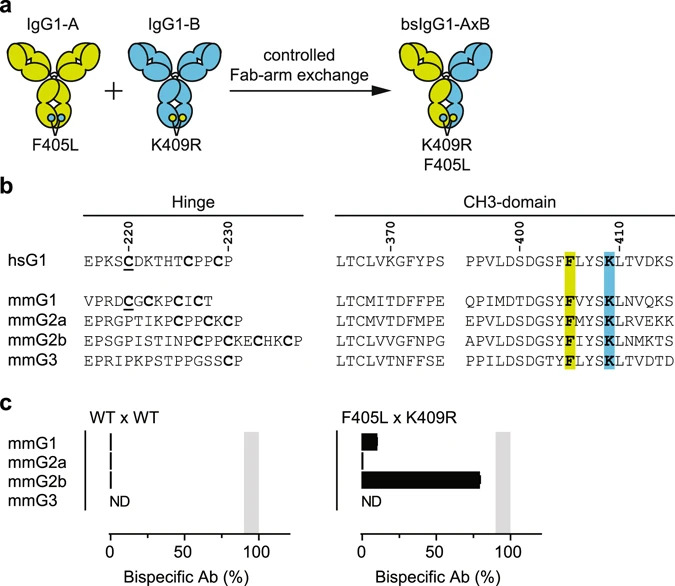 Fig.1 Principle of controlled Fab-arm exchange (cFAE) for the generation of human IgG1-based bispecific antibodies.1
The Controlled Fab-Arm Exchange (cFAE) method, as detailed in the publication by Labrijn et al., was successfully applied to generate bispecific antibodies (BsAbs) in various rodent IgG subclasses, which is crucial for preclinical studies in immunocompetent models. The core experiment involved introducing matched point mutations, such as the optimized T370K-K409R/F405L-R411T combination, into parental murine IgG antibodies. When subjected to the controlled reduction/re-oxidation exchange process, these optimized combinations consistently achieved cFAE efficiencies exceeding 90% across multiple mouse (IgG1, IgG2a, IgG2b) and rat subclasses. Crucially, the resulting BsAbs maintained their native IgG architecture, which was shown not to adversely affect inherent effector functions or pharmacokinetic properties of the corresponding subclasses. This demonstrates that cFAE is a versatile, efficient, and robust method for rapidly producing high-purity, functional, IgG-like BsAb surrogates for in vivo evaluation.
Creative Biolabs leverages deep expertise and a validated, clinically proven technology to deliver BsAbs with unparalleled quality and manufacturability. Our commitment to using standard mAb manufacturing processes translates directly into cost savings and reduced timelines for our clients, accelerating speed-to-clinic. The key advantages of our service include:
Experience the Creative Biolabs Advantage - Get a Quote Today
A: While KiH is effective, cFAE utilizes a modular two-step process: separate, platform-compatible expression of parental antibodies, followed by the highly efficient in vitro exchange step driven by designed CH3 mutations. The key advantage lies in the post-exchange purification, which can leverage standard Protein A methods due to the high (>90%) exchange yield and the native IgG structure of the final BsAb product, resulting in consistent purity above 95%.
A: Due to its native IgG1 structure, the FAE BsAb format is ideal for applications requiring a long serum half-life and preserved Fc-mediated functions. Primary applications include T-cell and NK-cell engagers (TCE/NKE), dual-targeting receptor blockers, and BsAbs for crossing biological barriers, where the stability and size of a full IgG are essential for therapeutic efficacy.
A: No. A key benefit of the cFAE platform is that the Fabs (Heavy Chain-Light Chain pairs) remain intact during the exchange process. The mutations are solely in the CH3 domain, driving heavy chain heterodimerization without affecting the light chain pairing. This inherent advantage eliminates the risk of light chain mispairing, which is a significant challenge for some other BsAb formats.
A: To initiate the service smoothly, we primarily require the genetic sequences for the variable domains of both parental antibodies and, ideally, purified samples of the parental mAbs. Providing initial target binding data is also highly beneficial. We can, however, start from sequence only and manage the upstream production if required.
A: The final cFAE BsAb product is highly stable, possessing a wild-type hinge that is naturally resistant to reduction in vivo. Precautions are generally standard for any IgG molecule. Compared to fragment-based BsAbs, which have inherent stability and aggregation issues, the full IgG1 format of the FAE product offers highly predictable stability profiles suitable for regulated manufacturing and long-term storage, minimizing risk in clinical stages.
Reference
Welcome! For price inquiries, we will get back to you as soon as possible.
INQUIRY





SERVICES
PRODUCTS
PLATFORMS