
Skin firmness at the cellular level is closely linked to cytoskeletal organization, extracellular matrix density, and mechanical stability within dermal structures. Changes in fibroblast contractility, collagen fiber arrangement, and elastin balance can influence how structural integrity is maintained over time. Creative Biolabs offers the exosome firming efficacy testing service to support basic research focused on biological pathways associated with structural support rather than visible tightening claims.
This service evaluates how exosome samples affect dermal fibroblast behavior, matrix assembly, and cytoskeletal regulation under controlled in vitro conditions. Readouts may include markers related to collagen organization, elastin associated proteins, focal adhesion components, and contractility related signaling. The objective at Creative Biolabs is to generate reproducible data that supports mechanistic understanding within a research context.
| Step | Detail |
|---|---|
| Step 1 Objective Clarification and Sample Characterization | Project discussions begin with defining what structural aspect of firmness is being investigated. Exosome origin, isolation approach, and concentration parameters are reviewed to ensure compatibility with mechanical and matrix related assays. |
| Step 2 Establishment of Structural Cell Models | Dermal fibroblasts are cultured in conditions that allow matrix deposition and cytoskeletal development. When relevant, three dimensional culture environments may be introduced to better represent structural organization. |
| Step 3 Controlled Exosome Administration | Exosome samples are introduced under defined dosing schedules. Time course formats may be applied to monitor gradual structural changes rather than immediate responses. |
| Step 4 Assessment of Structural and Mechanical Indicators | Markers associated with collagen alignment, elastin balance, cytoskeletal proteins, and cell contractility are measured. Signal pathways related to adhesion and structural reinforcement may also be evaluated. |
| Step 5 Structured Reporting and Interpretation | Experimental findings are compiled into a clear report outlining conditions, quantitative outcomes, and biological interpretation within a basic research framework. |
For workflow inquiries, contact Creative Biolabs scientific support.
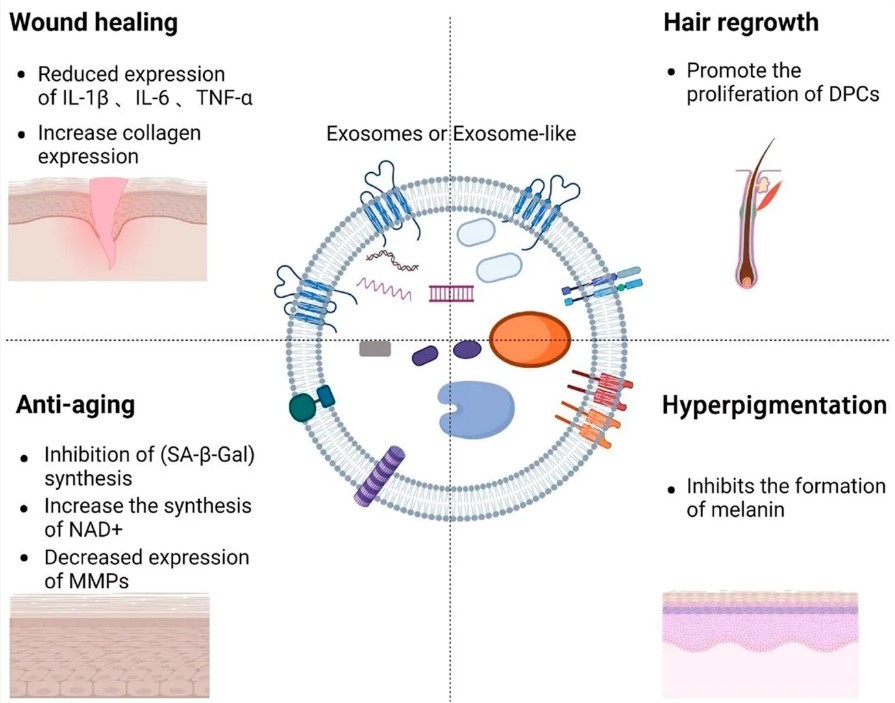 Fig.1 Overview of the composition of exosomes and the role of exosomes in medical aesthetics.1
The service helps define how exosomes influence cellular mechanisms that contribute to matrix density and organization.
Parallel testing under identical structural conditions allows meaningful comparison between exosome preparations.
Data connecting cytoskeletal behavior with extracellular matrix markers can deepen understanding of firmness related mechanisms.
Results may inform formulation research and guide future experimental design within a non clinical framework.
For application related consultation, connect with Creative Biolabs scientific advisors.
 Focus on Structural Integrity Mechanisms
The service emphasizes biological processes that contribute to maintaining cellular tension and matrix density rather than cosmetic appearance.
Incorporation of Cytoskeletal Evaluation
Cytoskeletal organization and adhesion related components can be assessed to better understand cellular contribution to firmness related biology.
Support for Three Dimensional Culture Formats
Where applicable, matrix deposition may be evaluated in advanced culture systems to enhance structural relevance.
Balanced Data Presentation
Reports maintain scientific neutrality and clearly distinguish observed trends from speculative interpretation.
For feature related questions, reach out to Creative Biolabs directly.
"The inclusion of cytoskeletal markers distinguished this study from typical matrix assays. It gave us insight into cellular tension related mechanisms."
"The final report provided comprehensive details about culture parameters and sampling times, which made the data evaluation more straightforward."
"Our team greatly appreciated the in-depth discussion regarding three-dimensional culture options before the study commenced, as it played a crucial role in guiding us toward the selection of the most suitable model for our research."
Exosome firming efficacy testing service provided by Creative Biolabs supports foundational research into structural stability and matrix organization within dermal cell models. By integrating cytoskeletal assessment with matrix related indicators, Creative Biolabs offers research teams biologically grounded data that informs subsequent investigation. To determine how this service aligns with your research objectives, contact Creative Biolabs for detailed guidance.
A: Firming related research focuses on structural density, cytoskeletal organization, and mechanical support at the cellular level. Anti wrinkle studies often concentrate more directly on collagen degradation and matrix remodeling markers.
A: The primary focus is on biological markers associated with structural reinforcement. Direct mechanical measurement techniques may be discussed depending on project scope and feasibility.
A: Three dimensional formats can allow more realistic matrix deposition and cell interaction patterns. Creative Biolabs discusses the advantages and limitations of such systems during project planning.
A: Yes. Many research teams use this service to compare early stage preparations and identify structural marker trends before advancing to further studies.
A: Marker panels, exposure durations, and culture formats can be adjusted within a defined research framework following discussion with Creative Biolabs scientists.
Reference