
IVIG & Plasma-Derived Immunoglobulins
Assess complement consumption associated with aggregates, product-related species, purification conditions, or batch variability in immunoglobulin preparations.


Creative Biolabs provides customized anticomplementary activity assays for IVIG and other immunoglobulin preparations, monoclonal antibodies, Fc-fusion proteins, recombinant biologics, formulation candidates, process intermediates, and research compounds. We help teams determine whether a test article consumes or perturbs complement, compare lots or formulations, investigate aggregate-associated complement activation, and build interpretable safety or development data using controlled hemolysis-based and complementary readout strategies.
Discuss Your ACA Testing ProjectAnticomplementary activity is a functional measure of how a material interacts with the complement system. In immunoglobulin products, aggregates, structurally altered IgG, contaminants, or other product-related species may consume complement before the intended biological challenge. Researchers working with immunoglobulin matrices can also access our sera and plasma products and complement-related antibody products for assay development and control selection. In discovery and development programs, the same principle can be used to compare formulations, investigate process changes, rank stress conditions, or determine whether a new biologic format has an unintended complement-activating profile.
Creative Biolabs can configure ACA studies as a focused screening assay or as part of a broader complement package. Programs can be connected with our total complement activity testing, complement activation product testing, and complement inhibitor validation when a single hemolytic endpoint is not sufficient to answer the development question.
The assay conditions should reflect what is being compared and why. We review concentration, formulation matrix, storage history, stress state, comparator availability, complement source, expected assay range, and downstream interpretation before setting the experimental matrix.
Assess complement consumption associated with aggregates, product-related species, purification conditions, or batch variability in immunoglobulin preparations.
Explore unintended complement activation from antibody concentration, Fc-dependent interactions, self-association, formulation, or stressed material.
Screen new therapeutic or research formats when complement compatibility is uncertain or a change in process or formulation requires functional comparison. Supporting reagents can be sourced from our complement protein products when appropriate.
Compare pre/post-change materials, hold-time samples, stressed preparations, excipient conditions, or process intermediates using a harmonized assay setup.
Pair complement consumption with pathway-specific function testing when the development question extends beyond a single endpoint.
In a classical hemolysis-based ACA design, the test material is first incubated with a defined complement source. Residual complement is then challenged with sensitized erythrocytes. Less residual hemolytic activity indicates greater complement consumption during the initial incubation. For programs requiring standardized supporting reagents, our complement assay kits and complement research reagents can support method development and follow-up studies.
| Study Question | Recommended Comparison | Useful Controls | Interpretation Focus |
|---|---|---|---|
| Does the material activate/consume complement? | Test article concentration series vs. vehicle | Complement-only, matrix control, assay reference | Magnitude and concentration dependence of ACA |
| Did a process change alter complement compatibility? | Pre-change vs. post-change lots under matched conditions | Shared reference lot and complement lot | Direction and size of functional shift |
| Is aggregation linked to elevated ACA? | Native vs. stressed or fractionated material | Low-aggregate reference, HAGG where appropriate | Association between sample state and complement consumption |
| Which formulation is preferable? | Multiple formulations at matched protein concentration | Formulation blanks and common material control | Relative complement activation liability |
| Is a single ACA endpoint sufficient? | ACA plus activation markers or pathway assays | Pathway-specific positive/negative controls | Functional consumption vs. generated activation products |
ACA is a functional signal, not a stand-alone explanation. We structure the data package so that the observed complement consumption can be interpreted in the context of concentration, controls, formulation, aggregation state, complement lot, and other available analytical information.
Supports low complement consumption under the tested conditions. For comparability work, the result is interpreted relative to reference and assay sensitivity rather than as an absolute guarantee of in vivo compatibility.
A rising response suggests that complement consumption scales with material concentration. Follow-up can evaluate aggregate content, stress state, formulation, or activation products to refine the mechanism.
A reproducible difference under matched conditions may flag a product- or process-related variable. Replicate testing and orthogonal analytics help distinguish biological change from assay variability.
Extend ACA with C3b deposition, C5b-9 deposition, split-product measurements, or cell-based complement readouts when mechanism matters.
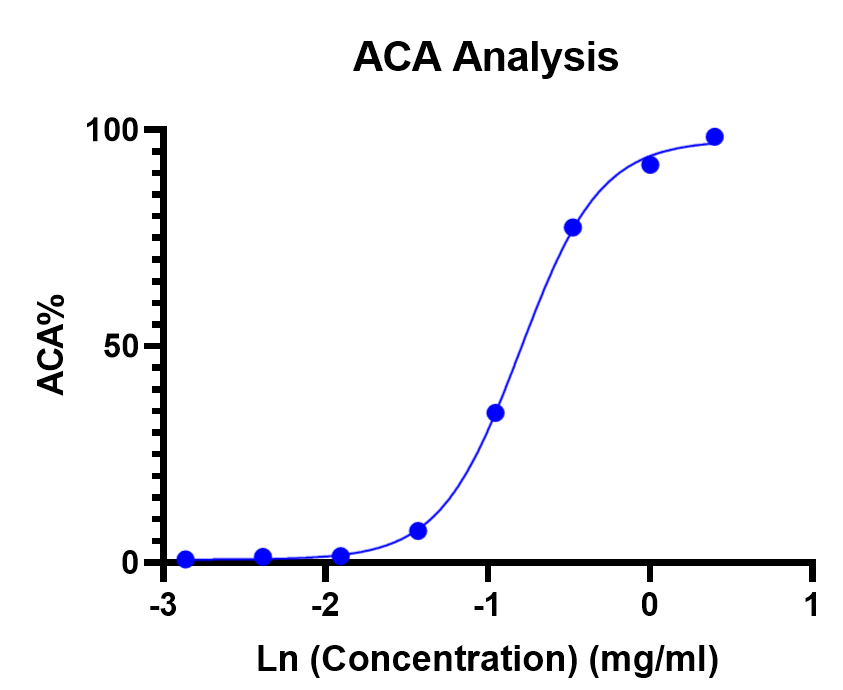
In this case, Creative Biolabs uses HAGG in human serum, the ACA assay reveals a clear, concentration-dependent, sigmoidal complement consumption: at low Ig concentrations, complement remains largely intact, but above a threshold concentration, nearly complete consumption occurs. This strongly implies that the HAGG preparation (or a sub-fraction within it) has substantial non-specific complement-activating capacity (likely due to aggregates or structurally altered IgG).
Combine anticomplementary activity with total pathway function or inhibition studies under a coordinated plan.
These original open-access studies illustrate three complementary uses of anticomplementary testing: direct hemolysis-based screening of inhibitory materials, structure-activity comparison across candidate polysaccharides, and quality evaluation of immunoglobulin preparations in relation to complement activation.
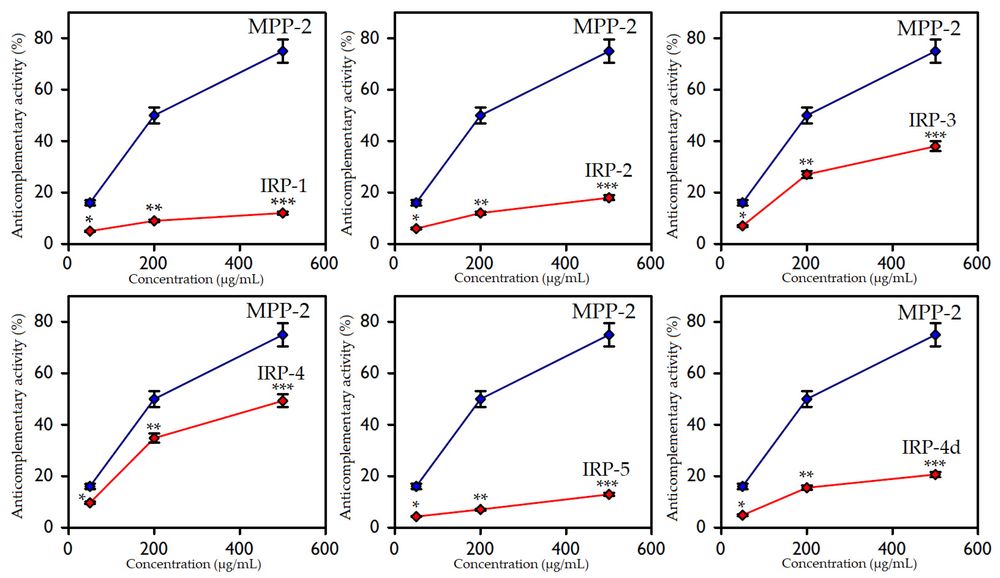
Olennikov and Gornostai evaluated purified fungal polysaccharides using sensitized sheep erythrocytes and human complement, linking polymer composition and branching with anticomplementary activity.
View research via DOI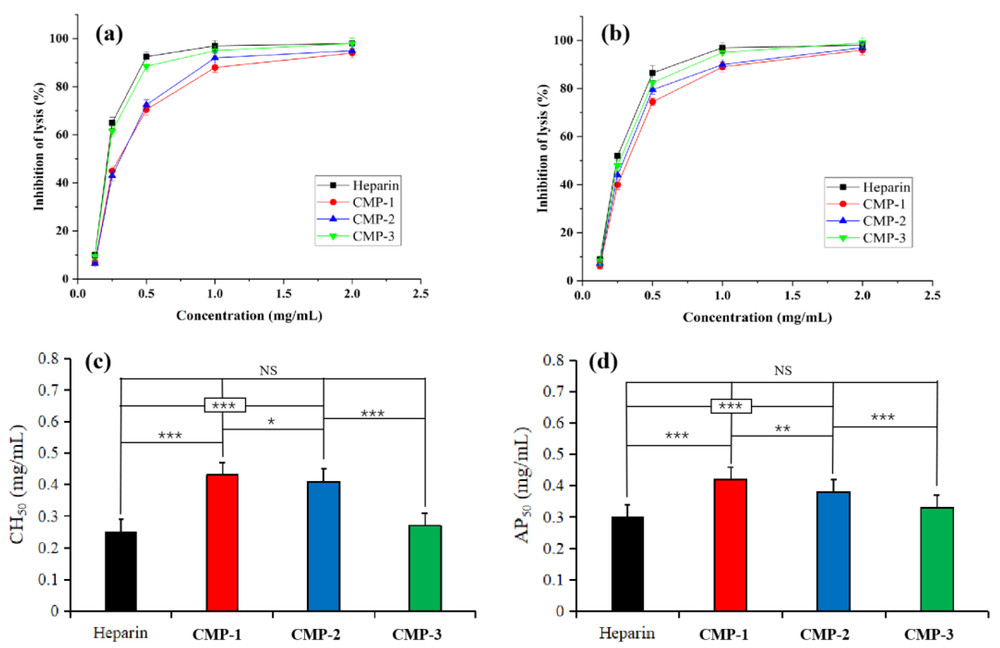
Hu and colleagues compared three purified polysaccharides and measured inhibition of classical and alternative pathway hemolysis, then explored complement components associated with the observed activity.
View research via DOI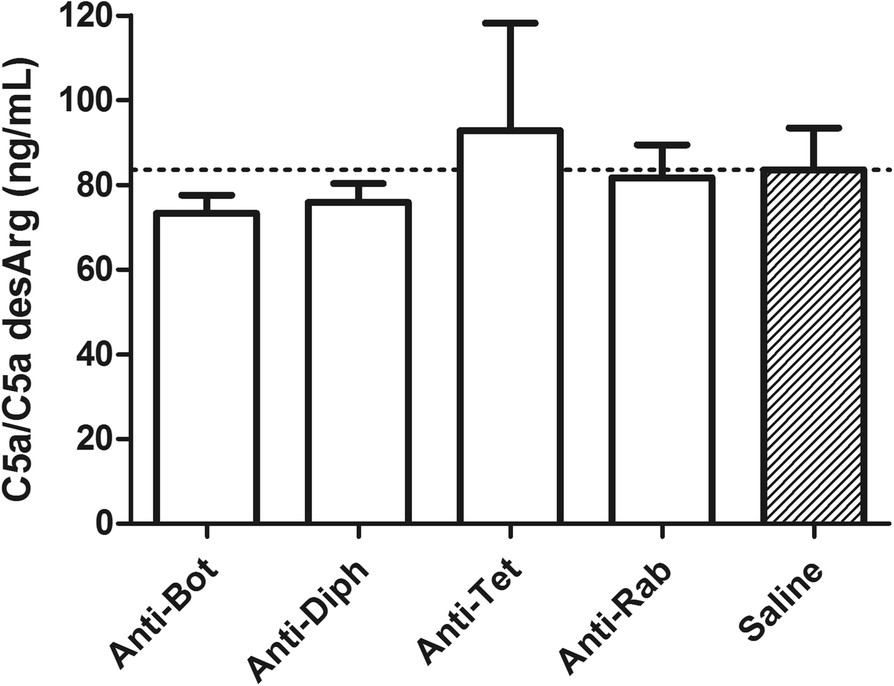
Squaiella-Baptistao and colleagues combined protein/aggregate characterization with an in vitro complement-activation readout, illustrating how functional complement testing can complement physicochemical quality control.
View research via DOIACA measures the capacity of a test article to consume or activate complement under defined in vitro conditions. In a hemolysis-based format, residual complement after test-article incubation is quantified through lysis of sensitized erythrocytes, allowing complement consumption to be compared with appropriate controls or reference materials.
Projects may include IVIG and other immunoglobulin preparations, monoclonal antibodies, Fc-fusion proteins, recombinant proteins, formulation candidates, process intermediates, stressed materials, and other research biologics or compounds after a feasibility review.
The original service commonly uses approximately 0.5-1 mL per condition as a practical starting range. Final material requirements depend on concentration, number of replicates, dilution series, comparator arms, and whether follow-up complement assays are included.
Yes. Lot-to-lot, pre/post-process-change, formulation, storage, or stress comparisons can be run under harmonized conditions with a shared complement source and reference controls to improve interpretability.
No. Aggregate analysis describes a physicochemical state, whereas ACA provides a functional measure of complement interaction. The two are complementary, and combining them can be useful when investigating whether aggregation or other product-related species contribute to complement consumption.
Yes. Depending on the question, ACA can be paired with activation products such as C3a, C5a, or sC5b-9, deposition assays such as C3b or C5b-9, or total/pathway-specific function testing to distinguish complement consumption from downstream activation signatures.
Helpful information includes sample type and concentration, formulation, storage and stress history, number of lots or conditions, available comparators, expected complement risk, intended study decision, required replicates, and any orthogonal analytical or complement data already available.

Complement Activity/Function Assay Products
Learn More
Complement Testing Services
Learn More
Complement Therapeutics Featured Products
Learn More
Complement Therapeutics Services Brochure
Learn More
Aptamer Development PLATFORM
Learn More
ComPLETTM Hemolysis Assay Solutions
Learn More