Stem Cell-derived Exosome Application
- Brain Nerve Injury Repair
Introduction Properties Applications Services FAQs
Stem Cell-Derived Exosomes for the Repair of Brain Nerve Injury
The human brain, a highly complex organ, communicates with the body through an intricate network of cranial nerves. These nerves are responsible for regulating critical physiological processes and behavioral responses. Damage to this system, regardless of its etiology, can severely compromise an individual 's motor, cognitive, sensory, and emotional functions. Causes of brain nerve injury range from traumatic incidents and ischemic strokes to infections, neurotoxicity, and genetic disorders such as amyotrophic lateral sclerosis or Huntington 's disease. These events commonly result in neuronal death and impaired neural circuitry, making functional recovery extremely challenging. A major barrier to effective treatment remains the limited permeability of the blood-brain barrier (BBB), which restricts the entry of many therapeutic agents.
In light of these challenges, extracellular vesicles, particularly exosomes derived from stem cells (SC-Exos), have garnered considerable attention as a promising strategy for brain nerve repair. Exosomes are lipid-bilayer-bound nanovesicles secreted by cells, carrying molecular cargo reflective of their cellular origin. SC-Exos, in particular, encapsulate diverse bioactive factors such as proteins, miRNAs, and growth factors that recapitulate the regenerative properties of their parent stem cells, but with enhanced safety and delivery potential. Notably, their intrinsic ability to cross the BBB positions them as ideal vectors for targeted therapy in neurological disorders. At Creative Biolabs, we specialize in providing cutting-edge exosome isolation services, including stem cell-derived exosome isolation and development services, to support research and therapeutic applications in brain nerve repair.
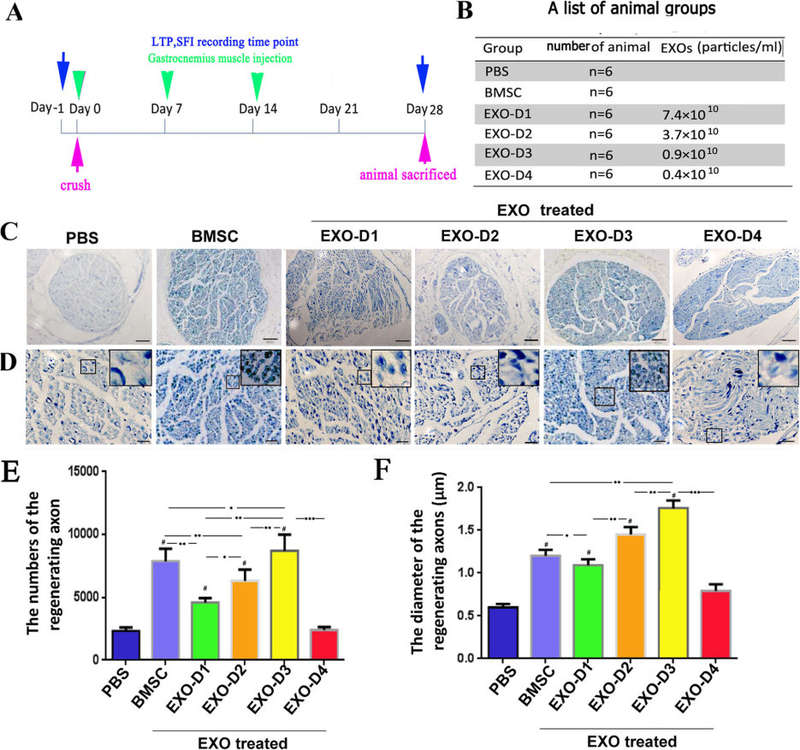 Fig.1 Dose-dependent nerve regeneration was demonstrated by quantifying myelinated fiber number and diameter following bone marrow stromal cell-derived exosome administration.1
Therapeutic Properties of SC-Exos in Neural Repair
-
Modulation of Neuroinflammation
SC-Exos have demonstrated the capacity to mitigate the inflammatory cascade that follows neural injury. By modulating the polarization of microglia and infiltrating macrophages toward an anti-inflammatory (M2) phenotype, SC-Exos reduce the production of pro-inflammatory cytokines and limit secondary tissue damage. Advanced profiling techniques offered by Creative Biolabs—such as proteomics, surface marker analysis, and mass spectrometry—allow researchers to identify immunomodulatory components within SC-Exos.
Oxidative stress, mitochondrial dysfunction, and inflammatory responses are major contributors to neuronal apoptosis after brain injury. SC-Exos harbor neurotrophic factors, antioxidant enzymes, and anti-apoptotic molecules that collectively exert neuroprotective effects. With our exosomal protein isolation and bioanalysis platforms, clients can uncover critical neuroprotective proteins that mediate these effects.
-
Promotion of Neural Regeneration
SC-Exos play a pivotal role in promoting the differentiation of neural stem cells and the outgrowth of axons. They create a permissive microenvironment that fosters neurogenesis and re-establishment of synaptic connections. Our RNA-focused services, including small RNA sequencing and qPCR analysis, support the discovery of exosome-derived regulatory RNAs that drive these regenerative processes.
-
Enhancement of Angiogenesis
Restoring blood supply is fundamental to neural tissue repair. SC-Exos contribute to neovascularization by delivering angiogenic signals, thereby facilitating oxygen and nutrient supply to injured regions. Our in vitro labeling services, including fluorescence and virus-based exosome tracking, help visualize and quantify these vascular effects in real-time.
-
Inhibition of Neuronal Apoptosis
SC-Exos have been shown to activate pro-survival signaling cascades in damaged neurons, thereby reducing apoptosis and preserving neuronal integrity. Mass spectrometry-based proteomic profiling can elucidate the key effectors responsible for these anti-apoptotic outcomes.
Empirical Evidence Supporting SC-Exos in Brain Injury Models
Recent preclinical investigations have yielded promising results regarding the application of SC-Exos in central nervous system (CNS) injuries. For example, bone marrow-derived mesenchymal stem cell (BMSC) exosomes have been found to reprogram microglial polarization, enhance hippocampal neurogenesis, and improve cognitive outcomes post-injury. Similar results have been observed with adipose-derived mesenchymal stem cell (ADMSC) exosomes, potentially through modulation of the NF-κB/MAPK pathways. Umbilical cord mesenchymal stem cell-derived exosomes have also demonstrated efficacy, possibly through PINK1/Parkin mediated mitophagy regulation.
In addition, exosomes derived from neural stem cells (NSCs) possess a natural tropism toward brain tissues. A study by Luo et al. reported that NSC-Exos enriched with miR-150-3p promoted neuronal survival, inhibited apoptosis, and supported proliferation, further underscoring the therapeutic promise of this approach. However, translational hurdles persist. Variables such as donor stem cell type, exosome production protocols, and quality control measures significantly influence therapeutic outcomes. At Creative Biolabs, we offer exosome manufacturing services, including stability, repeatability, and purity evaluation services, to ensure the consistency and efficacy of exosome-based therapies.
Creative Biolabs ' Solutions
While the clinical translation of SC-Exos remains in its early stages, overcoming manufacturing and standardization challenges is critical. Factors such as particle yield, cargo consistency, batch reproducibility, and long-term stability require stringent control.
Creative Biolabs provides a comprehensive suite of technical services to support SC-Exos research:
Through our robust and customizable workflows, researchers can navigate the complexities of SC-Exo therapy development with precision and confidence. If you have technical needs, please contact us immediately.
FAQs
Q: How are SC-Exos different from traditional stem cell therapies?
A: Unlike whole stem cell transplantation, SC-Exos offer a cell-free therapeutic strategy that avoids risks like tumor formation or immune rejection. They retain the regenerative signals of their parent cells but come with greater safety and easier delivery, especially in delicate areas like the brain.
Q: Why are SC-Exos considered effective for brain nerve injury?
A: SC-Exos naturally carry a cargo of neuroprotective proteins, miRNAs, and growth factors that can cross the blood-brain barrier. They 've been shown to reduce neuroinflammation, prevent neuron death, stimulate angiogenesis, and support nerve regeneration—all crucial for brain recovery.
Q: Can exosomes really cross the blood-brain barrier?
A: Yes, that 's one of their biggest advantages. Thanks to their nanoscale size and lipid bilayer structure, SC-Exos can penetrate the blood-brain barrier via transcytosis, making them ideal carriers for neurological treatments.
Q: Are SC-Exos used in clinical applications yet?
A: Most research is currently in the preclinical or early clinical trial stage. However, the results so far are promising, particularly in animal models of stroke, traumatic brain injury, and neurodegeneration. Regulatory considerations and standardization are the current hurdles.
Q: How does Creative Biolabs support SC-Exos research?
A: We offer a full suite of exosome services—from source cell culturing and exosome isolation to high-precision characterization, RNA/protein profiling, engineering for targeted delivery, and in vivo functional validation.
Q: How can I ensure the quality and consistency of SC-Exos in my project?
A: That 's where our expertise comes in. Creative Biolabs provides comprehensive QC testing—including NTA, TEM, ELISA and western blotting—to ensure your SC-Exos are pure, stable, and biologically active.
Q: Can SC-Exos be engineered for targeted delivery to brain tissues?
A: Absolutely. We offer exosome surface engineering and ligand modification services tailored for neural targeting. Whether you 're delivering therapeutic RNAs, proteins, or small molecules, we can help optimize targeting and uptake.
Reference
-
Zhao, Jiuhong et al. "Dose-effect relationship and molecular mechanism by which BMSC-derived exosomes promote peripheral nerve regeneration after crush injury." Stem cell research & therapy vol. 11,1 360. 18 Aug. 2020, doi:10.1186/s13287-020-01872-8. Distributed under Open Access license CC BY 4.0, without modification.
For Research Use Only. Cannot be used by patients.
Related Services: