Product List Background CD4 Aptamer Analysis
Background
Creative Biolabs provides a wide range of high-quality antibodies, assay kits, and CD4 proteins to help researchers improve their experiments and research. Our dedication to quality ensures reliable results, empowering researchers to produce publication-grade data.
Introduction
In molecular biology, CD4 is a 51 kDa surface marker expressed on immune cells, including T helper cells, macrophages, dendritic cells, and NK cells.
CD4 cells, also called CD4+ T helper cells, refer to T lymphocytes with CD4+ T molecules on their surfaces and are critical immune cells in the human immune system. Helper cells can transmit signals to other immune cell varieties, such as CD8 killer cells, prompting them to eliminate harmful particles. Since HIV attacks CD4+ T cells, its detection results play an important role in judging the effectiveness of AIDS treatment and the immune function of patients.
Functions of CD4
CD4 is essential in biomedical research today. Its roles include breakthrough T-cell immunotherapies for cancer, HIV, and multiple autoimmune diseases. It is primarily used as a marker for T-cell subsets but can also be found in NKT cells, innate lymphocytes, and macrophages. CD4 can promote the interaction between the T-cell receptor and the MHC/antigen complex on antigen-presenting cells, activating T cells. This process also forms the basis of some anti-cancer T-cell therapies.
CD4 activates pathways downstream of the T cell receptor by binding to the β2 domain of the MHC molecule. Anti-CD4 monoclonal antibodies can induce CD4 internalization, which reduces T cell activation by reducing overall CD4/MHC class II interactions. CD4 is also a receptor for IL-16; the latter stimulates the migration response of CD4+ T cells and monocytes and induces CD4+ T cells to respond to IL-2 and IL-15. At the same time, CD4 is also a coreceptor for HIV and human herpes.
CD4 and HIV
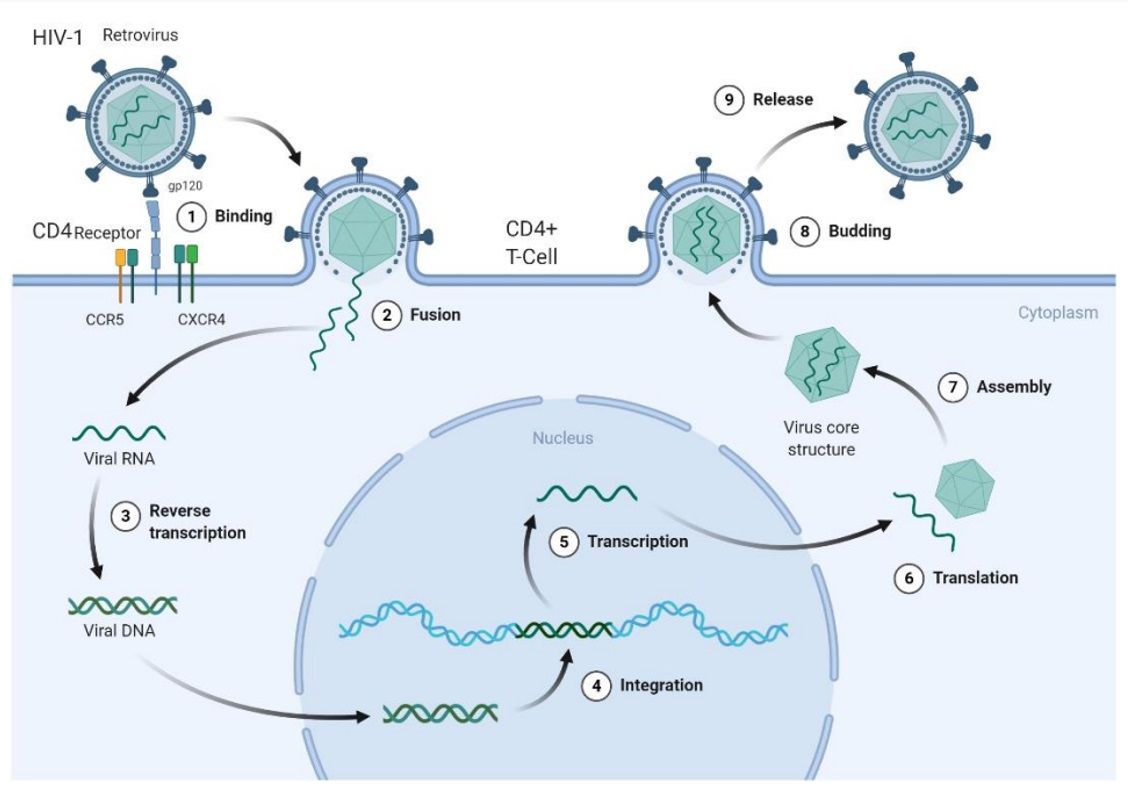 Fig.1 HIV life cycle.1
HIV-1 can use CD4 to enter host T cells through its viral envelope protein, gp120. When gp120 binds to CD4, it changes shape, allowing HIV-1 to attach to host cells' coreceptors CCR5 or CXCR4. Following a change in the structure of another viral protein (gp41), HIV places a fusion peptide into the host cell, enabling the viral envelope to merge with the cell membrane.
Creative Biolabs provides various CD4 products to help you improve your research and experiments. Our dedication to quality ensures reliable results, empowering researchers to produce publication-grade data.
CD4 Functional Service
Creative Biolabs supplies anti-CD4 aptamers recognized for their precise binding affinity to human CD4 protein. These aptamers have emerged as vital instruments in the extensive study and development of aptamer-based therapeutic and diagnostic solutions. An illustrative application is the anti-CD4 aptamer, which has been integrated into a multifunctional nanodevice for the targeted delivery of siRNAs in a T-cell line specifically designed to overexpress CD4.
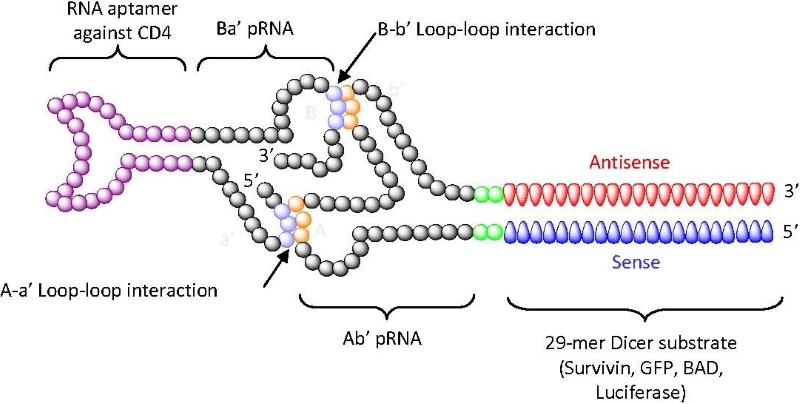 Fig.2 Delivery of small interfering RNA (siRNA) facilitated by anti-CD4 aptamer.2
Researchers have explored the use of RNA aptamers targeting the CD4 receptor, a glycoprotein on certain T lymphocytes that HIV-1 exploits to enter host cells. Previous studies revealed that CD4 overexpression in T helper cells prompts endocytosis. By immobilizing soluble CD4 antigen on Sepharose beads, researchers isolated high-affinity 2’-F-modified RNA aptamers for CD4. These aptamers were evaluated for their capacity to inhibit T cell responses using an allogeneic mixed lymphocyte reaction (MLR), gauged against the W3/25 CD4 monoclonal antibody. The aptamers exhibited specific inhibitory effects, leading to their integration into nanodevices for delivering siRNAs to CD4-overexpressing T-cell lines, facilitating targeted RNA interference.
Creative Biolabs provides expert services dedicated to the functional characterization of CD4, including analysis of interaction dynamics and detailed functional evaluations. These services, tailored to the unique demands of our clients, are essential in advancing both clinical and scientific research initiatives.
References
-
Hillman, Tatiana. "HIV-1: Tackling the Obstacles that Limit the Effectiveness of CRISPR-Cas9 Gene Editing of the T Cell Co-receptor CCR5." (2020). Distributed under Open Access license CC BY 4.0, without modification.
-
Zhou, Jiehua, and John J. Rossi. "Aptamer-targeted cell-specific RNA interference." Silence 1 (2010): 1-10. Distributed under Open Access license CC BY 2.0, without modification.


 INQUIRY
 Datasheet