The critical role of disease-related protein detection in biological research, clinical diagnostics, and medical treatment has significantly increased the demand for developing simple, sensitive, highly selective, and cost-effective bioassays. Enzyme-linked immunosorbent assay (ELISA) remains a widely adopted technique for protein detection due to its inherent sensitivity, specificity, accuracy, and practicality. Creative Biolabs has developed diverse methodologies and strategies based on various signal transduction principles. Our expert team is adept at providing high-quality, cost-effective testing services to ensure project success.
Our Main ELISA Based Kit Development Services
Creative Biolabs offers a comprehensive suite of custom ELISA-based kit development services, each designed to meet diverse analytical demands and deliver superior performance. We leverage a variety of advanced immunoassay technologies to deliver the best solution for your unique project.
Chemiluminescence Immunoassay (CLIA) Based Kits Development
CLIA offers exceptional sensitivity, enabling the detection of analytes at very low concentrations. This method utilizes a chemiluminescent substrate that emits light upon enzymatic reaction, providing a strong signal that is easily quantifiable. Our expertise in CLIA development ensures highly sensitive and robust assays, ideal for detecting rare biomarkers or for applications requiring minimal sample volumes.
Time-Resolved Fluorescence Immunoassay (TRFIA) Based Kit Development
TRFIA utilizes lanthanide chelates as labels, which exhibit long-lived fluorescence, effectively minimizing background interference. This results in assays with superior sensitivity and a wide linear range. Our team designs TRFIA kits that deliver highly specific and accurate measurements, particularly beneficial for complex biological matrices where non-specific signals can be problematic.
Electrochemiluminescence Immunoassay (ECLIA) Based Kits Development

ECLIA combines the high sensitivity of chemiluminescence with the precision of electrochemical detection. This technique offers a broad dynamic range and excellent reproducibility, making it a powerful tool for quantitative analysis. We specialize in developing ECLIA kits that provide stable and consistent results, crucial for both research and clinical diagnostic applications.
Immuno-PCR Based Kit Development
Immuno-PCR (Immunostep Polymerase Chain Reaction) significantly enhances the sensitivity of traditional immunoassays by linking an antibody to a DNA reporter molecule, which is then amplified via PCR. This hybrid technique allows for the detection of extremely low concentrations of analytes, far beyond the capabilities of standard ELISA. Our development services focus on creating highly sensitive Immuno-PCR kits for groundbreaking research and ultra-sensitive diagnostic applications.
Enzyme-Linked Immunosorbent Spot (ELISpot) Based Kit Development
ELISpot assays are invaluable for quantifying cytokine-secreting cells at the single-cell level. This method provides a direct measure of cellular immune responses, making it critical for vaccine development, infectious disease research, and autoimmune studies. We develop custom ELISpot kits optimized for various cell types and cytokine targets, ensuring precise and reliable cellular analysis.
Protein Microarray Based Kit Development
Protein microarrays enable the simultaneous detection and quantification of multiple proteins in a single experiment, offering a high-throughput solution for biomarker discovery and proteomic profiling. This technology allows for the analysis of complex protein interactions and expression patterns. Creative Biolabs develops custom protein microarray kits tailored for multiplex analysis, providing efficient and comprehensive insights into biological systems.
Our ELISA Based Kit Development Process
Our custom ELISA kit development process is meticulously structured, ensuring a seamless journey from concept to completion. We collaborate closely with clients, adapting each phase to their unique scientific objectives for optimal performance.
Initial Consultation
The journey begins with an in-depth discussion of your project's scope, including target analyte, desired assay characteristics, and application. This establishes a clear understanding and precise project plan.
Antigen & Antibody Development
Next, we strategically design and produce high-quality antigens, followed by generating and rigorously selecting highly specific monoclonal or polyclonal antibodies. This forms the foundation of a robust assay.
Assay Design & Optimization
Our scientists then meticulously design and optimize the ELISA format. This involves selecting the assay type, fine-tuning reagent concentrations, and establishing a reliable standard curve for accurate quantitative measurements.
Validation & Performance Characterization
The developed kit undergoes rigorous validation, assessing sensitivity, specificity, linearity, accuracy, and precision. Extensive stability studies ensure consistent, reliable performance over time, guaranteeing the kit meets high-quality standards.
Manufacturing & Quality Assurance
Finally, we manage the scalable production of all kit components with stringent quality control for lot-to-lot consistency. Comprehensive documentation and ongoing technical support facilitate seamless integration and successful utilization.
Published Data
1. Enzyme-Catalyzed Colorimetric Immunoassay Using Au Nanoparticle-Assembled Structures
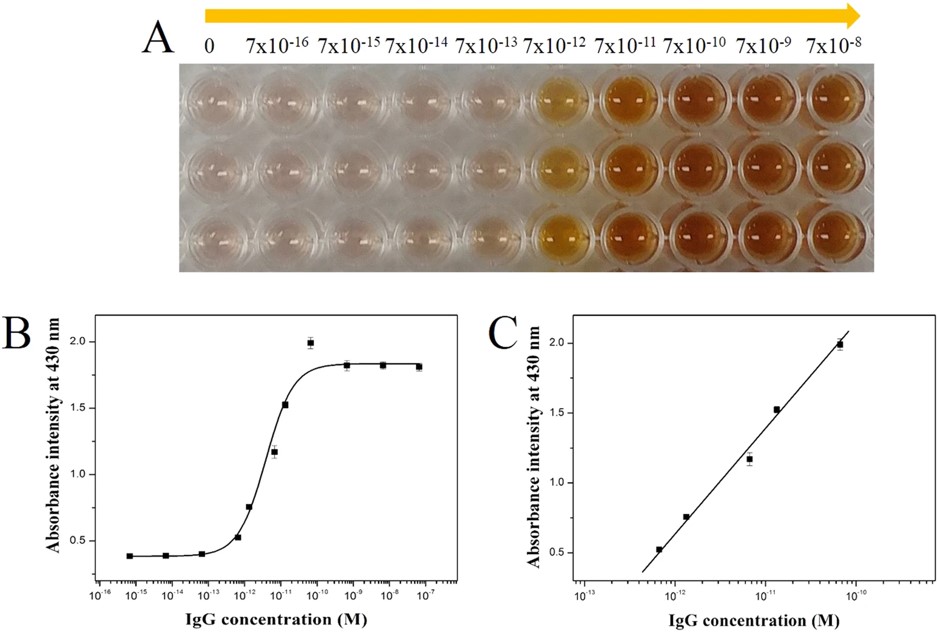 Fig.1 Schematic of enzyme-induced colorimetric enhancement immunoassay results.1
This study developed a highly sensitive colorimetric immunoassay featuring a broad dynamic range. The method used enzyme-catalyzed silver (Ag) growth on gold nanoparticle-assembled silica (SiO2@Au@Ag) and alkaline phosphatase (AP)-based amplification to significantly enhance the colorimetric readout. Immune complexes bound Ab-IgG-AP antibodies, triggering enzyme-driven conversion of 2-phospho-L-ascorbic acid into ascorbic acid. Ascorbic acid converted Ag+ to Ag, forming Ag shells on SiO2@Au and increasing absorbance. The plasmonic immunoassay demonstrated a strong linear response between absorbance and IgG concentration (7 × 10⁻¹³ M to 7 × 10⁻¹¹ M), with a detection limit of 1.4 × 10⁻¹³ M, significantly surpassing the sensitivity of conventional colorimetric assays. This method enabled highly sensitive in vitro diagnostics and protein detection with the naked eye.
2. Colorimetric Enzyme-Linked Immunoassay Based on CuO Nanoparticles and In Situ Gold Nanoparticle Growth
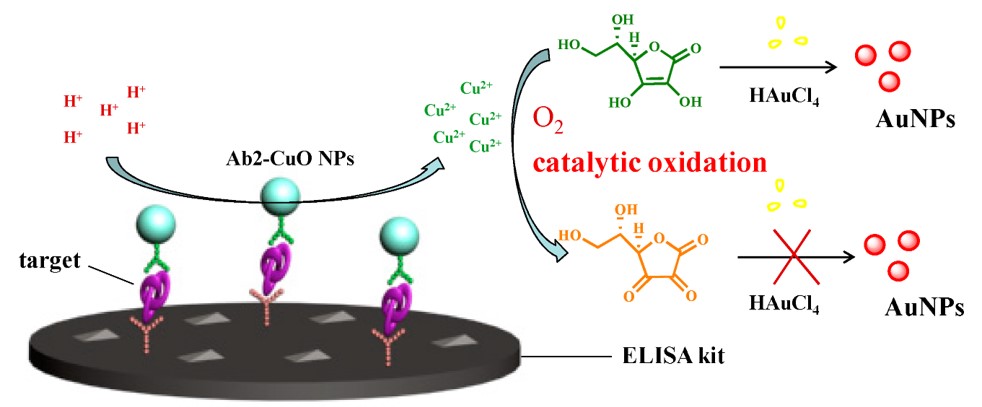 Fig.2 The detection principle of colorimetric Immunoassay in this study.2
This paper reported a colorimetric immunoassay using CuO nanoparticles (CuO NPs) as signal labels for sensitive prostate-specific antigen (PSA) detection. The method relied on the substantial release of Cu2+ from CuO NPs, their efficient catalytic oxidation of ascorbic acid (AA), and the high extinction coefficient of AuNPs. The assay demonstrated a linear response to PSA concentrations ranging from 0.1~10 ng/mL, with a detection limit of 0.05 ng/mL, comparable to other CuO NP-based methods. The assay's high throughput, simplicity, and sensitivity make it suitable for serum sample analysis.
Features of Our Services
- Unmatched Expertise: Benefit from our years of specialized experience in immunoassay development, backed by a team of highly skilled immunologists and biochemists. We apply profound scientific expertise to every project, ensuring technically sound and innovative solutions.
- Tailored Customization: Every kit is meticulously designed to meet your precise specifications, from target analyte and sample matrix to desired sensitivity and throughput. We offer unparalleled flexibility to accommodate unique research and diagnostic requirements.
- Rigorous Quality Assurance: Our stringent validation processes and comprehensive quality control measures guarantee the reliability, reproducibility, and stability of every custom kit. We adhere to the highest scientific standards, delivering products you can trust.
- Scalable Solutions: Whether you require a small batch for research or large-scale production for commercialization, our manufacturing capabilities are designed to scale with your needs. We provide consistent quality across all production volumes.
Q&A
-
Q: Can you develop kits for challenging or novel biomarkers?
A: Absolutely. Developing kits for challenging or novel biomarkers is one of our core strengths and a key area of our expertise. Our team possesses extensive experience in working with difficult targets, including those with low abundance, complex post-translational modifications, or those present in challenging biological matrices. We employ advanced antigen design strategies and innovative antibody generation techniques to overcome these hurdles, ensuring successful assay development even for the most demanding projects.
-
Q: What are the key differences between your custom service and off-the-shelf kits?
A: The primary distinction between our custom service and commercially available off-the-shelf kits lies in the bespoke nature of our solutions. Off-the-shelf kits are designed for broad applications, which may not fully address the specific nuances of your research or diagnostic needs. Our custom service, however, meticulously tailors every aspect of the kit—from antibody selection to assay format and validation—to your exact requirements, ensuring optimal performance, specificity, and sensitivity for your unique application.
-
Q: How do you guarantee the quality and reproducibility of the developed kits?
A: Ensuring the quality and reproducibility of our developed kits is paramount, and we achieve this through a multi-faceted approach. Our process incorporates rigorous validation steps, including comprehensive assessments of sensitivity, specificity, linearity, accuracy, and precision. Throughout the manufacturing process, from raw material inspection to final product testing, we maintain stringent quality control strategies. Furthermore, extensive stability studies are conducted to guarantee consistent performance over the kit's shelf life, providing reliable and repeatable results for your research.
-
Q: Do you provide post-development assistance and manufacturing?
A: Yes, Creative Biolabs provides comprehensive post-development support and scalable manufacturing services for your custom ELISA kits. Our commitment extends beyond the initial development phase; we offer ongoing technical assistance to address any queries or challenges you may encounter during the kit's use. Furthermore, we have robust manufacturing capabilities to produce your custom kits at various scales, ensuring consistent supply and quality for both your research needs and potential commercialization efforts.
ELISA utilizes antibodies to detect and quantify specific analytes such as peptides, proteins, and hormones. Creative Biolabs has significant experience in assay development with ELISA based kits. Our ELISA platform offers a sensitive and specific detection method that is also rapid and cost-effective. If you are interested, please feel free to contact us for more details.
References
- Pham, Xuan-Hung, et al. "Enzyme-catalyzed Ag growth on Au nanoparticle-assembled structure for highly sensitive colorimetric immunoassay." Scientific Reports 8.1 (2018): 6290. Distributed under Open Access license CC BY 4.0, without modification.
- Deng, Dehua, et al. "A colorimetric enzyme-linked immunosorbent assay with CuO nanoparticles as signal labels based on the growth of gold nanoparticles in situ." Nanomaterials 9.1 (2018): 4. Distributed under Open Access license CC BY 4.0. The image was modified by extracting and using only part of the original image.
For Research Use Only.