
01
Study definition
Specify the analyte, HS structural question, expected binding range, labeling status, and required biological comparisons.


Creative Biolabs provides custom heparan sulfate microarrays with defined sulfation, chain-length, density, and control designs for clear structure-binding interpretation across analytes.
Creative Biolabs supports researchers who need to compare how proteins, antibodies, pathogens, or other analytes respond to defined heparan sulfate structures. Our heparan sulfate microarray is part of the broader Polysaccharide Microarray portfolio and can be configured around chain length, N-sulfation, O-sulfation, uronic-acid context, printing density, and project-specific controls.
The central design question is which structural differences need comparison to distinguish a meaningful recognition pattern from general attraction to a highly anionic surface. HS-protein binding can depend on sulfate position, spacing, local conformation, chain length, and multivalency. An informative panel therefore needs a structured comparison series rather than only highly sulfated positive probes.
A defined HS array enables parallel comparison of oligosaccharides that vary in selected structural features. When the panel contains appropriate near-neighbors, it can show whether binding is associated with N-sulfation, 2-O-, 6-O-, or 3-O-sulfation, iduronic- versus glucuronic-acid context, chain length, or a combination of features. The result is a binding profile, not a complete solution-phase affinity model.
Creative Biolabs can align the HS panel, analyte handling, labeling or indirect detection, printing-density strategy, replicates, signal processing, and interpretation with the project question. The original service scope includes structurally defined HS probes and multiple sulfation patterns; final content is confirmed from probe availability and the structural contrasts required by the study.
Interaction profiling evaluates whether an analyte binds one or more HS structures and how the pattern changes across the panel. A useful specificity claim requires comparison with related HS probes and relevant non-HS controls. Concentration series or alternative detection routes may be included when signal saturation, low response, or labeling effects could influence the conclusion.
Sulfation-pattern analysis is strongest when the array contains matched structures that differ at a defined position. Highly sulfated structures frequently produce strong signals, but signal alone cannot separate a sequence-specific requirement from charge density, surface density, or multivalent avidity. The panel and controls can make those explanations experimentally distinguishable.
| Design Dimension | Useful Comparisons | Reason |
|---|---|---|
| Chain length | Matched oligosaccharides with shared sulfation features across several lengths | Tests whether the interaction requires a minimum span or benefits mainly from multivalency. |
| N- and O-sulfation | N-acetylated, N-sulfated, and positionally O-sulfated near-neighbors | Separates total charge from dependence on a particular sulfate position. |
| Uronic-acid context | GlcA- and IdoA-containing structures when available | Addresses conformational and sequence-context contributions to recognition. |
| Printing density | More than one surface density for selected probes | Reveals density-sensitive avidity and helps avoid interpreting saturation as specificity. |
| Negative space | Nonsulfated glycans, related GAGs, linker controls, and detection-only controls | Provides the baseline needed to identify nonspecific electrostatic or reagent-derived signal. |
Choose a focused HS array when the project asks which HS chain length, sequence context, or sulfation pattern drives recognition within the HS family. Choose a broader glycosaminoglycan (GAG) microarray when the first question is cross-class selectivity across HS, heparin, chondroitin sulfate, dermatan sulfate, or other GAG contexts. The broader screen can define the class-level boundary before a more focused HS panel is used for within-class structural resolution.
Specify the analyte, HS structural question, expected binding range, labeling status, and required biological comparisons.
Select available HS probes by chain length, sulfation pattern, backbone context, density, and control role.
Choose direct labeling or compatible indirect detection while considering activity, steric effects, and secondary-reagent background.
Incubate analytes, wash under controlled conditions, acquire images, and review spot-level quality and replicate consistency.
Compare signal across matched probes, concentrations, densities, and control classes.
Identify interactions that require SPR, competition, cell-surface, or functional follow-up.
Sample requirements vary with analyte type and detection strategy. Purified, well-characterized material generally provides the most interpretable result. Complex fractions, cells, viruses, or other research materials require additional discussion because particle size, endogenous fluorescence, nonspecific adsorption, and detection access may change array behavior.
Supports detection design and interpretation of multivalency or steric constraints.
Identifies compatibility issues and possible contributors to charge-driven background.
Guides positive controls, structural neighborhood, and concentration range.
Determines whether direct or indirect detection is more suitable.
Aligns the panel and reporting with a specific research decision.
HS probe inventory, structural annotations, printing layout, and control classification.
Array images, spot-quality review, replicate summaries, and processed signal matrix.
Heatmaps, concentration or density comparisons, and structure-oriented binding summaries as scoped.
Sulfation, length, and control patterns with explicit uncertainty where matched probes are unavailable.
Orthogonal experiments when array binding alone cannot resolve affinity, charge contribution, or biological relevance.
Compares HS structural requirements across related signaling proteins.
Profiles binding to sulfation-defined HS and neighboring structures.
Tests whether pathogen-derived proteins prefer selected HS features.
Examines interactions involving HSPGs, matrix proteins, and HS-binding regulators.
Prioritizes defined oligosaccharides for subsequent solution or functional testing.
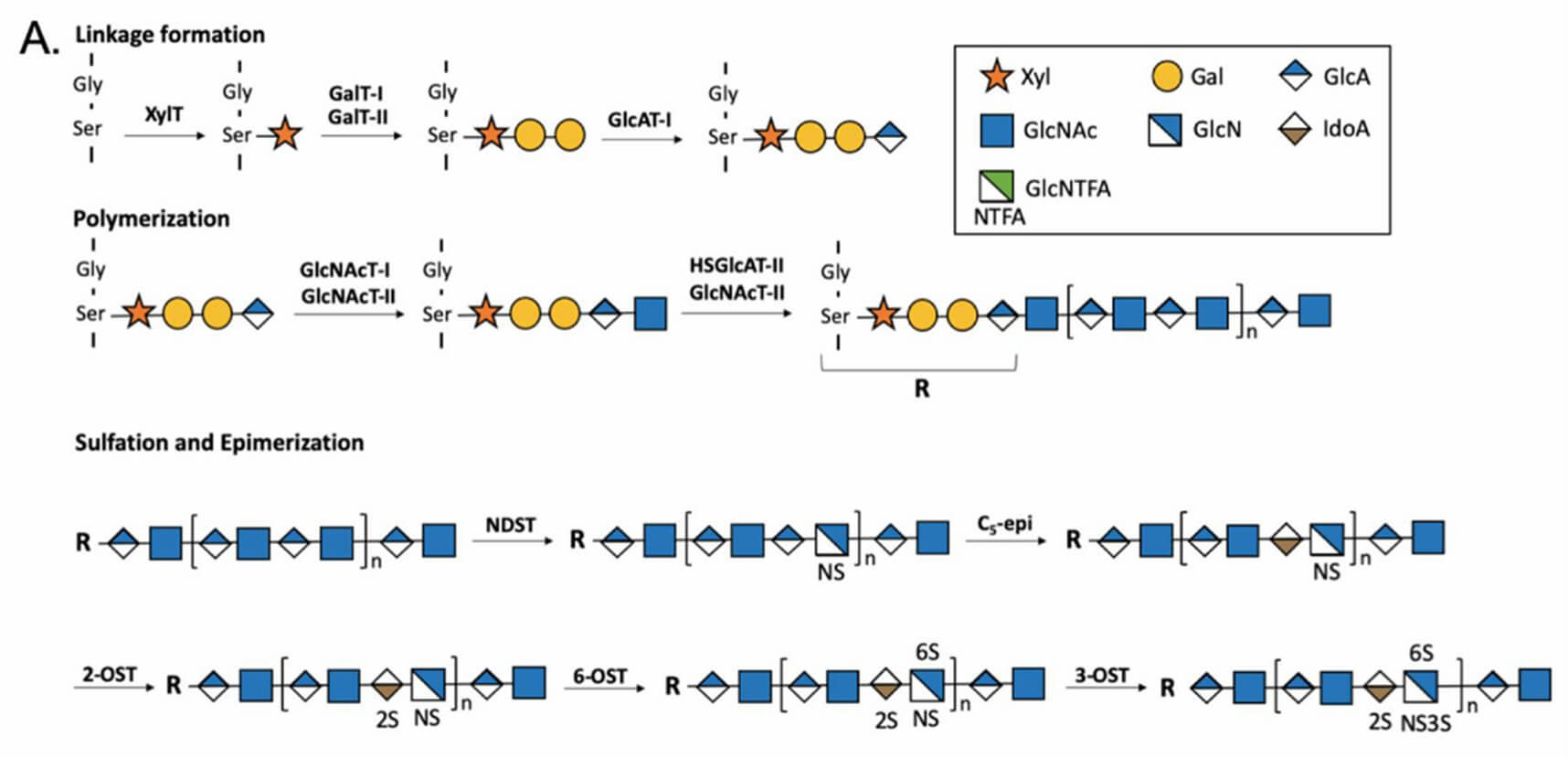
Arnold, Liao, and Liu summarized the biosynthetic processes that generate structural diversity in heparan sulfate (HS). HS synthesis begins with formation of the protein-linked tetrasaccharide linkage region, followed by polymerization of repeating GlcA–GlcNAc units. Subsequent C5 epimerization converts selected GlcA residues to iduronic acid, while N-, 2-O-, 3-O-, and 6-O-sulfation further diversify the chain. These modifications occur in an ordered, non-template-driven process, producing HS molecules that differ in chain composition, sulfation pattern, and conformational properties. The authors also highlighted chemoenzymatic approaches for generating structurally defined HS oligosaccharides, which help overcome the heterogeneity of material isolated from biological sources. This biosynthetic framework provides a structural rationale for HS microarray design: defined sulfation states, uronic-acid epimerization, and chain context should be represented independently when investigating HS–protein recognition rather than treating HS as a single uniform ligand.
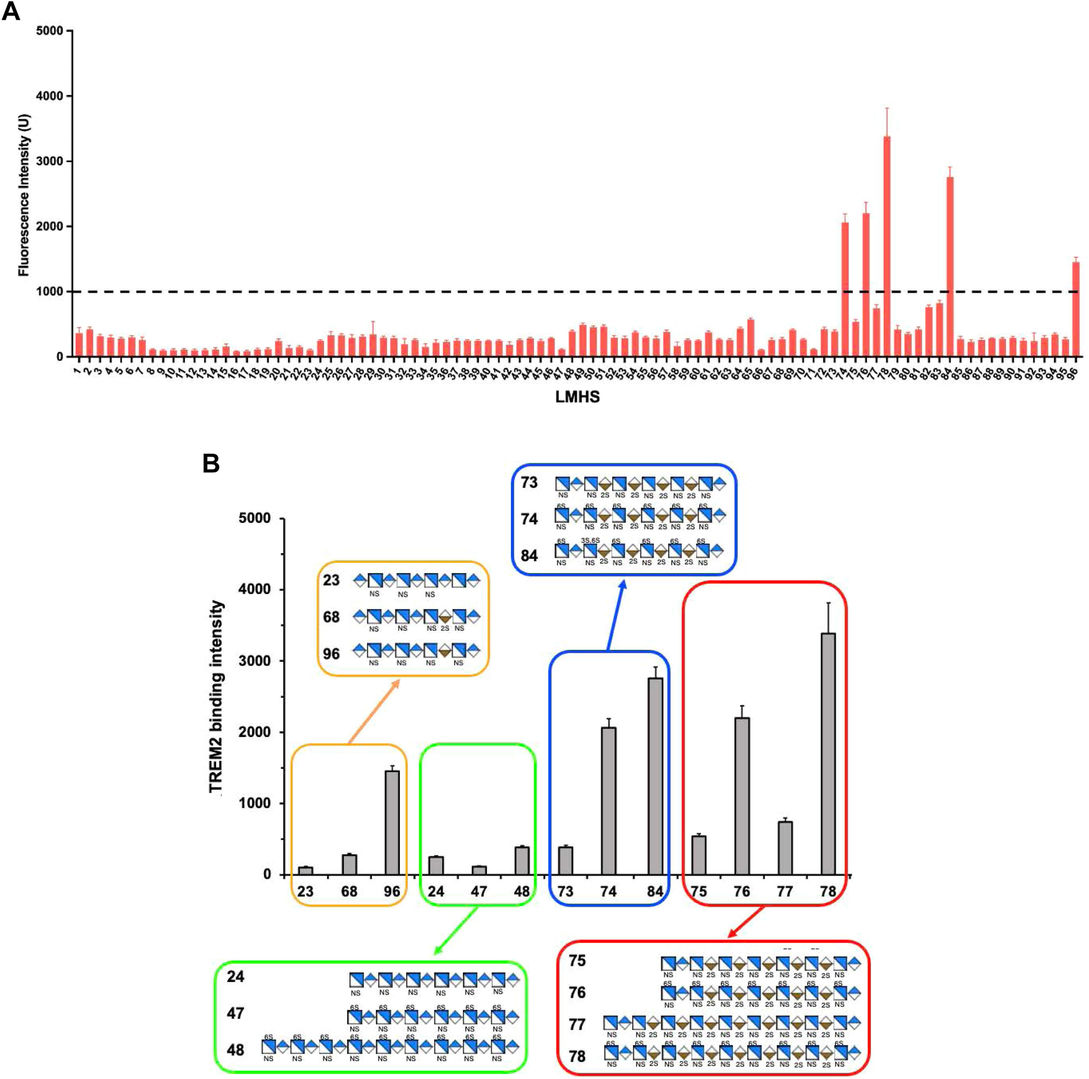
McMillan and colleagues used a low-molecular-weight HS microarray to define structural requirements for TREM2 binding. The array contained 96 chemoenzymatically synthesized HS oligosaccharides differing in chain length, sequence, and sulfation pattern, with each compound printed in replicate. Only five structures produced binding above the defined threshold, demonstrating that TREM2 recognition was not simply proportional to overall sulfation. Among the identified binders, HS showed substantially stronger binding than the closely related HS, which differed primarily by additional 6-O-sulfation. Comparisons across other paired structures supported the same 6-O-sulfation preference, while analysis of selected oligosaccharides also implicated iduronic acid in recognition. Binding structures ranged from approximately 9 to 18 residues, consistent with a minimum chain-length requirement near ten monosaccharides. These results show how structurally diverse HS arrays can distinguish specific sulfation and backbone-context preferences from nonspecific recognition of highly sulfated glycans.
Submit the analyte identity and construct, concentration and buffer, purity, oligomeric or particle state, labeling status, known HS-binding information, desired chain-length and sulfation comparisons, required controls, sample groups, expected concentration range, and the orthogonal or biological decision the array is intended to inform.