


How Does Glycosylation Influence Blood Type
Blood types are already complex enough with A, B, AB and O designations but the importance of glycosylation increases when we examine its role. The ABO blood group system and the immune system's recognition of glycosylation modifications in these molecules is what makes our blood type just that: ours. With years of experience serving the glycosylation analysis needs of the research community, Creative Biolabs is a leading provider of glycosylation analysis services. Our state-of-the-art platform and highly skilled team are ready to support your glycosylation research with the most accurate and reliable data possible. If you are seeking to study the effects of glycosylation on blood types or other complex immune responses, our glycosylation analysis services will get you the exact results you need.
ABO Glycosylation: The Determinants of Blood Type
One of the most well-known glycosylation modifications in human biology is the ABO blood group system. Determined completely by the glycan structures found on the surface of red blood cells, the ABO blood group system results from the presence or absence of terminal glycan residues added by specific glycosyltransferases acting on a common precursor structure known as the H antigen. This minor glycosylation modification of H antigen changes how red blood cells will react with antibodies, which is vital in blood transfusions, organ transplants, and susceptibility to disease. For example, individuals with type O blood have a significantly lower incidence of severe malaria, likely because of the difference in red cell-Plasmodium interactions based on the presence/absence of these terminal sugars.
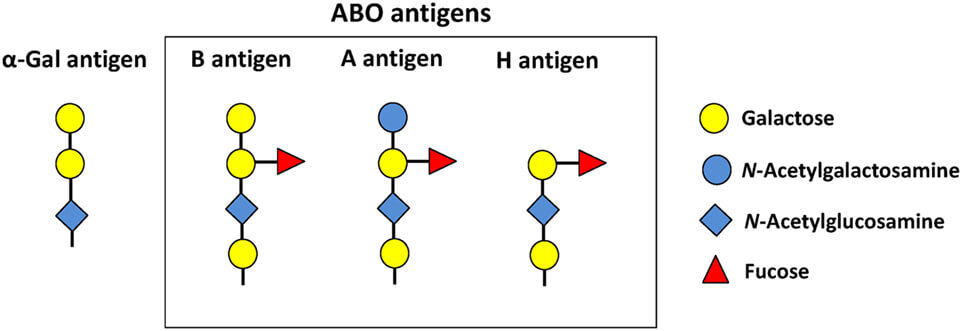 Fig.1 The structure of ABO-antigens and α-Gal antigen. 1
ABO Antigen Biosynthesis
| Blood Type | Key Enzyme | Terminal Sugar Added | Resulting Antigen Structure |
|---|---|---|---|
| O | No functional enzyme | None | Unmodified H antigen |
| A | A-transferase (GTA) | N-acetylgalactosamine (GalNAc) | H antigen + GalNAc → A antigen |
| B | B-transferase (GTB) | Galactose (Gal) | H antigen + Gal → B antigen |
| AB | Both GTA and GTB active | GalNAc + Gal | Co-expression of A and B antigens |
This example of glycan-based regulation and control of blood type is a microcosm of a broader scientific principle: small changes in glycosylation can have large-scale biological effects. This insight has already been leveraged to develop exciting new technologies:
- Conversion of blood groups enzymatically using bacterial glycosidases to cleave A/B antigens (e.g., converting ABO+ blood to O- for universal donor blood).
- Synthetic blood group antigen mimics to screen for anti-ABO antibodies and design glycoconjugate vaccines.
- Glycoarrays to map out anti-glycan repertoires in alloimmune conditions.
Design Your Anti-Glycan Antibody
N-Glycosylation/O-Glycosylation of Blood Group Systems
Glycosylation is critical to blood group systems, and both N- and O- glycosylation are responsible for the glycan modifications that characterize blood group antigens. While N-glycosylation is the primary mechanism behind ABO antigens found on the surfaces of red blood cells, O-glycosylation also modulates the function of cell surface proteins like selectins and mucins, which are involved in immune recognition and cell-cell adhesion. For glycosylation researchers interested in studying these modifications, Creative Biolabs' N-glycosylation analysis and O-glycosylation analysis of proteins can yield critical insights into the role of N-linked/O-linked glycans on proteins involved in blood type-specific immune recognition. Whether studying blood group antigens or more generally investigating the effects of glycosylation in disease, our advanced platform can perform the most accurate and detailed N-/O-glycan analysis for your research.
Glycosylation Determines Immune Compatibility
Another critical aspect of the ABO blood group system is that individuals have naturally occurring antibodies in their plasma that are directed against the blood group antigens that they lack. People produce anti-A or anti-B antibodies because their immune systems recognize ABO blood group antigens that they do not have. The naturally occurring antibodies specific to each ABO blood group are as follows:
- Type A individuals have anti-B antibodies
- Type B individuals have anti-A antibodies
- Type O individuals have both anti-A and anti-B antibodies
- Type AB individuals have none
During a transfusion, if the incompatible blood is introduced, then the pre-formed antibodies rapidly recognize the non-self glycan structures on the transfused red cells. This recognition will activate complement and result in cell lysis, hemolysis, and in some cases, death. That is why ABO-typing and cross-matching is so important for blood transfusion.
Glycosylation Affects Disease Susceptibility
As we have seen, glycosylation plays a critical role not only in blood type but also in how the immune system recognizes glycosylated blood group antigens. The susceptibility of different blood types to certain diseases has also been shown to be strongly correlated with glycosylation differences in these molecules. Malaria and tuberculosis have been shown to be associated with ABO blood group, with individuals with blood type O having some protection against malaria. This protection against malaria is thought to be due to the glycosylation patterns on the red blood cells of individuals with blood type O that interfere with parasite invasion. Glycosylation also modulates the immune response to different pathogens, as is the case with the α-Gal (alpha-galactose) antigen. While this antigen is found in all non-human mammals, it is absent from human cells. In some individuals, this results in the production of antibodies against this sugar that have been linked to a decreased risk of diseases such as Chagas disease, malaria, and Leishmaniasis. It has been hypothesized that the production of these anti-α-Gal antibodies in some individuals is due to modulation by the microbiota or by dietary differences. These examples show just how glycosylation can modulate immunity beyond the ABO blood type system.
Investigating how glycosylation impacts blood type has important clinical implications but also helps in the development of new therapies and vaccines. At Creative Biolabs, we are here to provide the most advanced glycosylation analysis services for your research. Whether you need support in N-/O-glycosylation analysis or the development of blood group-related products, contact our glycobiology experts to help customize your workflow.
Reference:
- Cabezas-Cruz, Alejandro, and Jose de La Fuente. "Immunity to α-Gal: The opportunity for malaria and tuberculosis control." Frontiers in immunology 8 (2017): 1733. Distributed under Open Access license CC BY 4.0, without modification. https://doi.org/10.3389/fimmu.2017.01733
Related Services
Anti-Glycan Antibody Development Services
Anti-Glycan Antibody Engineering Service
Anti-Glycan Antibody Detection Services
Antibody Glycosylation Analysis Service
Protein Glycosylation Analysis Service