
What is Bioconjugation Reagent?
Bioconjugation Introduction
Bioconjugation takes the concept to the next level, which is to say, the highly selective covalent linkage of two or more biomolecules or a biomolecule and a non-biomolecular construct, to produce a composite or hybrid structure with enhanced or wholly different characteristics. This complex chemical reaction provides at the same time a crossroad between chemistry, biology and medicine and a basis for state-of-the-art biotechnological applications. They can react with an immense variety of targets for bioconjugation, that are not limited to proteins, antibodies, peptides, nucleic acids, carbohydrates, or lipids but also include synthetic polymers or nanoparticles.
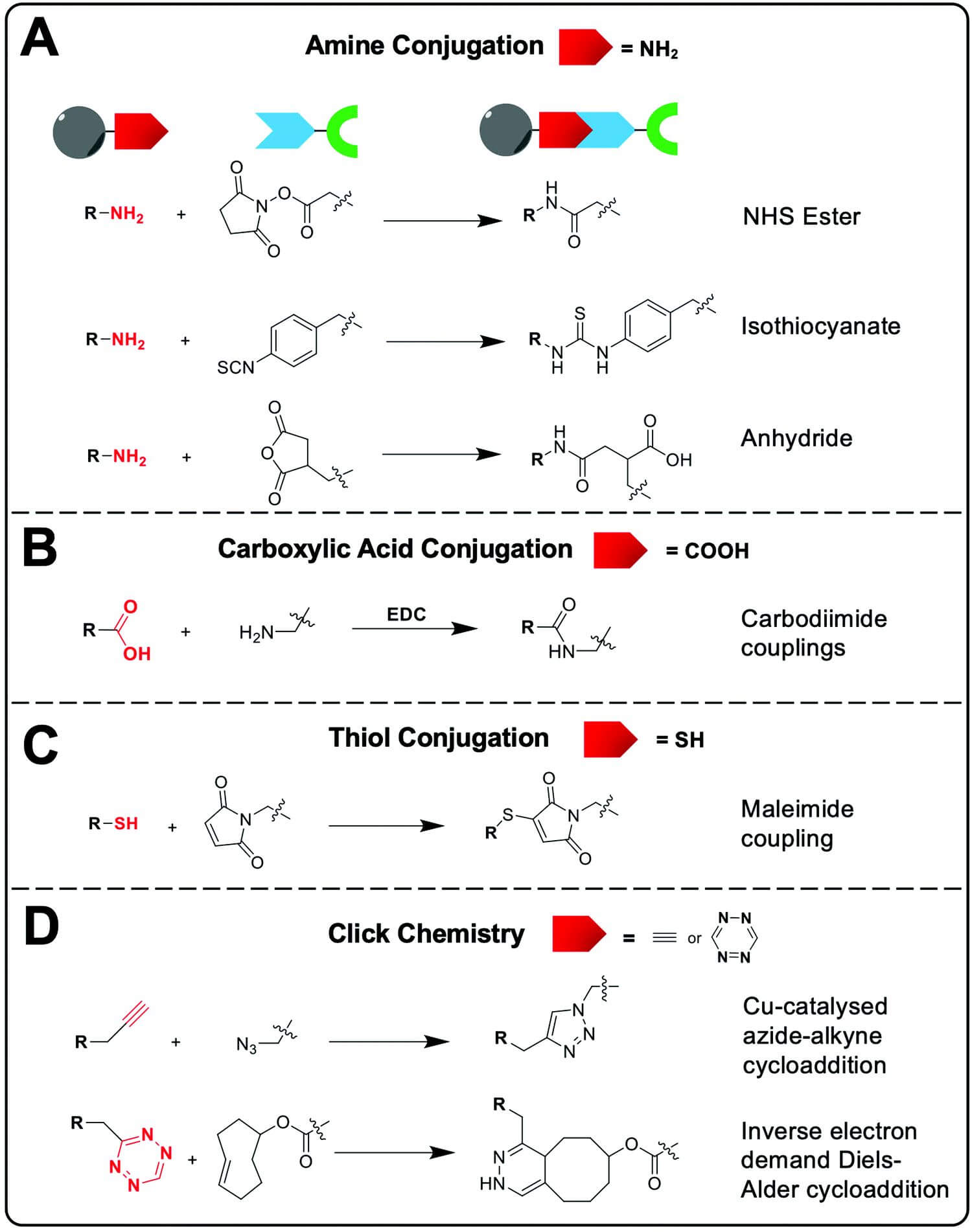 Figure 1 Common bioconjugation reactions that allow the attachment of bifunctional chelators to the nanomaterial surface.1
Structures of the Bioconjugation Reagents
A conjugation reagent commonly has two reactive groups, one for specific binding to a functional group on the first molecule and the other for specific reaction with a functional group on the second molecule. Such reactive groups are usually spaced by a spacer or linker arm with varying degrees of length, flexibility, hydrophilicity, and cleavability, which can be used to tailor the properties of the conjugate.
Features of Bioconjugation Reagent
Biological coupling reagents should possess certain specific characteristics in order to be considered "ideal" reagents. The primary characteristic of useful biological coupling reagents is high selectivity, which reacts with specific functional groups on biomolecules. Biological coupling reagents should react rapidly and quantitatively under mild conditions, such as room temperature or physiological temperature (37 ° C) and neutral pH. The purpose of mild reaction conditions is to maintain the structural integrity of biomolecules. Good biological coupling reagents should not have cytotoxicity or other damage to biomolecules. Biological coupling reagents form stable chemical bonds with oligosaccharides, nucleic acids, synthetic polymers such as polyethylene glycol and carbon nanotubes, which are not easily hydrolyzed or broken in biological environments.
Common Bioconjugation Reactions
| Type of Bioconjugations | Description |
|---|---|
Protein Related Conjugation |
Protein conjugation is a widely used biological experimental technique that facilitates the covalent attachment of small molecules (such as drugs, haptens, and fluorescent dyes) or macromolecules (including enzymes, nucleotides, and polysaccharides) to proteins. |
Oligonucleotides Related Conjugation |
Oligonucleotide conjugation is a method used to attach oligonucleotides to other molecules, including fluorescent markers, drugs, or solid supports. |
Small Molecule Related Conjugation |
Small molecules are one of the most critical elements for biological functions, most drugs contain such molecules. |
Bacteria Related Conjugation |
The conjugation of fluorescent particles to bacteria can make up for the weakness of traditional bacterial detection methods and provide qualitative or quantitative information about the detected strains, which is crucial for pathogen detection and clinical diagnosis. |
Click Chemistry Based Conjugation |
Click chemistry is a chemical reaction based on the formation of carbon-heteroatom bonds (C-X-C) to efficiently and reliably synthesize a diverse array of molecules through the assembly of small units. |
Virus Conjugation |
Virus can be easily modified with genes or chemical molecules to tune their immunogenicity. N-terminal and C-terminal modifications allow alternative functional groups to be fused to the peptide. |
Bioconjugate Technologies

Random Conjugation
Historically, the most common approach, relying on the statistical reaction of highly abundant functional groups (e.g., lysine amines, surface-exposed cysteines) on a protein. While straightforward, this method can lead to heterogeneous products with varying drug-to-antibody ratios (DAR) or conjugation sites, potentially impacting efficacy, pharmacokinetics, and safety (e.g., in ADCs).

Site-Specific Conjugation
A highly sought-after advancement that aims to attach the payload at precisely defined locations on the biomolecule. This leads to homogeneous conjugates with consistent properties, often enhancing therapeutic index.

Enzymatic Bioconjugation
Utilizes the exquisite specificity of enzymes to form covalent bonds. This includes:
- Transglutaminases: Enzymes that catalyze the formation of isopeptide bonds between glutamine and lysine residues. Engineered variants can be used for site-specific protein modification.
Frequently Asked Questions
Q: What are the primary considerations when choosing a bioconjugation reagent?
A: When selecting a bioconjugation reagent, consider the reactive groups on both the reagent and the biomolecule, the spacer arm length and properties (hydrophobic, hydrophilic, cleavable), reaction conditions (pH, temperature, solubility), site-specificity, and potential for off-target reactions. Also, consider the stability of the reagent and the conjugate, and the impact on the biomolecule's function.
Q: Can bioconjugation reagents be used for living cells or in vivo applications?
A: Yes, bioconjugation reagents can be used for living cells and in vivo applications, but it depends on the specific reagents and reactions used. Many bioconjugation reactions are designed to be biocompatible and can be performed in the presence of living cells, while others are more suited for in vitro applications due to toxicity or incompatibility with cellular processes.
Q: How does the linker arm of a bioconjugation reagent affect the conjugate?
A: The linker arm in a bioconjugation reagent significantly impacts the properties and performance of the resulting conjugate. Its length, flexibility, and chemical composition affect stability, solubility, drug release, and overall efficacy of the conjugate.
Overview of What Creative Biolabs Can Provide
With an advanced platform and strong knowledge, Creative Biolabs offers a comprehensive service of bioconjugation, including but not limited to organic dyes, fluorescent proteins and QDs labeling. If you are interested in our bioconjugation services, please feel free to contact us for more details.
Recommended products
Reference
- Pellico J, Gawne P J, de Rosales R T M. Radiolabelling of nanomaterials for medical imaging and therapy. Chemical Society Reviews, 2021, 50(5): 3355-3423.https://doi.org/10.1039/D0CS00384K. Distributed under Open Access license CC BY 4.0, without modification.