
What is Click Chemistry Reagent?
Click Chemistry Introduction
Click chemistry is a chemical synthesis method that emphasizes the efficiency, simplicity, selectivity, and modularity of chemical processes used to connect molecular building blocks. It includes the development and use of 'click to react', a set of simple biocompatible chemical reactions that meet specific criteria such as high yield, fast reaction rate, and minimal by-products. To view a response as a click response, it must meet certain characteristics:
- Modularization
- Not sensitive to solvent parameters
- High chemical yield
- Not sensitive to oxygen and water
- Regional specificity and stereospecificity
- A large thermodynamic driving force (>20kcal/mol) is advantageous for reactions with a single reaction product. An obvious exothermic reaction causes the reactants to 'spring load'.
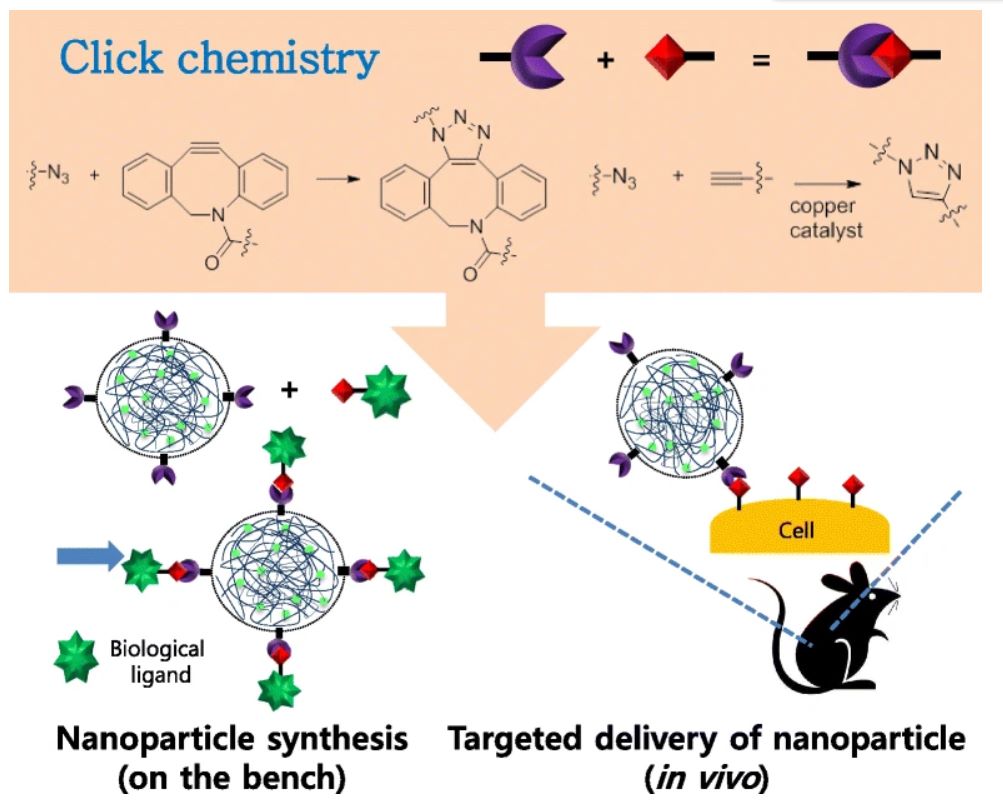 Figure 1 Illustration for the usage of click chemistry during nanoparticle synthesis and its targeting in vivo.1
Copper-Free Click Chemistry
Copper free click chemistry is another method of click chemistry, which has a low activation energy barrier and does not contain cytotoxic transition metal catalysts. Due to the absence of external metal catalysts, these reactions are suitable for in vivo applications in bioorthogonal chemistry or bioorthogonal click chemistry. The copper free click chemical reaction proceeds like an explosion, producing a single product 1-phenyl-4,5,6,7,8,9-hexahydro-1H-cyclooctanol [d] [1,2,3] triazole. Due to the presence of a large amount of cyclic strain (18 kcal/mol cyclic strain) in cyclooctyne molecules, the reaction rate is extremely fast. The release of cyclic strain in molecules drives rapid reactions. According to reports, cyclooctyne can selectively react with azides at room temperature and pressure to form a mixture of regional isomers of triazole, without the need for metal catalysis and without significant cytotoxicity. Copper free click chemistry is widely used in chemical biology, drug discovery and development, and molecular imaging.
Click Chemistry Reagents
Click chemistry reagents cover various azides, alkynes, catalysts, and ligands, which help accelerate the exciting research in the field of click chemistry. Click chemistry refers to a chemical reaction that is modular, efficient, widely applicable, highly productive, and produces only harmless by-products. The most famous example of a "click" reaction is the copper (I) catalyzed 1,3-dipolar cycloaddition reaction of azides alkynes (CuAAC), which generates 1,4-disubstituted pentagonal 1,2,3-triazole rings.
-
Amino Acid Azides/Alkynes for Click Chemistry
The use of natural and non-natural amino acids for peptide synthesis is a powerful tool for developing therapies and understanding biochemistry.
-
Azide Source for Click Chemistry
The incorporation of azide functional groups into organic molecules is becoming an increasingly important task, as these components continue to influence organic chemistry and biology in various applications ranging from amino protection to chemical bonding.
-
Organic Nitrides for Click Chemistry
The azide group can also be used as a protective group for primary amines, especially in sensitive substrates such as complex carbohydrates or peptide nucleic acids (PNA) and coordination compounds, as azides are stable to olefin metathesis conditions.
-
PEG Azide for Click Chemistry
PEG polymers also possess many inherent favourable biological characteristics, such as high water solubility, non-toxicity and non-immunogenicity. In many cases, the chemical modification ("PEGylation") of bioactive molecules such as peptides, antibody fragments, enzymes or small molecules with polyethylene glycol chains will therefore improve pharmacokinetics and biological activity.
Click Chemistry Reagents Advantages
- This is very selective. The click chemical reaction only occurs between the azide and alkyne components. It does not interfere with most other organic groups present in DNA and proteins, such as amino and carboxyl groups.
- There are no azides or alkynes in natural biomolecules. These functional groups should be specifically introduced into DNA and proteins. In the standard oligomeric synthesis process, DNA containing alkynes can be prepared using acetylphosphoramidite. Proteins labeled with azides and alkynes can be prepared using azide activated esters and alkyne activated esters.
- Chemical reactions occur in water. DMSO, DMF, Acetonitrile, alcohols, pure water, and buffer solutions can be used for the reaction. This reaction is biocompatible and can occur in living cells.
- React quickly and quantitatively. Click chemistry is a tool that can prepare nanomolar conjugates in diluted solutions.
- This reaction is insensitive to pH value. Unlike the reaction of NHS esters with amines and other conjugated chemicals, the reaction mixture does not require pH control. No specific buffer, acid or base needs to be added - click chemistry works well in the pH range of 4-11.
Frequently Asked Questions
Q: Which click chemistry reaction is best for in vivo applications?
A: SPAAC and Inverse Electron-Demand Diels-Alder (IEDDA) reaction (Tetrazine Ligation) are often preferred for in vivo applications. SPAAC is copper-free, avoiding toxicity concerns of metals, and its kinetics is fast. IEDDA is even faster (it is among the fastest bioorthogonal reactions) and forms very stable conjugates, so it is particularly well-suited for fast labeling and imaging in vivo, where speed and biocompatibility are key. CuAAC is generally avoided for in vivo applications due to copper ion toxicity.
Q: How do I choose the right spacer arm for my click chemistry reagent?
A: Selection of the appropriate spacer arm depends on the intended application:
- Solubility: If you wish to perform the reaction in aqueous media or if you want to improve the solubility of the final conjugate, hydrophilic spacers such as PEG (polyethylene glycol) chains are available.
- Steric Hindrance: Longer and more flexible spacers (e.g., longer PEG chains) can reduce steric hindrance between conjugated molecules, thus better maintaining the biological activity of the molecule.
- Targeting: In certain applications, precise distance or orientation is required between the two components and thus very short, rigid spacers may be desired.
- Cleavability: If you would like to be able to release one portion of the conjugate at a later stage, a cleavable linker can be chosen (examples include disulfide for reductive cleavage, hydrazone for pH dependent cleavage or a peptide sequence for enzymatic cleavage).
Overview of What Creative Biolabs Can Provide
Creative Biolabs is a world class supplier of bioconjugation services and reagents. We provide complete bioconjugation support to help enable science and drug development. With years of experience in chemical biology, protein engineering and synthetic chemistry, we have a large selection of quality click chemistry reagents and services to support the unique needs of our customers. If you are interested in our bioconjugation services, please feel free to contact us for more details.
Recommended Products
Recommended Services
-
Protein & Antibody Related Conjugation
-
Nucleic Acids/Oligonucleotides Related Conjugation
-
Small Molecule Related Conjugation
-
Bacteria Related Conjugation
-
Click Chemistry based Conjugation
-
Custom Virus Conjugation
-
Custom Bacteriophage Conjugation
Reference
- Yi G, Son J, Yoo J, et al. Application of click chemistry in nanoparticle modification and its targeted delivery. Biomaterials Research, 2018, 22(1): 13. https://doi.org/10.1186/s40824-018-0123-0 Distributed under Open Access license CC BY 4.0, without modification.