
Bioconjugation Introduction
Bioconjugation Overview
In the most fundamental aspect, biological coupling only involves the connection of one molecule to another, usually through covalent bonds, to form a complex composed of two molecules connected together. When this biological conjugate is formed, the process can produce complexes with roughly equal proportions of each component, or intentionally designed conjugates where one element has more molecules than another. The final form of biological conjugates depends on the desired application and the components and methods used to bind them together. Therefore, the process of preparing bio conjugates from individual molecules generates new complexes that possess the combination characteristics of each component used to prepare them. The result is the formation of a new structure with features typically not found in natural substances. For example, attaching a fluorescent label to an antibody produces a targeted complex that can be used to specifically bind the desired biomolecules through the antigen binding site on the antibody. Then, due to the fluorescent properties of the label, the targeted biomolecules can be detected - a feature that cannot be achieved using unlabeled antibodies alone.
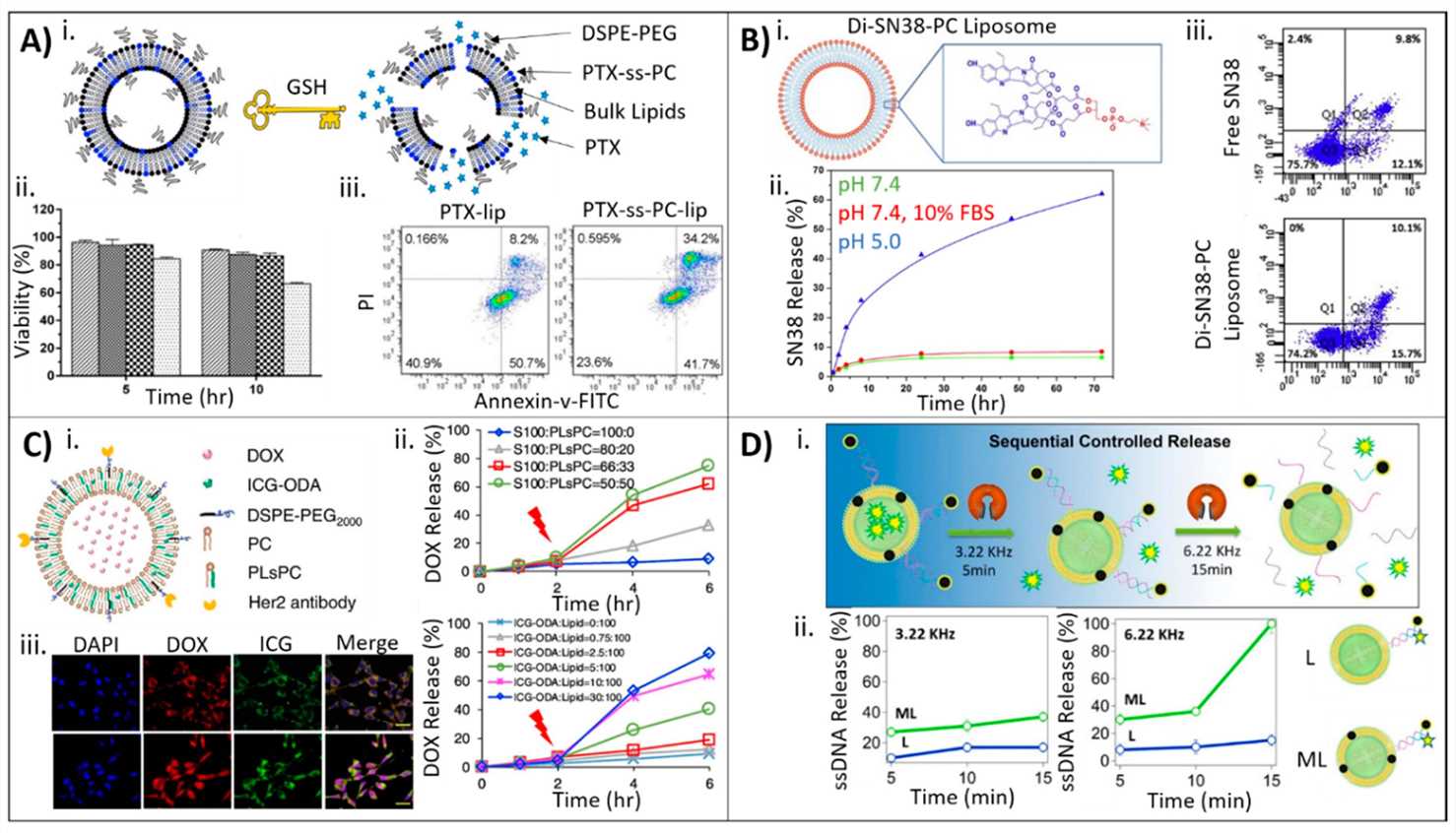 Figure 1 Examples of liposome–drug systems that incorporate drugs using covalent bioconjugation or a combination of bioconjugation methods.1
Types of Bioconjugation
Protein & Antibody Related Conjugation
Protein or antibody coupling involves linking proteins or antibodies with other molecules such as drugs, fluorescent groups, or nanoparticles for targeted therapy and diagnostic applications. This area focuses on chemically linking proteins, including antibodies, to other molecules like drugs, labels, or solid supports, to create bioconjugates with enhanced functions for diagnostics, therapeutics, or research applications, or research applications.
Nucleic Acids Related Conjugation
Nucleic acid/oligonucleotide binding requires connecting nucleic acids or oligonucleotides to various entities, including proteins, lipids, or small molecules, to enhance their stability, delivery.
Lipid Related Conjugation
Lipid related binding involves connecting lipids to other molecules, such as proteins, carbohydrates, or drugs, to alter their solubility, membrane interactions, or biological targeting abilities.
Small Molecule Related Conjugation
Small molecule conjugation refers to the chemical connection between small molecules and larger biomolecules such as proteins or polymers, in order to alter their properties or enhance their biological activity.
Bacterial associated conjugation is a process in which genetic material is transferred between bacterial cells through direct contact, typically mediated by plasmids, and plays a critical role in bacterial evolution.
Basics of Bioconjugation Techniques
- When an amino group reacts with a carboxylic acid, amide bonds are formed between amino acids to form peptides or proteins. This type of bond is stable over a wide pH and temperature range and is used in pharmaceuticals and nanoparticle mediated drug delivery.
- The thiol maleimide reaction is commonly used to modify the thiol groups of cysteine residues in proteins to produce functional therapeutic agents, namely ADCs. Due to the limited availability of cysteine residues, the reaction exhibits selectivity and uniformity.
- Click on chemistry, such as CuAAC copper catalyzed azide alkyne cycloaddition reactions, where alkynes and azides form rings during the cycloaddition process, requiring copper to tightly bound the two compounds together. For example, this method is used for polymer synthesis and protein drug conjugates. This reaction has high selectivity, but due to the toxicity of copper, it cannot be used for living cells, tissues, or organisms.
Challenges and Considerations of Bioconjugation
The constituents of a bioconjugate are joined through a group that engages the reactive functional groups of the component molecules. The amino acid residues lysine and cysteine are preferred reactive sites for conjugation on proteins. The high relative abundance of lysine and cysteine in proteins, however, can lead to heterogeneity in the number and location of conjugation sites on a protein, which can in turn disrupt the natural protein function, thus decreasing the efficacy of the resulting bioconjugate. Site-specific bioconjugation techniques allow for the control of protein conjugates in terms of structure and function. By assuring that the covalent attachment is made exclusively at the desired site, site-specific bioconjugation prevents undesired changes to the biomolecule which can otherwise be deleterious to its function.
Advantages of Bioconjugation

Targeting Specific Tissues/Cells
Conjugation of proteins/peptides to nanoparticles/drugs/imaging agents to target specific tissues/cells can be used, often in conjunction with methods to increase signal/noise ratio or decrease off-target interactions.

Enhance Therapeutic Index with Bioconjugation
Drug molecules can be conjugated to a biomolecule such that they remain inactive prior to uptake by target host cells. Drugs are thereby protected from degradation prior to uptake by target host cells. By protecting the drug from degradation, the half-life can be extended, and dosage can be reduced. Hydrophilic biomolecules may be attached to increase the solubility of a drug, thereby enhancing circulation and absorption of injectable or orally administered drugs.

Achieve Biocompatibility through Bioconjugation
By using biomolecules in functional enhancement ensures that the targeted therapeutic or diagnostic method is not cytotoxic to live, healthy cells. Therefore, bioconjugation provides an opportunity to visualize and track molecular interactions in live cells in real-time.
Applications of Bioconjugation
Bioconjugation in Cancer Treatment
In therapy, bioconjugation is used to attach therapeutic agents (cell toxins) to antibodies that can specifically target tumor associated antigens on cancer cells. These ADCs are selectively absorbed by tumor cells, and cytotoxins play a role in tumor cells. Polysaccharides, such as mucins, are excellent targets because they exhibit chemical differences between tumor cells and healthy cells. Antibodies can be radiolabeled to track and ensure delivery to the target. Therapeutic ADC is being developed, for example for breast cancer, lymphoma, lung cancer, cancer and stomach cancer.
Bioconjugation in ELISA
Biocoupling also has an important application in enzyme-linked immunosorbent assay (ELISA), it can produce detectable reagents and also enhance the quantification of the target molecule. The main method used in ELISA is to use an enzyme that is bound to an antibody (generally horseradish peroxidase or alkaline phosphatase). This enzyme-antibody conjugate will eventually produce a quantifiable signal (generally color change, luminescence, fluorescence) by the addition of a specific substrate. The intensity of the signal is directly or inversely proportional to the amount of the target analyte.
Bioconjugation in Protein Research and Detection
In protein research, biotin is the most widely used detection tag in protein detection and separation studies. The binding of biotin to antibodies and cell surface receptors can be used to highly enhance detection signals, as streptavidin has a high affinity for biotin and can replace secondary detection antibodies. In protein research, biological conjugation is used to create fusion proteins and study the interactions between proteins. These protein units are produced through gene fusion, enzyme mediated binding, or chemical linkage (such as click chemistry). Fusion proteins can function as a single unit.
General Reaction Conditions of Bioconjugation
- In many applications, it is necessary to maintain the natural structure of protein complexes, so crosslinking is usually carried out under conditions close to physiology. The optimal molar ratio of crosslinking agent to protein in the reaction must be determined through experiments, although product manuals for individual reagents typically include guidelines and recommendations for common applications.
- The degree of conjugation is an important factor depending on the application. For example, in the preparation of immunogenic conjugates, a higher degree of conjugation is required to increase the immunogenicity of the antigen. However, when bound to antibodies or enzymes, low to moderate binding may be the best choice to preserve the biological activity of the protein.
- The number of functional groups on the surface of proteins is also an important factor to consider. If there are a large number of target groups, a lower ratio of crosslinking agent to protein can be used. For a limited number of potential targets, a higher ratio of crosslinking agent to protein may be required. In addition, the number of components should be kept at a low or minimum level, as conjugates composed of two or more components are difficult to analyze and provide limited information on the spatial arrangement of protein subunits.
Overview of What Creative Biolabs Can Provide
Creative Biolabs can link two or more biomolecules, such as proteins, nucleic acids, carbohydrates, or small molecules, which is fundamental to a vast array of applications, from diagnostics and therapeutics to advanced materials science and fundamental biological research. If you are interested in our bioconjugation services, please feel free to contact us for more details.
Recommended products
Reference
- Almeida B, Nag O K, Rogers K E, et al. Recent progress in bioconjugation strategies for liposome-mediated drug delivery. Molecules, 2020, 25(23): 5672.https://doi.org/10.3390/molecules25235672. Distributed under Open Access license CC BY 4.0, without modification.