Why Complement Multiplex Assay Matters
The complement system is not a single linear cascade. It is a dynamic immune surveillance network that involves the classical, lectin, and alternative pathways, each of which can converge, amplify, and regulate downstream effector mechanisms. In many research and drug development programs, measuring one complement component alone is not sufficient. Traditional single-analyte ELISA methods remain valuable for targeted confirmation, but multiplex assays provide higher information density, lower sample consumption, better cross-analyte comparability, and stronger translational utility.
We develop and execute customized multiplex panels that can measure complement activation fragments, intact complement proteins, pathway-specific markers, soluble terminal complement complex, complement regulators, immune mediators, and disease-relevant biomarkers in parallel. A multiplex assay enables researchers to ask more sophisticated questions, such as:
-
Is complement activation occurring through the classical, lectin, alternative, or terminal pathway?
-
Does a therapeutic antibody trigger C1q engagement, C3 cleavage, C5 activation, or terminal complement complex formation?
-
Does a complement inhibitor block upstream activation, amplification, C5 cleavage, or MAC formation?
-
Are disease samples characterized by elevated anaphylatoxins, opsonins, terminal pathway markers, or regulatory imbalance?
-
Do nanoparticles, viral vectors, exosomes, engineered cells, or biomaterials induce broad complement activation signatures?
-
Can complement biomarkers be integrated with cytokines, chemokines, Fc receptor readouts, or cell-based functional assays?
Creative Biolabs helps clients move beyond isolated readouts. Our complement multiplex strategy can integrate pathway biology, assay feasibility, sample matrix considerations, species compatibility, biomarker stability, statistical design, and downstream interpretation into one coherent workflow.
Great Minds Choose Creative Biolabs
Assay Formats
Creative Biolabs offers multiple multiplex assay formats and can recommend the most suitable platform based on analyte selection, sample volume, dynamic range, sensitivity requirements, species, throughput, and data interpretation goals.
|
Assay Formats
|
Descriptions
|
Ideal for
|
|
Bead-Based Multiplex Immunoassay
|
Bead-based multiplex assays are highly suitable for simultaneous quantification of multiple soluble analytes. Distinct bead regions are coupled with analyte-specific capture reagents, allowing parallel detection of several complement components or activation products in a single well.
|
-
Serum and plasma biomarker profiling
-
Broad complement activation panels
-
Cytokine-complement combination panels
-
Preclinical and translational studies
-
Medium- to high-throughput sample testing
-
Limited-volume sample sets
|
|
Electrochemiluminescence-Based Multiplex Assay
|
Electrochemiluminescence platforms can offer high sensitivity, broad dynamic range, and robust performance in complex matrices. They are particularly useful when sample volume is limited or when low-abundance analytes must be measured with strong signal-to-background performance.
|
-
Pharmacodynamic biomarker panels
-
Low-abundance complement fragments
-
Translational assay development
-
High-sensitivity inflammatory marker integration
|
|
Planar Microarray or Custom Array Format
|
For exploratory biomarker discovery or broad immune profiling, planar array formats may be useful. These platforms allow screening of a wider marker space and can help identify analyte combinations for later focused assay development.
|
-
Discovery-phase complement biomarker studies
-
Broad immune profiling
-
Panel narrowing and biomarker prioritization
|
|
Customized Hybrid Workflow
|
Some complement projects require more than one assay format. For example, a multiplex panel may detect soluble markers, while flow cytometry evaluates cell-bound C3b/iC3b and ELISA confirms a key analyte. Creative Biolabs can create hybrid workflows that combine multiplex testing with orthogonal confirmation assays.
|
Common combinations include:
-
Multiplex complement panel + C3b deposition assay
-
Multiplex complement panel + C1q binding assay
-
Multiplex complement panel + CH50/AH50
-
Multiplex complement panel + CDC assay
-
Multiplex complement panel + sC5b-9 ELISA
-
Multiplex complement panel + cytokine release assay
-
Multiplex complement panel + flow cytometry opsonization assay
|
Design Your Protocol
Sample Requirements
Sample requirements vary depending on the selected platform, analyte number, matrix, species, and replicate design. The following guidelines are provided for planning purposes.
|
Sample
|
Requirements
|
|
Serum
|
-
Preferred for many complement activation studies
-
Fresh frozen samples are recommended
-
Avoid repeated freeze-thaw cycles
-
Provide collection, processing, storage, and freeze-thaw history when available
|
|
Plasma
|
-
Citrate plasma may be suitable for selected complement studies
-
EDTA plasma may be useful for measuring stabilized pre-existing analytes but is not ideal for activation-dependent assays
-
Heparin plasma requires project-specific feasibility assessment
-
Anticoagulant type must be documented
|
|
Cell Culture Supernatant
|
-
Clarify by centrifugation before freezing
-
Avoid debris and repeated freeze-thaw cycles
-
Provide culture conditions, stimulation conditions, time points, and treatment details
-
Concentration ranges may differ from serum or plasma and may require optimization
|
|
Tissue Lysate
|
-
Use compatible lysis buffer whenever possible
-
Avoid detergents or additives that interfere with antibody binding
-
Provide protein concentration when available
-
Normalization strategy should be defined before testing
|
|
Cerebrospinal Fluid, Ocular Fluid, and Other Limited-Volume Matrices
|
-
Low-volume assay planning is available
-
Pre-study feasibility may be recommended
-
Sample dilution and sensitivity requirements should be discussed in advance
-
Prioritize focused panels when sample volume is highly limited
|
|
Test Articles, Biologics, or Biomaterials
|
Creative Biolabs can help define incubation conditions, serum source, concentration range, time course, and downstream multiplex panel design.
|
Design Your Customization
Case Studies
Case 1
Detection of complement activation using a novel multiplex suspension assay
This study aimed to investigate the activation of the complement system in OSCC patients as potential biomarker. Therefore, an innovative complement activation array was developed. Characterized antibodies detecting the complement activation specific epitopes C3a, C5a and sC5b-9 along with control antibodies were implemented into a suspension bead array. Human serum were used to investigate the role of complement activation in oral tumor progression. The novel multiplex assay detected C3a, C5a and sC5b-9 from a minimal sample volume of human tears, aqueous humor and blood samples.
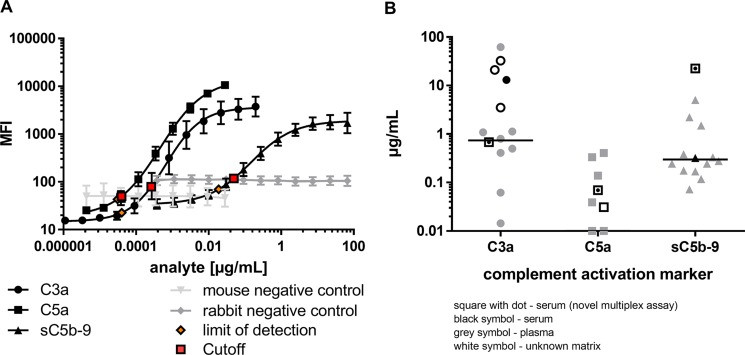 Fig. 1 Complement activation markers were simultaneously and sensitively quantified in the multiplex system.1,2
References
-
Gallenkamp, Juliane, et al. "A novel multiplex detection array revealed systemic complement activation in oral squamous cell carcinoma." Oncotarget 9.3 (2017): 3001. https://doi.org/10.18632/oncotarget.22963
-
Distributed under Open Access license CC BY 3.0, without modification.
Frequently Asked Questions
How do I choose the right analytes for a complement multiplex panel?
The best analytes depend on your scientific question. If you are studying classical pathway activation by antibodies, markers such as C4a, C4d, C3a, C5a, and sC5b-9 may be useful. If alternative pathway amplification is central, Bb, Ba, C3 fragments, and terminal pathway markers may be prioritized. For therapeutic inhibitor studies, analytes should be selected based on the drug target and expected mechanism.
What sample type is best for complement multiplex assays?
Serum is commonly used for complement biomarker profiling, but plasma and other matrices may also be suitable depending on the analytes and study design. For activation-dependent studies, anticoagulants and sample processing conditions matter greatly. EDTA can prevent ex vivo complement activation but may not be suitable when the goal is to measure activation capacity. We recommend discussing sample collection and handling before starting a study.
How much sample volume is required?
Sample volume depends on the number of analytes, platform, matrix, dilution factor, replicate design, and need for repeat testing. Focused panels may require only small volumes, while broad panels or confirmatory workflows require more.
Can complement multiplex assays be used for drug screening?
Yes. Multiplex assays are useful for ranking complement inhibitors, antibody candidates, formulation variants, delivery systems, and biomaterials. They can reveal whether a candidate blocks or induces specific complement activation steps and can be paired with functional assays for deeper interpretation.
Are multiplex results equivalent to ELISA results?
Multiplex assays and ELISA can both provide valuable quantitative information, but they may differ in antibody pairs, calibrators, dynamic range, matrix effects, and sensitivity. For critical biomarkers, multiplex findings may be confirmed by ELISA or another orthogonal method. Creative Biolabs can recommend confirmation strategies when needed.
What will be included in the final report?
The final report can include study objectives, sample information, assay platform, analyte list, methods, standard curve performance, QC summary, concentration data, normalized data, figures, statistical summaries, pathway-level interpretation, and recommendations for follow-up studies. Raw and processed data tables can also be provided.