Creative Biolabs is offering the most comprehensive services for antibody development projects. With strict regulation and effective execution, we are dedicated to providing the most valuable solutions to complete your projects.
HighlightsCreative Biolabs is offering the most comprehensive services for antibody development projects. With strict regulation and effective execution, we are dedicated to providing the most valuable solutions to complete your projects.
HighlightsCreative Biolabs has established a broad range of platforms for developing novel antibodies or equivalents. These cutting-edge technologies enable our scientists to meet your demands from different aspects and tailor the most appropriate solution that contributes to the success of your projects.
HighlightsWith deep understanding in antibody-related realms and extensive project experience, Creative Biolabs offers a variety of references to help you learn more about our capacities and achievements, including infographic, flyer, case study, peer-reviewed publications, and all kinds of knowledge that can assist your projects. You are also welcome to contact us directly for more specific solutions.
HighlightsGet a real taste of Creative Biolabs, one of the most professional custom service providers in the world. We are committed to providing highly customized comprehensive solutions with the best quality to advance your projects.
Highlights Loading...
All listed services and products are For Research Use Only. Do Not use in any diagnostic or therapeutic applications.
C-C motif chemokine receptor 3 (CCR3), also known as CD193, is a 355 amino acid, seven-transmembrane GPCR that is the dominant eosinophil chemotactic receptor. At last, the receptor topology follows the dominant GPCR architecture: an extracellular N-terminal domain, three extra-cellular loops (ECL1–ECL3), seven α-helical trans-membrane segments (TM1–TM7), three intracellular loops (ICL1–ICL3) and an intracellular C-terminal tail. Such membrane topology forms the structural basis for multiple chemokine ligands convergence to evoke downstream signaling. CCR3 is expressed on eosinophils, which allows this receptor to act as a primary gatekeeper for eosinophil trafficking into tissues due to its remarkably high density of expression; estimated at 40,000–50,000 receptors per cell. In addition to eosinophils, CCR3 is expressed on basophils, subsets of mast cells, Th2 lymphocytes, dendritic cells and airway epithelial cells. This pattern of expression places CCR3 at the center of type 2 inflammation. In allergic asthma, bronchi polise and epithelium CCR3 transcript and protein levels are increased and genetic ablation of CCR3 leads to abolition of 30-70% allergen-induced airway eosinophilia in murine models. CCR3-mediated cell recruitment drove pathogenesis in eosinophilic esophagitis, age-related macular degeneration and select malignancies; therapeutic interest has since broadened into these areas.
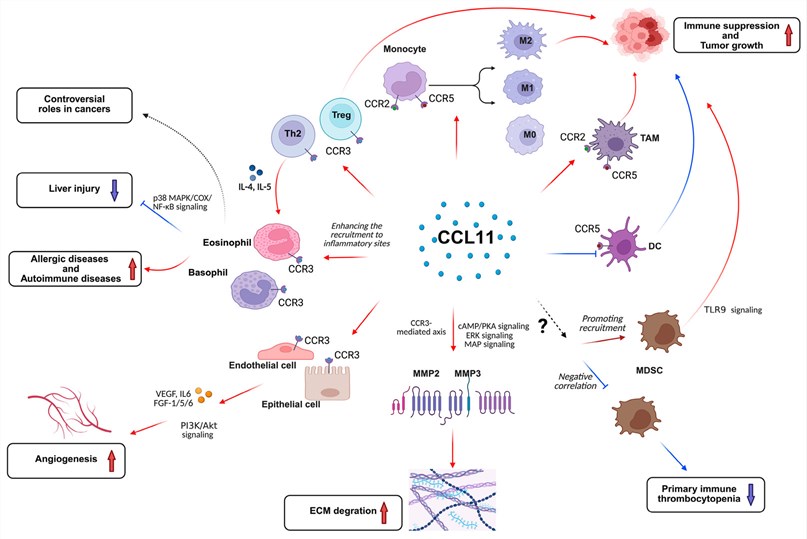 Fig.1 Schematic representation of CCL11 signaling mechanisms in immune regulation and disease pathogenesis.1
CCR3 serves an important physiological and pathological functional sphere:
The broad hydrophobic transmembrane core of the receptor presents challenges to both structural and pharmacological studies that have rendered conventional soluble expression strategies largely ineffective. To meet this need, Creative Biolabs has developed a custom CCR3 protein design platform, specifically with the goal of producing conformationally intact receptor preparations suitable for multiple downstream research applications. We apply our unique multidisciplinary skills in the areas of structural biology, membrane protein biochemistry and high-throughput expression screening to select constructs that maximize yield, stability and pharmacological fidelity. We understand that each downstream application has unique demands for protein structure, so every project begins by collaborating with you to ensure that the construct design aligns with your experimental needs.
Not finding the membrane protein product you need? Contact us to start your one-stop custom service!
Cell lines that express native functional CCR3 on the plasma membrane are crucial for assays with ligands, antibody screening and pathways modulation experiments. Engineered ACCR3 stable cell lines using optimized protocols for transduction and selection with a focus on achieving homogeneous, long-term receptor expression. Cell engineering platform is based on lentiviral delivery, transposon-mediated integration and targeted knock-in strategies for accurate genetic control. There are multiple rounds of monoclonal selection to ensure clonal purity and it is phenotypically validated with receptor density, confirming both surface level expression and functional responsiveness in assays with eotaxin stimulation. Therefore, this generous qualification pipeline standardises a transient transfection system that eliminates the variability typically associated with cell models and affords you an assurance from which to pursue longitudinal studies and high-throughput screening campaigns.
Not finding the stable cell line product you need? Contact us to start your one-stop custom service!
Antibodies recognizing CCR3 extracellular epitopes are an attractive therapeutic option as small-molecule antagonists of CCR3 have been unsuccessful in the clinic to date in eosinophil-mediated diseases. Creative Biolabs has end-to-end programs for recombinant antibody discovery against conformational and linear CCR3 epitopes. Our antibody development process, consisting of immunogen design, multi-platform selection and downstream engineering seamlessly integrated to yield binders with required specificity and affinity while remaining within developability profiles suitable for research use. Using recombinant expression and clonal sequencing, we remove the batch-to-batch variation of traditional polyclonal sera, providing a renewable fully characterised reagent, with consistent results across experiments and sites.
Not finding the recombinant antibody product you need? Contact us to start your one-stop custom service!
In addition to catalog products, Creative Biolabs provides cutting-edge discovery services that meet CCR3 research needs in all areas. These advanced capabilities are intended for investigators seeking mechanistic detail requiring custom reagents, complex assay architectures, or multi-component integrated workflows:
No, reagents/services are for research use only and not for diagnostic or therapeutic purposes.
Yes, we may help you create multi-stable lines that constitutively express full-length CCR3 along with a Gαi-based biosensor and a fluorescent calcium indicator from separate loci. CCL11-stimulated fluorescence responses and receptor internalization assays are performed to qualify each batch, allowing a reproducible and uninterrupted profiling of compounds for signaling studies as transient transfection is not repeated.
Yes, selected clones have been confirmed on archival specimens after antigen retrieval and showed pattern of membrane staining consistent with distribution of inflammatory infiltrate & epithelial cells. Epitope specificity across different tissues is further confirmed by validation of targets with peptide competition and recombinant antigen controls.
Yes, we supply recombinant proteins and stable cell lines expressing documented variants with targeted alterations in the ligand-binding pocket or intracellular loops. These materials serve as critical controls for dissecting chemokine recognition from downstream signal transduction.