Creative Biolabs is offering the most comprehensive services for antibody development projects. With strict regulation and effective execution, we are dedicated to providing the most valuable solutions to complete your projects.
HighlightsCreative Biolabs is offering the most comprehensive services for antibody development projects. With strict regulation and effective execution, we are dedicated to providing the most valuable solutions to complete your projects.
HighlightsCreative Biolabs has established a broad range of platforms for developing novel antibodies or equivalents. These cutting-edge technologies enable our scientists to meet your demands from different aspects and tailor the most appropriate solution that contributes to the success of your projects.
HighlightsWith deep understanding in antibody-related realms and extensive project experience, Creative Biolabs offers a variety of references to help you learn more about our capacities and achievements, including infographic, flyer, case study, peer-reviewed publications, and all kinds of knowledge that can assist your projects. You are also welcome to contact us directly for more specific solutions.
HighlightsGet a real taste of Creative Biolabs, one of the most professional custom service providers in the world. We are committed to providing highly customized comprehensive solutions with the best quality to advance your projects.
Highlights Loading...
All listed services and products are For Research Use Only. Do Not use in any diagnostic or therapeutic applications.
CUB domain-containing protein 1 (CDCP1), encoded by the CDCP1 gene on chromosome 1p34.2 and also known as CD318 or Trask, is a glycosylated type I transmembrane protein. The deduced 836-amino-acid protein contains an N-terminal signal peptide, three extracellular CUB domains (C1r/C1s, Uegf, Bmp1)—protein interaction modules commonly found in proteins involved in development and cell adhesion—a single transmembrane region, and a cytoplasmic tail. The mature protein contains two CUB domains, a consensus type-1 palmitoylation motif, and five PxxP motifs that mediate binding to Src homology-3 (SH3) domains. CDCP1 is expressed in various tissues and cell types, including fibroblasts, and has been detected in hematopoietic stem cell subsets. The extracellular CUB domains participate in protein-protein interactions relevant to cell communication and adhesion, whereas the intracellular domain serves as a substrate for Src family kinases.
CDCP1 acts as a tyrosine phosphorylation-dependent signaling platform that converts extracellular signals into intracellular responses. Upon phosphorylation by Src family kinases at specific tyrosine residues in its cytoplasmic domain, CDCP1 recruits and activates downstream effectors such as protein kinase C delta (PKCδ). This CDCP1–PKCδ signaling axis has been reported to inhibit autophagy, contributing to anoikis resistance in certain cellular contexts. CDCP1 also associates with tetraspanin-enriched microdomains (TEMs) and interacts with tetraspanins like CD9; its phosphorylation status changes in response to dissociation of integrin α6β4 from laminin-5. These features make CDCP1 a valuable research target for studies of cell adhesion dynamics, Src family kinase signaling, tetraspanin web organization, and the molecular basis of anchorage-independent survival and cell migration.
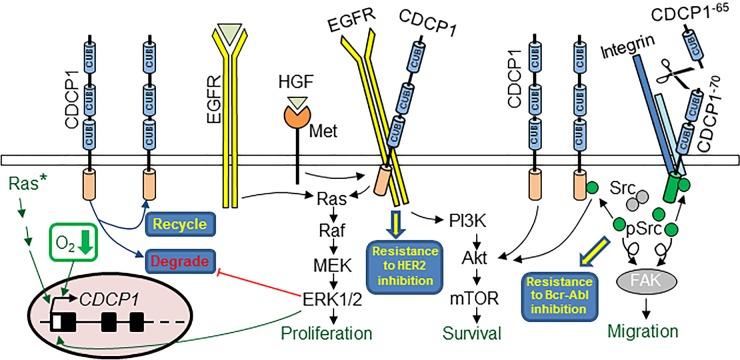 Fig. 1 CDCP1 promotes cancer cell proliferation (generally under non-adherent conditions), survival and migration, and mediates resistance to chemo- and targeted-therapies.1
CDCP1, encoded by the CDCP1 gene, functions as a transmembrane signaling molecule that integrates Src family kinase-dependent signaling with cell adhesion dynamics:
Creative Biolabs offers high-quality CDCP1 membrane protein products produced using optimized expression systems. These include full-length type I transmembrane protein that retains the native membrane-spanning domain and cytoplasmic tail, as well as isolated extracellular domain variants containing the CUB domains. The extracellular CUB domains mediate protein-protein interactions involved in cell adhesion and communication, making these proteins suitable for studies of CDCP1 interaction networks, tetraspanin web assembly, and adhesion-related signaling. All CDCP1 proteins undergo strict quality control to support consistent performance across applicable research platforms.
Not finding the protein product you need? Contact us to start your one-stop custom service!
Creative Biolabs provides custom-engineered CDCP1 stable cell lines, including overexpression and knockdown models. These cell lines are optimized for studies of Src family kinase signaling, cell adhesion dynamics, tetraspanin web organization, and anchorage-independent survival mechanisms. Each cell line undergoes stringent validation to ensure stable expression profiles and consistent functional performance in diverse experimental contexts.
Not finding the stable cell line product you need? Contact us to start your one-stop custom service!
High-specificity recombinant antibodies targeting CDCP1 are developed using antibody engineering technologies for research applications involving CDCP1 expression, localization, and protein-protein interaction studies. These antibodies can be used in studies of CDCP1 distribution in relevant cell and tissue models and may also support characterization of CDCP1-containing tetraspanin complexes and signaling assemblies in combination with appropriate detection reagents.
Not finding the recombinant antibody product you need? Contact us to start your one-stop custom service!
Beyond catalog products, Creative Biolabs offers specialized custom services for CDCP1 research: