
Creative Biolabs is offering the most comprehensive services for antibody development projects. With strict regulation and effective execution, we are dedicated to providing the most valuable solutions to complete your projects.
HighlightsCreative Biolabs is offering the most comprehensive services for antibody development projects. With strict regulation and effective execution, we are dedicated to providing the most valuable solutions to complete your projects.
HighlightsCreative Biolabs has established a broad range of platforms for developing novel antibodies or equivalents. These cutting-edge technologies enable our scientists to meet your demands from different aspects and tailor the most appropriate solution that contributes to the success of your projects.
HighlightsWith deep understanding in antibody-related realms and extensive project experience, Creative Biolabs offers a variety of references to help you learn more about our capacities and achievements, including infographic, flyer, case study, peer-reviewed publications, and all kinds of knowledge that can assist your projects. You are also welcome to contact us directly for more specific solutions.
HighlightsGet a real taste of Creative Biolabs, one of the most professional custom service providers in the world. We are committed to providing highly customized comprehensive solutions with the best quality to advance your projects.
Highlights Loading...
All listed services and products are For Research Use Only. Do Not use in any diagnostic or therapeutic applications.
IL23R is a type I transmembrane glycoprotein belonging to the class I cytokine receptor superfamily, with the full-length core polypeptide having an estimated molecular weight of approximately 70 kDa that can increase after N-linked glycosylation. This receptor heterodimerizes with IL12Rβ1 to form an active receptor complex on the surface of Th17 cells, innate lymphoid cells, macrophages, dendritic cells, and activated natural killer cells. IL-23 is a heterodimeric cytokine composed of a unique p19 subunit and the common p40 subunit shared with IL-12 that engages this receptor complex. IL23R ligation activates the receptor-associated kinases JAK2 and TYK2, leading to phosphorylation of receptor-associated signaling components and downstream STAT proteins. STAT3 is a major mediator of IL-23 signaling, with STAT4 also contributing in a cell-type-dependent manner. Activated STAT3 and STAT4 translocate to the nucleus and regulate transcriptional programs that promote the expression of effector molecules including IL-17A, IL-17F, IL-22, and granulocyte-macrophage colony-stimulating factor (GM-CSF).
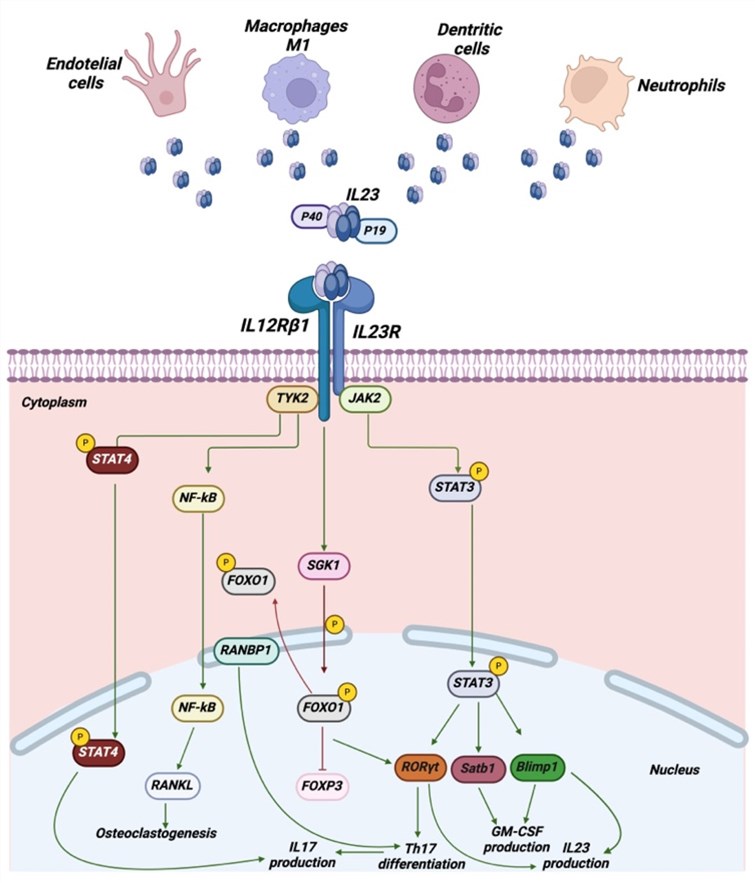 Fig.1 Signaling by IL-23R.1
IL23R biological function permeates several interconnecting physiological and pathological networks:
Psoriasis and Cutaneous Inflammation: The IL-23/IL-17 axis is currently recognized as a major pathway involved in plaque psoriasis pathogenesis. Experimental intradermal injection of IL-23 in wild-type mice induces epidermal hyperplasia, erythema, and inflammatory infiltrates that resemble key features of human psoriatic lesions.
Advance your cytokine receptor research with our recombinant IL23R protein offerings for autoimmune disease research. The type I transmembrane topology, extensive disulfide bonding, and glycosylation-dependent folding of IL23R present particular production challenges. With these considerations in mind, appropriate expression and formulation strategies can be selected to produce IL23R constructs suitable for different research applications. Available research formats may include membrane-associated receptor constructs and soluble extracellular domain (ECD) proteins, while receptor complex formats can be evaluated according to specific product availability and project requirements. Expression systems, construct design, and characterization strategies are selected according to the intended protein format and application. These preparations can be characterized using appropriate biochemical and biophysical methods to support structural studies, ligand-binding assays, and antibody screening.
Not finding the membrane protein product you need? Contact us to start your one-stop custom service!
Development of reliable, reproducible cellular models unequivocally dissecting IL23R-driven biology is important for testing therapeutic candidates. We have cationic stable cassette generating methods for the co-expression of wild-type or disease-related human, mouse and rat IL23R forms alongside a symmetrical loss-of-function modulated endogenous expression assay. They are additionally amenable to use with high-throughput IL-23 neutralization assays, Th17 differentiation studies, STAT3 reporter gene analysis and cytokine profiling thus providing the experimental reproducibility requisite for multi-phase research priorities in parallel.
Not finding the stable cell line product you need? Contact us to start your one-stop custom service!
Our comprehensive portfolio includes high-affinity recombinant antibodies against IL23R developed to our high standards for any of your research needs. Compared with traditional polyclonal antibodies, these next-generation recombinant-derived monoclonal antibodies exhibit superior specificity, sensitivity and batch-to-batch consistency. Each of our IL23R recombinant antibodies is validated for WB/ ELISA/ FCM/ IF/ ICC/ IHC (mouse, rat, monkey), specificity detection in various samples (such as T-cell lysates, tissue section from psoriatic plaques and intestinal biopsies).
Not finding the recombinant antibody product you need? Contact us to start your one-stop custom service!
In addition to our catalogue products, we supply custom services for your membrane protein and antibody discovery and development needs. Drawing upon our deep knowledge of cytokine receptor biology and autoimmune disease pharmacology, we can help you with:
No, IL23R products and services are offered for research purposes only, not intended for clinical diagnosis, prevention, treatment or cure of any disease.
Absolutely. Our cell engineering team routinely generates tetracycline-inducible systems and lines co-expressing IL23R with IL12RB1, JAK2, TYK2, or STAT3 reporter constructs for comprehensive pathway analysis. We welcome detailed discussions regarding your preferred expression architecture and phenotypic requirements.
Our catalog includes human, mouse, and rat IL23R reagents. Custom production of additional orthologs or engineered mutants—including the protective R381Q variant, JAK2-binding deficient mutants, and domain-specific truncations—can be arranged upon request.
We offer a range of products including recombinant full-length IL23R, soluble extracellular domain (exIL-23R), IL23R-IL12RB1 heterodimeric complexes, stable cell lines expressing IL23R or its signaling components, and high-quality recombinant IL23R antibodies, along with comprehensive custom services.








