
Creative Biolabs is offering the most comprehensive services for antibody development projects. With strict regulation and effective execution, we are dedicated to providing the most valuable solutions to complete your projects.
HighlightsCreative Biolabs is offering the most comprehensive services for antibody development projects. With strict regulation and effective execution, we are dedicated to providing the most valuable solutions to complete your projects.
HighlightsCreative Biolabs has established a broad range of platforms for developing novel antibodies or equivalents. These cutting-edge technologies enable our scientists to meet your demands from different aspects and tailor the most appropriate solution that contributes to the success of your projects.
HighlightsWith deep understanding in antibody-related realms and extensive project experience, Creative Biolabs offers a variety of references to help you learn more about our capacities and achievements, including infographic, flyer, case study, peer-reviewed publications, and all kinds of knowledge that can assist your projects. You are also welcome to contact us directly for more specific solutions.
HighlightsGet a real taste of Creative Biolabs, one of the most professional custom service providers in the world. We are committed to providing highly customized comprehensive solutions with the best quality to advance your projects.
Highlights Loading...
All listed services and products are For Research Use Only. Do Not use in any diagnostic or therapeutic applications.
Interleukin-6 signal transducer (IL6ST) referred to as glycoprotein 130, gp130 or CD130 is a approximately 130 kDa type I transmembrane glycoprotein, and was the first identified member of the cytokine receptor superfamily. Biological functionarily, IL6ST is well known as a super promiscuous shared signal-transducing receptor subunit. It is an essential signaling component of at least nine different cytokine receptor complexes that signal through the gp130 receptor include IL-6, IL-11, IL-27, oncostatin M (OSM), leukemia inhibitory factor (LIF), ciliary neurotrophic factor CNTF; cardiotrophin 1 CT-1 and cardiotrophin-like cytokine factor–1 CLCF1. Each cytokine targets a ligand-receptor-specific alpha or beta receptor subunit but all encode protein in the pathway that requires gp130 to transduce cellular signals into the cytoplasm. Cytokine-dependent homodimerization of gp130 or heterodimerization with co-receptors such as LIFR or OSMR for the other family members. Such combinatorial flexibility permits a single receptor subunit to coordinate distinct biological pathways from immune cell differentiation and hepatic acute-phase responses in myeloid cells, to neuronal survival and cardiac homeostasis.
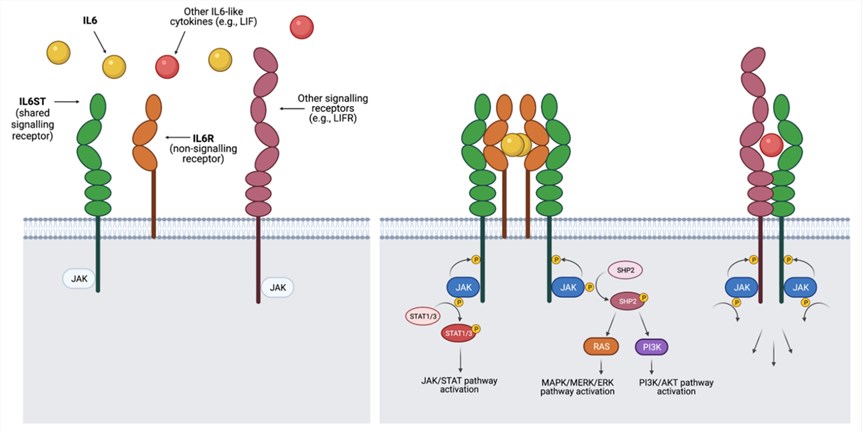 Fig.1 Summary of signalling by cytokines in the IL6-like family.1
IL6ST functionally lies at the nexus of multiple interrelated physiological and pathological areas:
We are aware that four features of the six-domain extracellular architecture (extensive glycosylation, required for homodimeric and heterodimeric complex assembly) provide a significant challenge for production. To overcome these, we use flexible expression platforms (mammalian HEK293 cells, insect cell systems and novel lipid-based formulations), to provide precavitation at milligram scale of IL6ST membrane constructs in their correctly folded and fully glycosylated forms that retain both native cytokine-binding affinity and JAK-recruitment competence. We present full-length membrane-bound gp130 plus soluble ectodomain fragments (D1–D6 and D2–D3; as well as disease-associated variants). All preparations are subjected to stringent biophysical validation, for use in structural studies, ligand binding assays and antibody screening.
Not finding the membrane protein product you need? Contact us to start your one-stop custom service!
Reliable, reproducible cellular models are essential to dissect IL6ST biology and evaluate therapeutic candidates. We also offer stable cell lines that have been engineered for over-expression of wildtype or disease-related human, mouse and rat IL6ST (loss-of-function studies with modulated expression of endogenous IL6ST). These platforms have been validated for use in high throughput JAK-STAT reporter assays, Th17 differentiation studies, cytokine signaling pathway characterization and compound screening of gp130 modulators—grouping the experimental reproducibility necessary to yield multi-step data.
Not finding the stable cell line product you need? Contact us to start your one-stop custom service!
We have developed high-affinity recombinant antibodies against IL6ST to fulfil all the rigorous demands in various research applications as a complete package. Unlike conventional polyclonal antibodies, these recombinant technologies allow for the production of highly specific, sensitive and with batch-to-batch constancy. Il6st Recombinant Antibodies: We have validated our recominanant IL6ST antibodies for western blot (WB), ELISA, flow cytometry (FCM), immunofluorescence, ICC (Immunocytochemistry) and IHC in a variety of samples including lymphocyte lysate, hepatocytee preparations from mice with liver injury, inflammatory disease model tissues.
Not finding the recombinant antibody product you need? Contact us to start your one-stop custom service!
In addition to our catalog products, we also provide custom services for membrane protein and antibody discovery and development. Utilizing our years of experience in cytokine receptor biology and JAK-STAT pathway pharmacology, we can help you with:
No, all reagents and services offered are for research use only and not for diagnostic or therapeutic use.
Yes, we have created dual-stable lines that express full-length IL6ST and IL6RA under constitutive expression in independent loci. Surface heterodimer density and IL-6–stimulated STAT3 reporter induction were documented for each batch, creating a well-characterized cellular platform that enables continuous signal transduction study over time using the same cells without involving transient transfection of heterogeneous factors between studies.
Yes, we have generated stable lines in which IL6ST is co-expressed constitutively with oncostatin M receptor or leukemia inhibitory factor receptor (LIF-R) and their respective alpha subunits. Ligand-specific STAT3 versus ERK activation profiles qualify the results of each configuration, allowing comparisons of signal specificity without performing multiple sequential transfections.
Yes, the immunogen sits within a well conserved sequence between mammalian species so detection may reliably be shown in cell preparations and tissue lysates of human, mouse and rat with no need for multiple species specific reagent.








