Creative Biolabs is offering the most comprehensive services for antibody development projects. With strict regulation and effective execution, we are dedicated to providing the most valuable solutions to complete your projects.
HighlightsCreative Biolabs is offering the most comprehensive services for antibody development projects. With strict regulation and effective execution, we are dedicated to providing the most valuable solutions to complete your projects.
HighlightsCreative Biolabs has established a broad range of platforms for developing novel antibodies or equivalents. These cutting-edge technologies enable our scientists to meet your demands from different aspects and tailor the most appropriate solution that contributes to the success of your projects.
HighlightsWith deep understanding in antibody-related realms and extensive project experience, Creative Biolabs offers a variety of references to help you learn more about our capacities and achievements, including infographic, flyer, case study, peer-reviewed publications, and all kinds of knowledge that can assist your projects. You are also welcome to contact us directly for more specific solutions.
HighlightsGet a real taste of Creative Biolabs, one of the most professional custom service providers in the world. We are committed to providing highly customized comprehensive solutions with the best quality to advance your projects.
Highlights Loading...
All listed services and products are For Research Use Only. Do Not use in any diagnostic or therapeutic applications.
NOTCH3 is a single-pass transmembrane receptor protein that belongs to the Notch family of cell surface signaling proteins, its calculated molecular weight is about 256 kDa (for full-length NOTCH3 precursor) or size between 270 kD and 280BD for heterodimeric mature form. In contrast to NOTCH1 and NOTCH2, which are among the most widely expressed genes during development, Notch3 is primarily associated with adult vascular smooth muscle cells (VSMCs) and pericytes as well as its expression in osteoblasts/osteocytes and some epithelial cell populations. The NECD contains 34 EGF-like repeats that mediate ligand binding to neighboring cell surface Delta-like (DLL1, DLL3, DLL4) and Jagged family ligands on neighbouring cells while the NRR blocks ligand-independent activation by shielding the S2 metalloprotease cleavage site from ADAM10/17. Ligand binding induces a structural rearrangement within the NRR, leading to exposure of S2 for cleavage followed by intramembrane γ-secretase-mediated proteolytic (S3) cleavage in the TMD that provides NICD liberation into cytoplasm for nuclear translocation and transcriptional activation of target genes such as HES1, HEY1, HRT1 and HRt2. Distinct structural features of NOTCH3 in contrast to other Notch receptors include 34 instead of 36 EGF-like repeats, a shorter NICD without the tandem nuclear localization sequences present in NOTCH1/2 and an NRR with different packing interactions that give it higher basal sensitivity to proteolysis. We report the high-resolution X-ray crystal structure of NOTCH3 in its autoinhibited conformation, which reveals a conserved dimerization interface between the S2 and HD domains across species (as previously observed for both human and mouse NOTCH1 and for FNDX) as well as hot spots within the heterodimeric core target site. The role of NOTCH3 signaling in maintaining VSMC phenotypic stability as well as arterial structural integrity and vascular tone. The most common monogenic cause of stroke and vascular dementia is cerebral autosomal dominant arteriopathy with subcortical infarcts and leukoencephalopathy (CADASIL), a familial condition caused by mutations in NOTCH3, characterized by an accumulation of granular osmiophilic material (GOM) within the vessel walls as well as aggregates of Notch3 extracellular domain (N3ECDs) on degenerating VSMCs. Outside the domain of vascular disease, NOTCH3 is overexpressed in breast cancer and lung adenocarcinoma where it drives chemoresistance, stem cell maintenance and tumor angiogenesis, further justifying its targeting for antibody–drug conjugates (ADCs) that induce receptor-mediated apoptosis followed by transendocytosis into ligand-expressing cells.
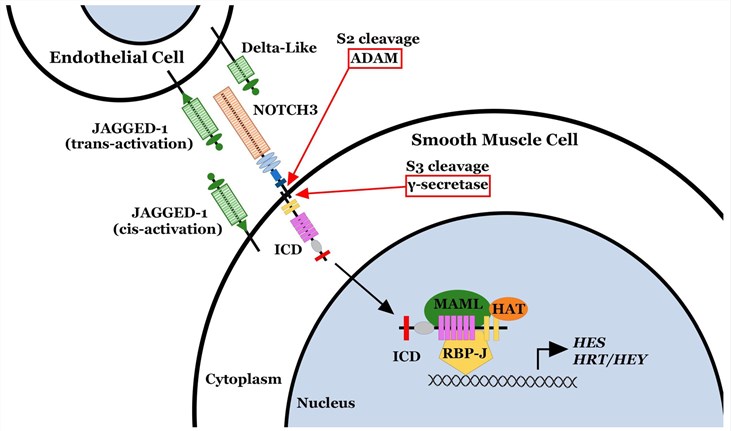 Fig.1 NOTCH3 is activated by the binding of the JAGGED-1 ligand, stimulating the proteolytic S2 cleavage by ADAM of the NOTCH3 extracellular domain (ECD) and intracellular domain (ICD).1
Functional roles of NOTCH3 including vascular development, neuronal protection, and oncogenic signal transduction, relate to limited tissue expression patterns as well as specific structural features:
Creative Biolabs provides a wide range of high-quality NOTCH3 protein products for structural and functional studies of this vascular Notch receptor. Our portfolio may include membrane-associated NOTCH3 proteins and extracellular-domain (ECD) constructs designed to meet different research requirements. These products can support applications including ELISA, antibody production and characterization, ligand-binding assays, structural studies, and investigation of NOTCH3 signaling. They can also be used to study NOTCH3 interactions with ligands such as JAG1 and DLL4, receptor processing, and related vascular signaling mechanisms. Available formats, expression systems, species, and functional characteristics should be determined according to the corresponding product information.
Not finding the membrane protein product you need? Contact us to start your one-stop custom service!
The construction of such reliable cellular models is vital for investigations into NOTCH3. Creative Biolabs designs custom NOTCH3 membrane protein stable cell lines to produce high levels of target (NOTCH3) expression reliably. These stable cell lines provide a basis for drug screening, ligand binding studies, NICD reporter assays, cancer stem-like characterization, and high-throughput screenings in investigating the biology of NOTCH3 and pharmacology. We know how to express and fully characterize transmembrane proteins, ensuring the ideal cell integrity possible in a system that minimizes time-to-next experiment. We provide NOTCH3-overexpressing lines to study ligand-induced activation and cancer stem cell maintenance, as well as NOTCH3-knockdown (loss-of-function) lines validated by flow cytometry, Western blotting, and functional HES1 reporter assays. The unique application of CBF-dependent luciferase or NICD-GFP fusion proteins in specialized reporter cell lines enables real-time tracking of canonical Notch signaling, granting magical powers to cancer models.
Not finding the stable cell line product you need? Contact us to start your one-stop custom service!
We have a large quantity of high-affinity recombinant antibodies against NOTCH3 specifically created to meet the rigorous demands for multiple research approaches. These are made with recombinant technologies for improved specificity, sensitivity and batch to batch performance vs pollyclonal antibodies. Widely validated NOTCH3 recombinant antibodies for WB, ELISA, FCM/ICC/IHC/IP applications to support accurate detection and quantification of NB gene/protein in a variety eyepiece such as VSMC lysates from patient derived tumor biopsy or brain tissue samples obtainedfrom CADASIL patients serum samples. We provide antibodies that target individual NOTCH3 epitopes, including the EGF-like repeats (for ligand competition studies), NRR (to assess inhibition of signaling or cleavage end-point generation by small-molecule inhibitory reagents), HD domain, and NICD proteins for CADASIL mutation tracking in tumor samples as well as assessment of activation state.
Not finding the recombinant antibody product you need? Contact us to start your one-stop custom service!
In addition to our catalog products, we offer bespoke custom services for membrane protein and antibody discovery & development. With our years of experience & modern platforms, we could help you with:
Yes, stable lines have been generated which express full-length NOTCH3 carrying known cysteine missense substitutions by tetracycline induction. This system allows for temporally regulated onset of variant expression and downstream tracking of progressive accumulation of extracellular granular osmiophilic material, Notch signaling inhibition and smooth muscle cell dedifferentiation markers providing a standardized background to study disease pathobiology without the variability introduced by transient overexpression.
No, all reagents and services are for research use only, not for any clinical diagnostic or therapeutic purpose.
Yes the protein is enriched in a specific calcium-containing endotoxin monitored buffer at physiological pH maintaining native EGF-like repeat conformation and heterodimeric integrity of This makes it suitable for immediate use in surface plasmon resonance immobilization, light-scattering aggregation assays and crystallisation trials without requiring buffer exchange, preserving the calcium-dependent folding required to mediate ligand binding and proteolytic regulation.
Absolutely. This service offers a variety of modifications for signaling-inhibitory NRR stabilizers, as well as CADASIL-associated EGF repeat mutants and cysteine-sparing variants (G149V), domain-specific truncations, and tag fusions. Our scientists work closely with clients to create constructs suitable for structural biology, aggregation studies, therapeutic antibody development and assay validation.