
Creative Biolabs is offering the most comprehensive services for antibody development projects. With strict regulation and effective execution, we are dedicated to providing the most valuable solutions to complete your projects.
HighlightsCreative Biolabs is offering the most comprehensive services for antibody development projects. With strict regulation and effective execution, we are dedicated to providing the most valuable solutions to complete your projects.
HighlightsCreative Biolabs has established a broad range of platforms for developing novel antibodies or equivalents. These cutting-edge technologies enable our scientists to meet your demands from different aspects and tailor the most appropriate solution that contributes to the success of your projects.
HighlightsWith deep understanding in antibody-related realms and extensive project experience, Creative Biolabs offers a variety of references to help you learn more about our capacities and achievements, including infographic, flyer, case study, peer-reviewed publications, and all kinds of knowledge that can assist your projects. You are also welcome to contact us directly for more specific solutions.
HighlightsGet a real taste of Creative Biolabs, one of the most professional custom service providers in the world. We are committed to providing highly customized comprehensive solutions with the best quality to advance your projects.
Highlights Loading...
All listed services and products are For Research Use Only. Do Not use in any diagnostic or therapeutic applications.
Platelet Basic Precursor Protein (PPBP, also known as β‑thromboglobulin precursor) is a chemokine precursor encoded by PPBP gene, which is generated during megakaryocyte differentiation and stored inside platelet α‑granule secretory vesicles. This molecule shows tissue‑restricted expression features distinct from immune cell‑derived CXC chemokines, and exists as an inactive precursor form under resting platelet status. After stimulation signals trigger platelet degranulation, PPBP may undergo proteolytic cleavage to produce mature CXCL7 fragments that interact with CXCR2 receptors distributed on neutrophil and endothelial progenitor surfaces, regulating leukocyte migratory behaviors inside tissue microenvironments. Different vascular tissue compartments carry unique sets of signal regulators, requiring platelet‑specific stored chemokines like PPBP to coordinate local immune cell recruitment under injury conditions. Under mild vascular damage conditions, released PPBP fragments may support ordered recruitment of circulating immune cells to injury sites and facilitate regular tissue remodeling progress. Sustained abnormal accumulation of cleaved PPBP molecules may shift the balance of local inflammatory signals and alter the progression of long‑term vascular tissue changes. Other CXC chemokine subtypes cannot fully replicate the platelet‑specific storage and cleavage‑dependent regulatory mode carried by PPBP in laboratory observation systems. Varied PPBP expression levels may correlate with leukocyte recruitment efficiency under vascular injury states, rendering it a valuable research target for platelet related molecular mechanism exploration. Multiple laboratory simulation datasets have recorded changes in immune cell migration linked to altered PPBP abundance under vascular injury environments.
PPBP may be encapsulated inside platelet α‑granule lipid layers and retain inactive precursor conformation before proteolytic processing. Conserved structural segments inside the precursor molecule may shield CXCR2 binding sites until thrombin‑associated cleavage events occur, enabling signal activation only after platelet stimulation. Its megakaryocyte‑restricted synthesis mode separates PPBP from broadly expressed immune chemokines, forming an exclusive signal axis linking platelet activation and vascular immune regulation. PPBP‑associated molecular processes may coordinate platelet secretion activity and sequential immune cell recruitment, balancing acute tissue repair signals and chronic vascular inflammatory signals. Altered functional PPBP expression may change leukocyte aggregation efficiency at damaged vascular sites and adjust tissue remodeling behaviors observable in laboratory research. Therefore, PPBP may serve as a meaningful research object for platelet‑derived CXC chemokine basic studies, focusing on mature CXCL7‑receptor and glycosaminoglycan competitive molecular interactions.
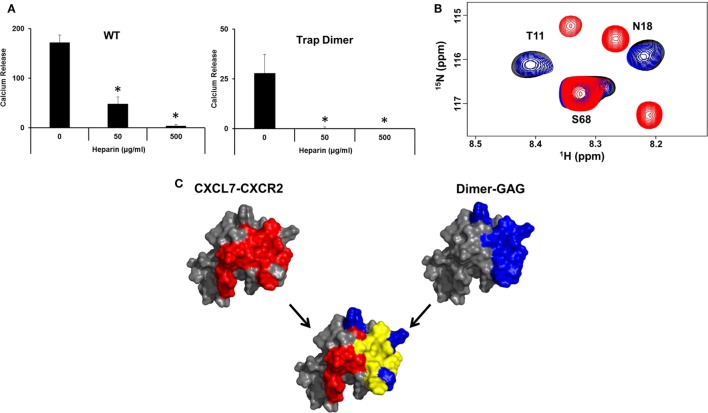 Fig. 1 Functional and structural analysis of mature dimeric CXCL7 (processed PPBP), illustrating competitive binding interfaces for CXCR2 receptor and glycosaminoglycan.1
The biological functions of granule-stored pro-form PPBP precursor are fully focused on post-cleavage CXCR2 binding and vascular inflammatory signal amplification:
Creative Biolabs offers high-quality PPBP proteins through optimized megakaryocyte-mimic expression systems, including full-length pro-PPBP precursor and mature CXCL7 cleavage variants. These products retain native CXCR2 binding chemotactic activity, suitable for platelet activation and anti-atherosclerotic compound screening assays. All PPBP proteins undergo strict quality control to ensure consistent performance and reliable application across cardiovascular research platforms.
Not finding the protein product you need? Contact us to start your one-stop custom service!
Creative Biolabs provides custom-engineered PPBP stable cell lines, including megakaryocytic overexpression and blank empty vector control models. These cell lines are optimized for platelet granule chemokine profiling and neutrophil migratory signal functional analysis. Each cell line undergoes stringent validation to ensure stable expression profiles during long-term hematopoietic cell culture, and can be deployed for large-scale cardiovascular protective compound screening experiments.
Not finding the stable cell line product you need? Contact us to start your one-stop custom service!
High-specificity recombinant antibodies targeting PPBP are developed via advanced antibody engineering technologies, with no cross-reactivity with other CXC family chemokines. These antibodies are validated for platelet granule localization detection and atherosclerotic vessel tissue expression profiling, and can be combined with CXCR2 detection reagents to analyze cleaved PPBP-leukocyte recruitment complexes in vascular cell models.
Not finding the recombinant antibody product you need? Contact us to start your one-stop custom service!
Beyond catalog products, Creative Biolabs offers specialized custom services for PPBP research:
PPBP is platelet alpha-granule precursor chemokine that cleaves into CXCL7 to recruit neutrophils after vascular injury.
PPBP bridges platelet activation and arterial inflammation, a key biomarker for atherosclerotic lesion progression.
No, all PPBP products and services are strictly for research use only, not intended for clinical diagnosis or treatment.
Offerings include full-length pro-PPBP precursor proteins, precursor-specific detection antibodies and custom stable cell lines for platelet research.
PPBP proteins are validated via cleaved CXCR2 binding and neutrophil chemotaxis functional testing.








