Creative Biolabs is offering the most comprehensive services for antibody development projects. With strict regulation and effective execution, we are dedicated to providing the most valuable solutions to complete your projects.
HighlightsCreative Biolabs is offering the most comprehensive services for antibody development projects. With strict regulation and effective execution, we are dedicated to providing the most valuable solutions to complete your projects.
HighlightsCreative Biolabs has established a broad range of platforms for developing novel antibodies or equivalents. These cutting-edge technologies enable our scientists to meet your demands from different aspects and tailor the most appropriate solution that contributes to the success of your projects.
HighlightsWith deep understanding in antibody-related realms and extensive project experience, Creative Biolabs offers a variety of references to help you learn more about our capacities and achievements, including infographic, flyer, case study, peer-reviewed publications, and all kinds of knowledge that can assist your projects. You are also welcome to contact us directly for more specific solutions.
HighlightsGet a real taste of Creative Biolabs, one of the most professional custom service providers in the world. We are committed to providing highly customized comprehensive solutions with the best quality to advance your projects.
Highlights Loading...
All listed services and products are For Research Use Only. Do Not use in any diagnostic or therapeutic applications.
SLC17A7 (VGLUT1), a brain-specific Na+-dependent inorganic phosphate cotransporter (BNPI), is a polytopic membrane protein. Topology of the protein includes an N-terminus in intracellular space and multiple transmembrane segments along with a large loop domain localized inside the cell, while the C-terminal tail is also located within the cytosol. In this architecture, the transporter is optimally placed to detect cytoplasmic chloride and glutamate levels while latching onto the electrochemical H+ gradient generated by vesicular H+-ATPase. SLC17A7 expression is largely specific to telencephalic glutamatergic neurons, with the highest transcript and protein levels observed in cerebral cortex, hippocampus, cerebellar granule cells and amygdala. The regional pattern provides an additional layer of specificity to the more caudal distribution of VGLUT2 in the thalamus, pons, medulla and spinal cord, as well as sparse cell-type-specific expression of VGLUT3 in striatal cholinergic interneurons, cochlear inner hair cells and serotonergic neurons. The selective enrichment of SLC17A7 within higher circuits involved in cognitive processing suggests a role for this isoform in synaptic plasticity, long-term potentiation and working memory. Pathological alterations in VGLUT1 expression and function have been reported in a number of conditions including Alzheimer disease, where synaptic loss is associated with reduced SLC17A7 puncta density; epilepsy, in which dysregulated glutamate release can contribute to excitotoxicity; and schizophrenia and autism spectrum disorders, where excitatory−inhibitory imbalance is an increasingly common theme.
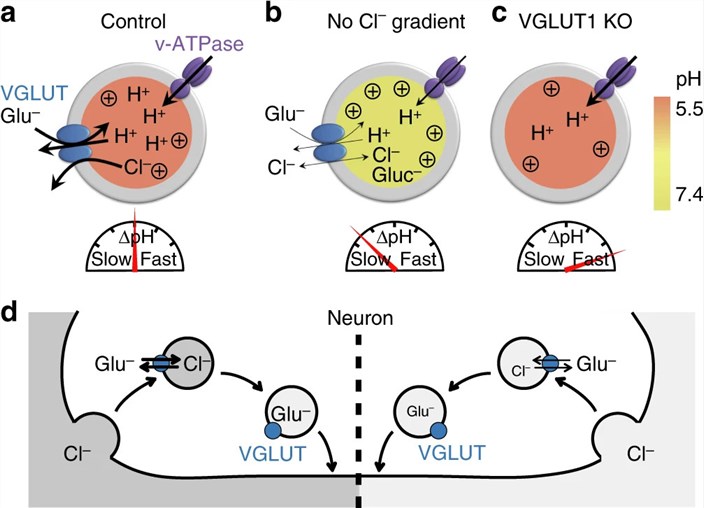 Fig.1 Model for VGLUT transport mechanism and SV re-acidification.1
The functional scope of SLC17A7 spans multiple domains of neurobiological and neuropathological relevance:
Challenges associated with the membrane-embedded topology of SLC17A7, the requirement for an appropriate lipid environment to maintain proper folding, and its relatively low abundance in brain tissue complicate structural and functional investigations. These challenges are addressed by Creative Biolabs through a custom SLC17A7 protein design platform that provides membrane protein research constructs for structural biology, ligand-binding studies, antibody development, and transport-related research. Our engineering team utilizes structural information from homology modeling and codon-optimized gene synthesis to develop constructs suited to studies of SLC17A7-mediated vesicular glutamate transport and associated regulatory mechanisms. Every engagement begins with a detailed technical consultation to ensure that the protein architecture is compatible with the planned research application, including structural studies or vesicular reconstitution. Specific expression hosts, production yields, preparation formats, and functional validation strategies are determined according to individual project requirements.
Not finding the membrane protein product you need? Contact us to start your one-stop custom service!
Cellular models expressing SLC17A7 are useful for localization studies, transport research, antibody screening, and studies of chemical modulation. Creative Biolabs engineers customized SLC17A7 stable cell lines according to specific research needs, optimizing transduction and selection strategies to support consistent transporter expression. Lentiviral delivery, transposon-mediated integration, and targeted knock-in approaches can be considered for cell engineering depending on project requirements. Generated cell lines can support studies of SLC17A7 localization and transporter-associated functions. Specific expression characteristics, detection methods, and functional performance are determined according to the individual cell line and documented in the corresponding project data or datasheet.
Not finding the stable cell line product you need? Contact us to start your one-stop custom service!
SLC17A7 is critical for detecting expression in original brain tissue, mapping its subcellular distribution to synaptic vesicles and differentiating it from the closely-related VGLUT2 and VGLUT3 isoforms. Creative Biolabs: Complete recombinant antibody discovery programs targeting cytosolic and conformational SLC17A7 epitopes We target antibodies in a breadth of therapeutic areas and therapeutic modalities with our fast turnaround, high success multi-stage which combines immunogen design, selection on multiple platforms and tailored downstream engineering to provide binders with the specificity, affinity and developability profiles required for research, diagnostic or therapeutic applications. You get a fully characterized, renewable reagent by removing the batch-to-batch variability common to traditional polyclonal sera using recombinant expression and cloning sequencing.
Not finding the recombinant antibody product you need? Contact us to start your one-stop custom service!
In addition to typical catalog products, Creative Biolabs provides cutting-edge discovery services that address all SLC17A7 related research needs:
No, all reagents and services provided are designated solely for research purposes.
Yes, we manufacture isoform-specific antibodies against the divergent C-terminal tail sequence common to SLC17A7.
Yes, we have generated lineages of stable full-length SLC17A7-expressing transgenic cells with fluorescent proteins targeted in an independent locus to synaptic vesicle.
Yes, certain validated clones produce punctate staining in fixed brain sections that colocalize with synapsin or synaptophysin.