Creative Biolabs is offering the most comprehensive services for antibody development projects. With strict regulation and effective execution, we are dedicated to providing the most valuable solutions to complete your projects.
HighlightsCreative Biolabs is offering the most comprehensive services for antibody development projects. With strict regulation and effective execution, we are dedicated to providing the most valuable solutions to complete your projects.
HighlightsCreative Biolabs has established a broad range of platforms for developing novel antibodies or equivalents. These cutting-edge technologies enable our scientists to meet your demands from different aspects and tailor the most appropriate solution that contributes to the success of your projects.
HighlightsWith deep understanding in antibody-related realms and extensive project experience, Creative Biolabs offers a variety of references to help you learn more about our capacities and achievements, including infographic, flyer, case study, peer-reviewed publications, and all kinds of knowledge that can assist your projects. You are also welcome to contact us directly for more specific solutions.
HighlightsGet a real taste of Creative Biolabs, one of the most professional custom service providers in the world. We are committed to providing highly customized comprehensive solutions with the best quality to advance your projects.
Highlights Loading...
All listed services and products are For Research Use Only. Do Not use in any diagnostic or therapeutic applications.
Solute carrier family 45 member 2 (SLC45A2) - also known as membrane associated transporter protein (MATP), melanoma antigen AIM1, and MATP gene-is an integral membrane glycoprotein with twelve transmembrane domains that is primarily localized in the internal membranes of melanosomes where it maintains a pH conducive to melanin synthesis. This protein contains a canonical conserved sugar recognition sequence (RxGRR) in its cytosolic loop, which is a hallmark of proton-coupled sugar symporters and has been proven to operate as an acid-dependent importer for sucrose, glucose, fructose and mannose when heterologously expressed in yeast. The physiological significance of SLC45A2 has been indicated by association with the gene for oculocutaneous albinism (OCA4), which is an autosomal recessive disease caused by a defect in melanin biosynthesis from melanocytes affecting skin, hair and eyes. New therapies targeting the genetic mechanisms of OCA4 remain in early developmental phases, largely owing to its inherent low prevalence as an orphan disease; estimated global population frequency is around 1:100.000 but significantly differs between ethnic groups (3%–4% of all OCA cases reported from Dutch variant populations corresponding with only 27% registered during comprehensive evaluations performed within Japan where the p.D157N( c.469G>A) founder mutation predominates). In addition to its relevance in albinism, SLC45A2 is becoming an important player in determining normal human pigmentation variation because the common p.F374L (rs16891982) polymorphism has displayed hallmark of positive selection signals within European populations and accounts for much of skin color diversity between continental groups.
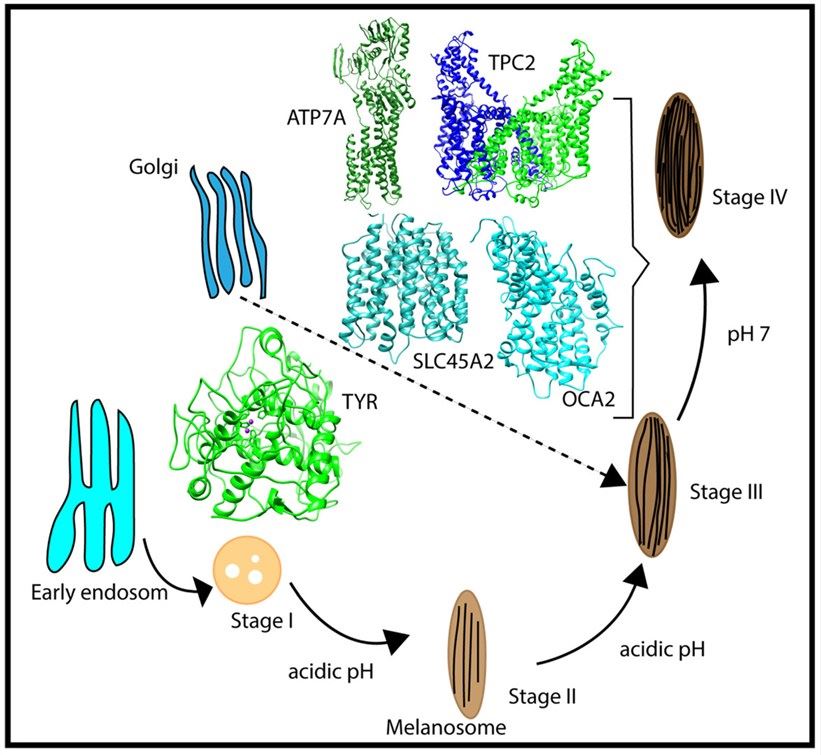 Fig.1 Schematic representation of the multistage processes of melanosome formation and proteins participating in pH regulation and melanin synthesis.1
From the functional spectrum of SLC45A2 across diverse aspects of melanocyte biology, pigmentation physiology and cancer pathogenesis:
We engineer a collection of SLC45A2 membrane protein constructs designed to address key challenges associated with major facilitator superfamily transporter research. Since proper organization of the twelve transmembrane α-helices and preservation of structural features relevant to transporter function are important for studying proton-coupled transport and melanosome pH regulation, our platform supports the development of protein constructs tailored to specific experimental requirements. These preparations can be used for structural, biochemical, transporter, and pigmentation-related research, including studies of substrate interactions and SLC45A2-associated transport mechanisms. Protein format, production conditions, and applicable structural or functional characterization strategies are selected according to individual project requirements. Specific quality-control methods and performance data are provided based on the corresponding construct or project documentation.
Not finding the membrane protein product you need? Contact us to start your one-stop custom service!
Physiologically representative cellular platforms are a prerequisite for decoding SLC45A2-mediated melanosomal transport and accelerating therapeutic development pipelines. We infuse state of the art high-throughput selection platforms with stable SLC45A2 cell lines that retain true-to-life melanosomal membrane localization and native glycosylation, along with weak stressor responsiveness in standard driving media. We have developed loss-of-function models via shRNA-depleted and dominant-negative SLC45A2-expressing cells to permit mechanistic interrogation of SLC45A2-driven tumor suppression, along with corresponding high-throughput screening systems for synthetic lethality. Every cell line is well characterized by genomic integration, somal pH with ratiometric fluorescent indicators, and functional assays of melanin content quantification, as well as melanogenesis-related cellular processes such as tyrosinase trafficking or adhesion. Such expandable values characterize cellular resources critical for investigating pigmentation disorders, screening compounds that ameliorate metastatic features, and preclinical characterization of potential biologics directed against the SLC45A2 axis.
Not finding the stable cell line product you need? Contact us to start your one-stop custom service!
Advance your SLC45A2 studies with our suite of sequence-defined, high-affinity monoclonal antibodies developed for detection and characterization of this twelve-pass transmembrane transporter. Depending on the individual clone, antibodies may recognize epitopes within different regions of SLC45A2 and support applications for studying its expression, localization, and membrane-associated biology. Validated applications may include Western blotting, ELISA, flow cytometric analysis, immunofluorescence, and confocal microscopy, depending on the characteristics and validation data available for each antibody. These reagents can support SLC45A2 antibody discovery and detection research in relevant cellular models. Conformation or state specificity, species reactivity, cross-reactivity, epitope accessibility, and application suitability should be determined according to the clone-specific datasheet and available experimental evidence.
Not finding the recombinant antibody product you need? Contact us to start your one-stop custom service!
On top of our catalog products we have dedicated capabilities in custom services for membrane protein and antibody discovery&development:
All SLC45A2 products and services are for research use only, not for clinical diagnosis.
We provide various products such as recombinant SLC45A2 membrane proteins (L374 and F374 full-length variants & pathogenic mutants), stable cell lines stably expressing wild-type/mutant SLC45A2, high-quality anti-SLC45Ab antibodies, along with all custom services.
Yes, the protein is purified in a mild, non-ionic detergent buffer and buffer-exchanged into a lipid-compatible system. This supports immediate insertion into synthetic membranes for cryo-electron microscopy, stopped-flow fluorimetry, or reconstituted proton-substrate symport assays without additional dialysis or detergent exchange steps.
Yes, we provide recombinant proteins and also the stable cell lines which contain known pathogenic substitutions in transmembrane helices or cytoplasmic loops where proton coupling/coordinate of substrate is disrupted.