
Creative Biolabs is offering the most comprehensive services for antibody development projects. With strict regulation and effective execution, we are dedicated to providing the most valuable solutions to complete your projects.
HighlightsCreative Biolabs is offering the most comprehensive services for antibody development projects. With strict regulation and effective execution, we are dedicated to providing the most valuable solutions to complete your projects.
HighlightsCreative Biolabs has established a broad range of platforms for developing novel antibodies or equivalents. These cutting-edge technologies enable our scientists to meet your demands from different aspects and tailor the most appropriate solution that contributes to the success of your projects.
HighlightsWith deep understanding in antibody-related realms and extensive project experience, Creative Biolabs offers a variety of references to help you learn more about our capacities and achievements, including infographic, flyer, case study, peer-reviewed publications, and all kinds of knowledge that can assist your projects. You are also welcome to contact us directly for more specific solutions.
HighlightsGet a real taste of Creative Biolabs, one of the most professional custom service providers in the world. We are committed to providing highly customized comprehensive solutions with the best quality to advance your projects.
Highlights Loading...
All listed services and products are For Research Use Only. Do Not use in any diagnostic or therapeutic applications.
Transforming growth factor beta 2 (TGFB2) is a 25 kDa secreted cytokine member of the TGF-β superfamily of growth and differentiation factors. Furin-like proprotein convertases cleave the precursor into two different chains, which are the N-terminal latency-associated peptide (LAP) and C-terminal mature bioactive peptide. Post-cleavage, these chains stay non-covalently associated, providing a latent, inactive cytokine during matrix storage and transport. Mature TGFB2 peptide is a disulfide-linked homodimer that has pleiotropic effects on most if not all cell types in the body. Latent TGFB2 can be activated through context-dependent extracellular mechanisms that release or expose the mature cytokine from its latent complex. Once activated, dimeric TGF-β binds a receptor complex formed by type II and type I receptors. The interaction results in trans-autophosphorylation of TGFBR2, which then phosphorylates TGFBR1, activating the serine/threonine kinase domain. The downstream signalling cascade involves SMAD2/3 phosphorylation, nuclear translocation and transcriptional regulation of target genes associated with cell proliferation, apoptosis, extracellular matrix deposition, and immune suppression. In addition, the mature peptide has been shown to heterodimerize with TGFB1 and TGFB3, further increasing the combinatorial milieu in which they can signal.
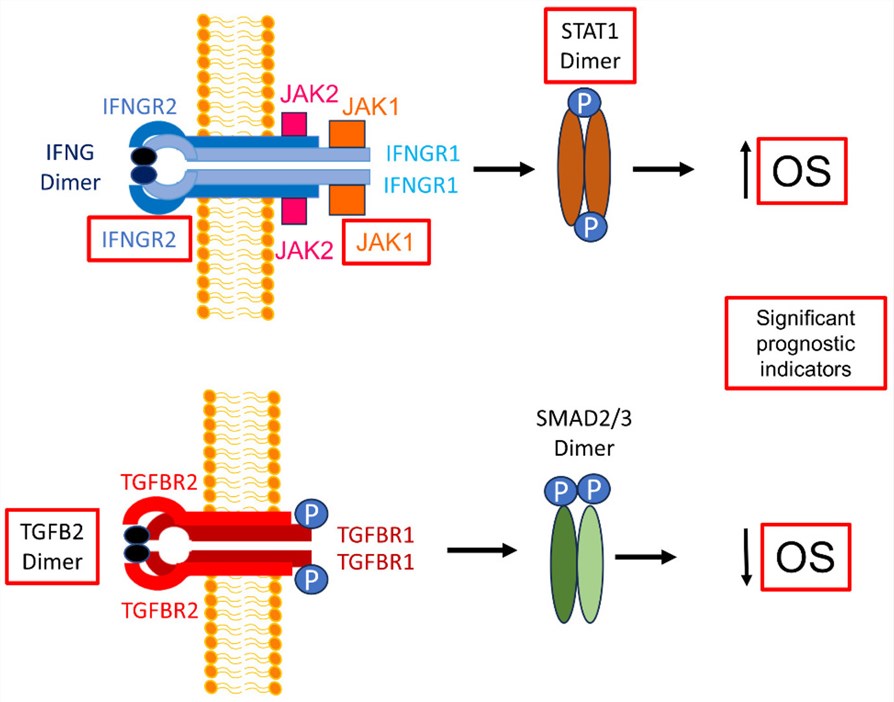 Fig.1 Opposite effects of increasing TGFB2 and IFNGR2/JAK1/STAT1 mRNA levels on OS outcomes in pbDMG patients.1
TGFB2 plays a biological role in development, immunity and disease:
Boost your research with our curated portfolio of recombinant TGFB2 proteins. As a secreted cytokine, TGFB2 requires appropriate folding, disulfide bond formation, and structural integrity to support studies of its latent and active states. We provide TGFB2 protein formats designed for a range of research applications, including receptor-binding studies, antibody screening and characterization, signaling research, and drug discovery. Specific protein formats, expression systems, quality-control specifications, and available bioactivity data are provided according to the corresponding product datasheet or individual project requirements.
Not finding the protein product you need? Contact us to start your one-stop custom service!
Developing robust, physiologically relevant cellular platforms that can recapitulate TGFB2-driven biology and assess anti-fibrotic candidates are key. Here we describe the engineering of stable cell lines that exclusively express human, mouse or rat TGFB2 as a single isoform or in physiologically relevant latent complexes in fibroblast, epithelial, or immune cell backgrounds either constitutively or inducibly. They have been optimized and standardized for differentiation assays relevant to myofibroblast (MF) biology, quantification of collagen deposition upon TGFbeta2 stimulation, SMAD reporter gene assay analysis as well as high-throughput screening of both TGFB2-neutralizing antibodies and receptor kinase inhibitors with the reproducibility needed for multi-phase studies performed by multiple research groups.
Not finding the stable cell line product you need? Contact us to start your one-stop custom service!
One of the most thoroughly tested recombinant antibody collections specifically for TGFB2, to ensure accurate TGFB2 detection and strong quantification. Developed from prominent techniques in the immunology field, they are incredibly specific for unique TGFB2 epitopes (the mature peptide and the latency-associated peptide) and having lower cross-reactivity with TGFB1 or TGFB3. Well validated for numerous applications Types Test validation: WB, ELISA, FCM, IF, ICC, IHC and IP — read more Well characterized (strong specificity) against TGFB2 across fibrotic tissues, tumor microenvironments and serum samples.
Not finding the recombinant antibody product you need? Contact us to start your one-stop custom service!
We also provide full-service custom services in addition to our catalog products, focused on expediting TGFB2-targeted drug discovery and biomarker development:
No. All TGFB2 recombinant proteins, cell lines and antibodies are for research use only.
Absolutely. We prior have cell engineering team constantly developed tetracycline-inducible systems and lines co-expressing TGFB2 with TGFBR2, TGFBR1 or SMAD2/3 reporter constructs for signalational analysis.
Yes. We generated triple-stable lines with constitutive expression of mature TGFB2, TGFBR1 and TGFBR2 from independent loci. As the data for each batch is released showing Smad2 phosphorylation and fibronectin induction, these provide a repeatable cellular platform that allows continuous mechanistic studies without re-performing transient transfection.
Yes. We provide a unique set of recombinant proteins as well as stable cell lines that express variants containing alanine substitutions at key positions in the hydrophobic receptor binding pocket domain required for type II receptor protein-protein interaction.








