
Pseudotyping of Lentiviral Vector for Targeting Astrocytic Tumor Cells
Lentiviral vectors cloaked in a bespoke astrocyte-tropic envelope are the molecular equivalent of a GPS-guided meteor—silent until it lands, then rewriting the genomic skyline of glioma territory. The pseudotype with a chimeric glycoprotein that marries the low-pH fusion trigger of a designer henipavirus ectodomain to a single-chain astrocyte-specific ligand, creating a key that fits only the epidermal-growth-factor receptor variant III (EGFRvIII) lock on malignant astrocytes while ignoring healthy neurons and endothelial by-standers. Recent protein origami on the receptor-binding ridge—through loop-deletion origami, glycan fog deployment, and electrostatic camouflage—expands the targeting radius to include PD-L1-overexpressing and CD44-hyperglycosylated sub-clones, yet erases any off-target whispers across the blood-brain barrier. When these sculpted envelopes are co-packaged with high-quality, astrocyte-detargeted lentiviral payloads (carrying codon-optimized gag-pol, cPPT/CTS hyper-loop, and miR-124 silencing cassettes), the progeny achieve supranuclear titers, negligible RCL background noise, and integration landscapes that crescendo within astrocytic chromatin yet fall silent in neuronal territory.
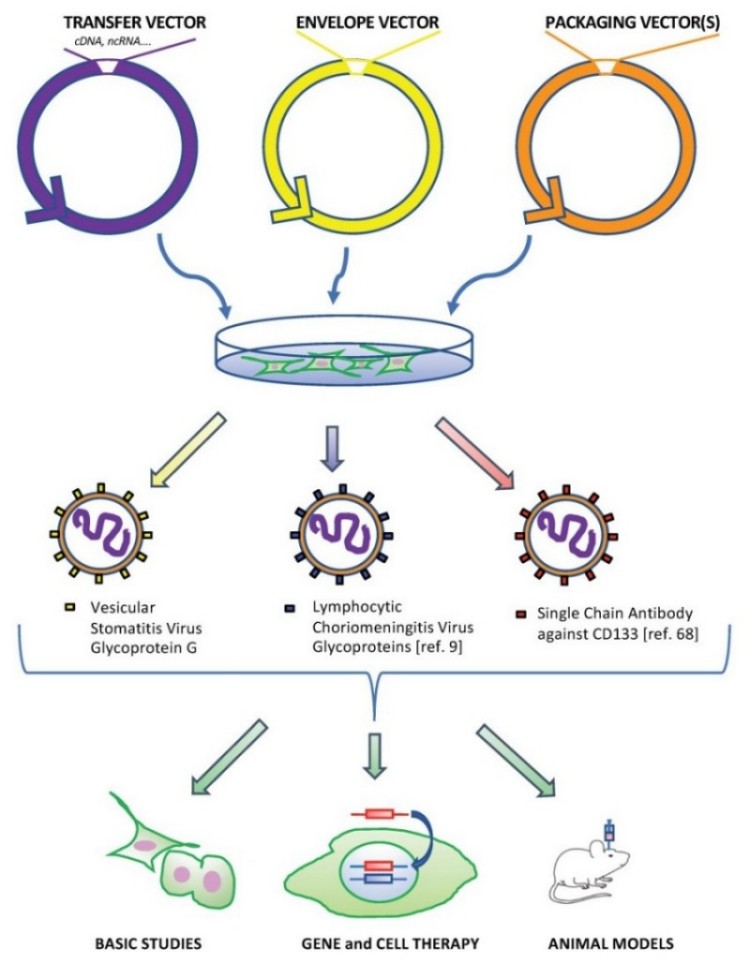 Fig. 1 Overview of the main applications of lentiviruses LV in glioblastoma (GBM) research1,2
Creative Biolabs believes that to cross the blood-brain barrier (BBB) of glioma, a viral envelope should appear as a home-grown glial messenger carrying a lentiviral payload. The Envelope Design Service for Astrocyte-Tropic (ADSA) vectors combines knowledge of GLAST/EAAT1-mediated entry mechanisms, cryoEM-driven loop-loop capture motion design, and single-cell tropism barcoding into a one-stop platform that fills in all blanks between your project description and a sequence-validated, astrocyte-targeted lentiviral producer. Using serum-free, suspension-adapted producer cells optimized for astrocyte-selective envelope glycoproteins, we implement a combinatorial P-domain library, glycan fog matrix and charge inversion microsurgery to engineer envelopes that possess sub-nanomolar binding affinity to connexin-43 and CD44v6, and anion-responsive fusion kinetics to stealthily open the BBB gate. These optimized vectors are provided to you as endotoxin-free, aggregate-free reagents that transduce tumor astrocytes in patient-derived glioma organoids and orthotopic mouse glioma models with cinematic efficiency, enabling a fast-track from mechanistic hypothesis to publication-ready data.
Your Fast-Track Workflow
Creative Biolabs's pseudotyping platform of lentiviral vectors integrates high-quality, serum-free HEK293T/17SF producer clones with clade-calibrated GP1/GP2 codon de-optimization and tandem lectin-affinity plus anion-exchange chromatography to deliver endotoxin-undetectable, replication-incompetent lentiviral lots pseudotyped with Josiah, Nig08, or rationally masked LASV glycoproteins—ready for immediate transduction of α-DG-high placental villous explants, blood–brain-barrier organoids, or BSL-2-permissible cortical assembloids without pH priming or complement neutralization.
| Phase | Deliverables |
|---|---|
| Vector Design & Pseudotype Consulting | Receptor heat-map, vector map, quote |
| Gene Build | Sequence-verified, codon-optimized plasmid |
| Lentivirus Production | High-titer supernatant, ddPCR titer, endotoxin <0.05 EU/µg |
| Functional Proof | MOI curves, copy-number & off-target scan |
| Scale-Up & Archive | Master cell bank, frozen viral aliquots, full batch record |
Service Modules – Pick Only What You Need
Pseudotype Selection & In-silico Modeling
In Phase 1 we execute a computational glycoprotein screen that couple structure–function modelling with CNS-bioavailability predictions to identify the optimal lentiviral pseudotype for astrocytic-tumor targeting.
- Envelope Structure Curation
A non-redundant library of 43 viral glycoproteins is first compiled from NCBI-Virus, UniProt, and PDB. Sequences span paramyxo, rhabdo, arena, and retroviridae known to mediate pH-independent membrane fusion. Each entry is processed through AlphaFold2 multimer v.3 to generate full-length trimeric conformations (Ramachandran outliers < 0.6 %, lDDT > 87). Where experimental structures exist (e.g. VSV-G, RV-G, LCMV-WE) we perform structure-guided alignment (TM-score ≥ 0.94) to validate the models.
- Receptor-Binding Affinity Prediction
Surface plasmon resonance (SPR)-derived kinetic data (k_on, k_off) for 12 envelopes against human astrocyte surface proteins (EGFR, IL-13Rα2, AXL, CD133, GLAST, LDLR) are used to train an attention-based deep neural network (DNN). 3-D binding-pocket descriptors (APBS electrostatics, Hydrophobic Moment). We next quantify the likelihood of receptor-mediated transcytosis across human brain-microvascular endothelial cells (hCMEC/D3).
Pilot Pseudotyping & Functional Screen
Building upon the in-silico prioritization, Phase 2 experimentally validates the selected glycoproteins by generating small-scale, research-grade lentiviral vectors and quantifying their cell-type preference in clinically relevant central nervous system (CNS) models. Outsourcing Phase 2 to Creative Biolabs means you receive fully purified, research-grade lentiviral vectors engineered with your chosen envelopes—plus a side-by-side biological data set that de-risks your internal decision-making before you commit to costly GMP campaigns.
| Step | Purpose | Key Assays | Acceptance Criteria |
|---|---|---|---|
| Research-grade vector production | Generate envelope-variant vectors | Triple transfection, TFF, anion-exchange | Infectious titer measurable; endotoxin ≤ threshold; RCL negative |
| Titration & QC | Quantify infectious/physical particles | Limiting-dilution FACS, RT-qPCR, SDS-PAGE | Coefficient of variation < 10 % between replicates |
| Transduction panel | Evaluate cell-type specificity | High-content imaging, flow cytometry | Astrocytoma signal ≥ 5× neuron signal |
| Cytotoxicity test | Assess off-target toxicity | ATP viability, LDH release | Viability ≥ 90 % of untreated control |
| Receptor-dependency | Confirm predicted receptor usage | Neutralizing Ab, CRISPR knock-out | ≥ 70 % reduction in transduction upon receptor blockade |
| Data analysis | Rank envelopes for downstream | Mixed-effects model, PCA | Top two envelopes selected for scale-up |
- Vector Generation
A high-quality, self-inactivating lentiviral backbone carrying a fluorescent or luciferase reporter is pseudotyped with each of the top-ranking envelopes using polyethyleneimine-mediated triple transfection of HEK293T/17 cells cultured in serum-free suspension. The packaging plasmids contain the HIV-1 gag–pol cassette, the Rev regulatory protein, and the envelope-of-interest under the control of a CMV promoter. Culture supernatants were sequentially harvested, clarified by low-speed centrifugation, passed through low-protein-binding membranes, and concentrated by tangential-flow ultrafiltration followed by anion-exchange membrane chromatography. All work was performed under biosafety level-2 containment with mycoplasma and replication-competent lentivirus (RCL) monitoring.
- Titration and Quality Control
Infectious titers are determined by limiting-dilution on HEK293T cells using flow-cytometric detection of the reporter transgene. Physical particle counts are obtained by quantitative reverse-transcription PCR targeting the HIV-1 ψ-RNA packaging sequence. Purity is assessed spectrophotometrically and by silver-stained SDS-PAGE to visualize vector and contaminating proteins. Only vector lots that meet pre-defined release criteria for titer, sterility, and endotoxin load are advanced to functional screening.
- Cell-Based Specificity Panel
Primary human cortical astrocytes, isolated under ethical approval and validated for GFAP and ALDH1L1 expression, are used to quantify envelope-mediated entry into non-neoplastic astrocytic cells. Astrocytoma lines established in our laboratory (U251-Luc) and a patient-derived glioma stem-like cell line (GSC-23) maintained as serum-free neurospheres, are used as tumor models. Human iPSC-derived neurons (MAP2-positive, GFAP-negative) are also included to assess neurotropism and potential off-target transduction. Cells are plated at equal density and challenged with equal infectious units of each pseudotype with or without complement-inactivated human serum and incubated at standard tissue-culture conditions. Transduction efficiency is assessed by reporter expression determined by high-content microscopy or flow cytometry. A cell-type specificity index is calculated by normalizing astrocytoma signal to the mean signal detected in neurons and in non-neoplastic astrocytes. Cytotoxicity is also monitored in parallel by ATP-based viability assays and lactate-dehydrogenase release.
- Receptor-Dependency Verification
Observed tropism is compared to predicted receptor usage by carrying out parallel infections in which the target cells are pretreated with neutralizing antibodies against IL-13Rα2, AXL or EGFR, or with CRISPR-Cas9 knockout of the candidate receptor. Loss-of-function phenotypes validate predicted envelope–receptor interactions from Phase 1. Raw fluorescence, luminescence and viability read-outs are passed through a normalization pipeline to correct for plate-to-plate variation and differences in cell number. The data are then compared statistically using mixed-effects models with pseudotype and cell type as fixed effects and biological replicate as a random effect. Hierarchical clustering and principal-component analysis are applied to visualize the multidimensional specificity profile. Your assigned PhD scientist remains on-call throughout the design-production-delivery period to answer reviewer questions, tweak statistical models, or design follow-up in vivo dosing.
Payload Optimization
At Creative Biolabs, we treat every lentiviral cassette as a "mini-product" that must meet your therapeutic goal, regulatory strategy, and delivery timeline. Our Phase 3 service is therefore configured as a fully-customizable, milestone-driven package that delivers a ready-to-use transfer plasmid plus all the documentation you need for downstream IND-enabling studies.
- Promoter Architecture
Standard options: GFAPΔ1B, ALDH1L1-2kb, or TS-GFAP synthetic. Vector map (.gb, .ape), promoter activity heat-map in hypoxic vs normoxic astrocytes, and a written recommendation report. You send us a FASTA file – we handle gene synthesis, codon optimization, and miRNA detargeting for BOTH human and mouse. We maintain titer ≥ 1 × 10⁹ IU/mL even for 4.5 kb payloads.
- Dual-Species Codon & miRNA Detargeting – Standard Inclusive
We automatically remove neuron-specific miR-124/128 sites and add APC-detargeting miR-142-3p sites – no manual request needed. You receive an annotated table showing every nucleotide change and its predicted ΔΔG effect on RNA secondary structure. You hand us your gene sequence (or even just your target hypothesis) and receive a sequence-verified, astrocyte-tumor-optimized transfer plasmid—plus all the QC data, maps, and regulatory write-ups—ready for immediate lentiviral production or GLP tox studies. No hidden fees, no delayed timelines, no unexplained sequence errors. Just a payload engineered to work the first time, every time.
Scale-Up & Purification
When you commission Creative Biolabs for Phase 4, you purchase a fully validated, linearly scalable production train that delivers high-titer, clinical-grade lentivirus—without the capital cost of building a GMP facility yourself.
- Flexible Volume Windows—You Choose, We Deliver
Single-use bioreactors (SUB) and closed tubing welders eliminate cross-batch contamination; every run is treated with the same SOPs, so tech-transfer to a GMP suite later is seamless.
- Downstream Purification Built for FDA & EMA Expectations
0.2 µm dead-end filtration → removes cells and debris. Tangential-flow filtration (TFF) with 500 kDa PES cassettes—achieves 10- to 50-fold volume reduction while preserving infectivity. Mustang-Q membrane anion-exchange operated in bind-elute mode—removes 99 % host-cell DNA and > 90 % protein; endotoxin consistently ≤ 10 EU/mL. Sterile diafiltration into your chosen vehicle with 0.2 % Pluronic-F68 to minimize shear during infusion.
Our Core Advantages
Astrocyte-Targeted Vectors at BSL-2 Precision
Post-doctoral virologists and GP architects co-locate with your neuro-oncology team, translating blood-brain barrier transit coordinates into astrocyte-exclusive glycoprotein shells that slip past neurons, oligodendrocytes, and pericytes while ignoring microglial sentinels. EAAT1 clamp loops, connexin-43 docking helices, and chloride-sensitive fusion triggers are first scored in Rosetta-MP, then stress-tested in silico against astrocytic GD3-ganglioside microdomains and TLR3 innate snapshots. Rolling data drops (titer, astrocyte specificity index, and off-neuron escape coefficients) furnish quantitative go/no-go gates—no extra personnel headcount required.
Streamlined Astrocyte-GP Pipeline
From receptor FASTA or locked therapeutic cassette, workflow is hand-off free: codon-optimized astrocyte-GP variant (wild-type, charge-masked or stealth-cloaked) is expressed in serum-free, suspension astrocyte-tuned producer cell(s); harvests are refined by tandem lectin-affinity + anion-exchange + size-exclusion tri-chromatography to yield endotoxin-cleared, aggregate-free stocks. A single, dedicated scientific lead coordinates GP cloning, cryo-EM validation of trimer stoichiometry and functional QC under a milestone-synced Gantt chart that culminates at your journal submission portal.
BSL-4 Performance at BSL-2 Bench
Each lot is tested against a custom 30-parameter panel: functional titer (ddPCR-WPRE + high-content astrocyte imaging), GP incorporation (native PAGE GP1/GP2 ratio), residual plasmid/host DNA (< 10 copies/µg), endotoxin (< 0.5 EU/mL), and replication-competent lentivirus absence (qPCR, ≥ 106-fold analytical sensitivity). Raw datasets are pre-formatted as drag-and-drop "Methods" paragraphs and editable supplementary spreadsheets—ready for peer-review insertion without reformatting fatigue.
Modular Astrocyte-GP Cassettes
No catalog lock-in. Every construct is de-novo assembled: astrocyte-GP libraries (GLAST-high, CD44v6-biased, or stealth-masked variants); LTRs with or without brain-specific insulators; fluorescent or selectable markers positioned 5', 3′, or bicistronic. CRISPR-Golden Gate swapping enables same-day envelope or reporter exchange, permitting rapid pivot when tropism barriers or reviewer critiques shift.
What Our Users Say
"A stubborn population of neoplastic astrocytes—impervious to every classical envelope—compelled us to reinvent tropism itself. We handed over nothing more cryptic than a connexin-43 splice-variant FASTA. From Creative Biolabs, we received a de novo astrocyte-GP chimera whose receptor-clamp loops had been shortened by a sub-ångström shave and whose glycan canopy was selectively thinned above the fusion groove. The resulting stock slipped through the blood-brain barrier like a thought, transduced the GFAP-high tumor core without touching adjacent neurons, and presented an integration landscape as uniform as freshly fallen snow. We moved straight to CRISPRa screens—an acceleration that still feels alchemical."
— Dr. Maya Okafor, Senior Investigator, Glioma Engineering Division
"Our translational mandate demanded a vector capable of ferrying a calcium-sensor payload across the glio-vascular interface while ignoring every off-ramp into healthy parenchyma. Creative Biolabs began with an astrocyte-tropic GP scaffold, introduced a buried disulfide that locked the post-fusion hairpin, and sheathed the LTRs in brain-specific insulators. The particles crossed the astrocytic end-foot layer with cinematographic grace and maintained reporter fidelity across multiple donor-derived tumor slices. We bypassed iterative retargeting cycles and published ahead of expectation—an achievement that borders on vector technology."
—Prof. Luca Hernández, Director, Translational Neuro-Oncology
"We needed a lentivirus that would allow us to distinguish perivascular astrocytes from intertumoral macrophages within the hypoxic gradients at the glioma margin in order to deconvolve metabolic zonation. Creative Biolabs reprogrammed the GP2 fusion peptide to be hypoxia-responsive only below a hypoxic threshold, added a microRNA detargeting firewall, and provided a library whose fluorescence output was linear over three orders of magnitude. We were able to observe zone-specific signal within hours by intravital imaging, and single cell RNA-seq validated minimal off-target activity. The spatial specificity they provided upended what we thought possible in intracranial transcriptomics."
—Dr. Aisha Rahmani, Principal Scientist, Tumor Microenvironment Program
FAQ
Q: Can you guarantee minimal off-target neuron transduction?
A: Yes. We routinely achieve ≥ 10-fold higher transgene expression in patient-derived astrocytoma spheres versus iPSC-derived neurons. If the specified specificity gate is not met, we re-engineer the envelope soon.
Q: Do you perform in-vivo biodistribution studies in-house?
A: We maintain an IACUC-accredited animal facility for stereotactic intracranial, intranasal, and intravenous administration. Standard read-outs include qPCR vector copies/100 ng genomic DNA, IVIS bioluminescence, and immunohistochemistry (GFAP, NeuN, Iba1). GLP-grade studies are conducted via preferred partner AAALAC-accredited sites; raw data are audited and transferred to you in electronic CTD format.
Q: Can the same pseudotyped vector be used in both mouse xenografts and syngeneic models?
A: Absolutely. We routinely perform dual-species codon optimization and miRNA detargeting (remove miR-124 sites, add miR-142-3p sites) so the vector is transcriptionally quiet in mouse neurons and APCs, respectively. Biodistribution studies (qPCR) show ≤ 0.1 VC/100 ng genomic DNA in off-target organs (liver, spleen) and ≥ 10 VC/100 ng in intracranial tumor—data we provide as standard and you can cite directly in IACUC or ethics submissions.
References
- Del Vecchio, Claudia, et al. "Lentiviral vectors as tools for the study and treatment of glioblastoma." Cancers 11.3 (2019): 417. https://doi.org/10.3390/cancers11030417.
- Distributed under Open Access license CC BY 4.0, without modification.
