
Custom Nucleic Acid Nanostructure Service
Nucleic acid nanotechnology has been developed to be a promising strategy for RNA interference (RNAi). Creative Biolabs is fully competent and dedicated to serving as your one-stop-shop for the development of DNA/RNA nanostructure for RNAi, including rational DNA/RNA nanostructure design, synthesis, and characterization. We offer high-quality custom services by adjusting protocols to meet even the most specific requirements.
Nucleic Acid Nanostructure Introduction
The field of nucleic acid nanotechnology represents a paradigm shift in our ability to engineer matter at the molecular scale. By harnessing the programmable base-pairing rules of DNA and RNA, scientists can now design and construct nanostructures with unprecedented precision, predictable geometry, and dynamic functionality. Unlike traditional nanomaterials, these structures are not merely passive carriers but are inherently functional platforms whose biological interactions can be predetermined through sequence design. The core principle relies on the specificity of Watson-Crick base pairing, where strands of nucleic acids self-assemble into complex two- and three-dimensional architectures, from simple origami tiles to intricate polyhedral cages and dynamic nanomachines.
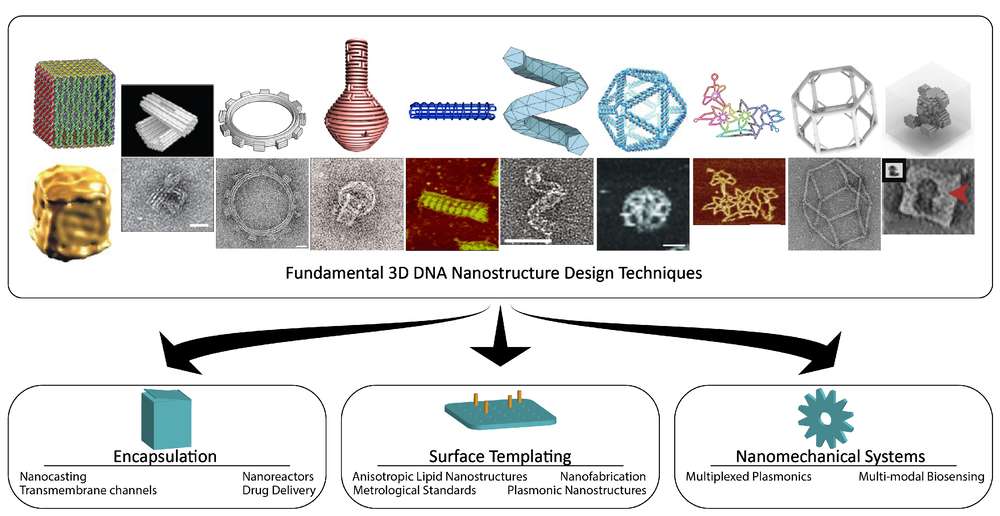 Figure 1. Mechanical designs of 3D DNA nanostructures are applied to a wide range of interdisciplinary areas through three archetypal functions of nanoscale geometric design.1
Characteristics of Nucleic Acid Nanostructures
DNA Nanostructures
Grown exponentially in the past decade, DNA nanotechnology has been developed to be a promising strategy to construct various nano-biomaterials with structural programmability, spatial addressability and excellent biocompatibility. The sequences are programmable and the interactions between DNA are predictable. All these intrinsic properties of DNA allow numerous DNA nanostructures to be self-assembled with precisely controlled sizes and shapes. Comparing to traditional therapeutics carriers, DNA nanostructures exhibit a few advantages as an emerging delivery system for RNAi. They typically own high capacity for payloads, excellent biocompatibility and biodegradability, as well as great stability under physiological conditions. In addition, the inherent compatibility with therapeutic short double-stranded RNA (dsRNA) is the most outstanding feature of DNA nanostructures. Therefore, DNA nanostructures can serve as effective scaffolds and nanoscale vehicles for siRNA delivery for efficient gene silencing.
RNA Nanostructures
RNA nanostructures can be programmed to exhibit defined sizes, shapes and stoichiometries from naturally occurring or de novo designed RNA motifs. These constructs can be used as scaffolds to attach functional moieties, such as ligand binding motifs and gene expression regulators. RNA has been used extensively to construct various nanostructures, some of which are functionalized toward therapeutic applications. The suitability of RNAs as a material for use in nanotechnology and nanomedicine is due to their chemical, structural and functional properties. Multivalent RNA nanoparticles can be a very promising vehicle for the delivery of multiple siRNAs to suppress multiple genes simultaneously. A publication has shown that several RNA and RNA/DNA nanocubes could be functioned with multiple dsRNAs and the siRNAs can be conditionally released. Furthermore, the RNA nanocubes can be tracked intracellularly using fluorophores. In addition, spherical nucleic acid nanoparticle conjugates have also shown promise for systemic siRNA delivery for treating diseases.
Polyvalent Nucleic Acid Nanostructures
Polyvalency—the simultaneous presentation of multiple ligands—is a fundamental strategy in nature to enhance binding strength and specificity. Nucleic acid nanostructures are ideal platforms for engineering polyvalent interactions, as they allow for the precise spatial organization of multiple functional groups at defined nanoscale distances.
A. Affinity Effect
When a single ligand weakly binds to a single receptor, the overall interaction is usually transient. However, if multiple ligands are rigidly displayed on a single nanocarrier (i.e., a multivalent nanoparticle), the statistical probability of all ligands dissociating simultaneously decreases dramatically. This leads to a significant increase in apparent binding affinity, known as the affinity effect or chelation effect.
B. Precise Spacing and Orientation
A key advantage of custom nanoparticle design is that it allows control not only over the number of displayed ligands but also over their precise spacing and orientation. Receptors on cell surfaces typically aggregate or distribute in specific patterns. Custom nanoparticles can be designed to match this natural spacing, thereby optimizing affinity and facilitating specific biological responses that cannot be achieved with randomly functionalized nanoparticles.
Nucleic Acid Nanostructure Synthesis and Purification
The successful application of nanostructures depends on high-yield synthesis and rigorous purification to ensure structural homogeneity. This requires a carefully optimized process to translate digital designs into actual physical forms.
Thermal Annealing Synthesis
The standard method for synthesizing DNA nanostructures is thermal annealing. This process involves mixing the scaffold strand and all necessary short chains in a carefully formulated buffer solution.
Homogeneous Purification
While efficient, annealing often yields a mixture containing correctly folded nanostructures, misfolded structures (kinetic traps), and excess/unreacted short chains.
Key purification techniques include:
- Rate Zone Ultracentrifugation (RUC): This method utilizes the high density and hydrodynamic size differences between folded nanoparticles (NANs) and smaller free oligonucleotides and misfolded nanoparticles. It is well-suited for large-scale purification.
- Size Exclusion Chromatography (SEC): This method uses a porous column matrix to separate components based on their size. Dedicated SEC columns can effectively separate high molecular weight nanoparticles (NANs) and free short chains.
- Non-denaturing Polyacrylamide Gel Electrophoresis (PAGE): Non-denaturing PAGE is usually used for preliminary screening and quality control, but preparative non-denaturing PAGE can also be used to cut and purify specific nanostructure bands with the desired migration rate to determine whether their folding pattern and size are correct.
Conjugation Technology for Custom Nucleic Acid Nanostructure
-
Thiol-Maleimide Chemistry
This is one of the most reliable and widely used methods. The synthesized oligonucleotides have terminal thiol groups (-SH), which react rapidly and selectively with maleimide groups attached to the support. -
Click Chemistry
Referred to as the "gold standard" due to its high yield, stability, and orthogonality. The synthesis of nanoparticles (NANs) begins with the introduction of an alkynyl (or azide) group at the end, followed by reaction with a complementary group on the support. -
N-Hydroxysuccinimide (NHS) Ester
Used to couple ligands containing primary amine groups to the 5' or 3' end of oligonucleotides, providing flexibility for simple modifications such as fluorophores or biotin.
Our Services
Scientists from Creative Biolabs have developed a versatile strategy to prepare well-defined nucleic acid nanostructures. Effective solutions have been employed to functionalize nucleic acid nanostructures for therapeutic dsRNA delivery for RNAi. So far, several nucleic acid nanostructures of variable sizes and shapes have been synthesized and have shown functionality for siRNA delivery for efficient gene silencing.
Computational Design and Optimization
- De novo design of 2D (e.g., tiles, lattices) and complex 3D nanostructures (e.g., barrels, polyhedra, functional nanorobots).
- Advanced sequence optimization using proprietary algorithms to maximize folding yield and minimize misfolding products.
- Integration of cargo placement sites (e.g., thiol, amine, alkyne) at desired spatial coordinates.
Custom Synthesis and Folding
- High-fidelity oligonucleotide synthesis up to 150 bases.
- Optimized, large-scale thermal annealing protocols tailored for yield maximization.
- Synthesis of both DNA- and RNA-based nanostructures (RNA origami).
Functionalization and Conjugation
- Attachment of virtually any cargo: therapeutic small molecules, fluorescent tags, proteins, peptides, aptamers, and antibodies.
- Implementation of advanced click chemistry, ensuring high yield and minimal off-target modification.
Analytical Characterization and Quality Control
For custom nanostructure services, rigorous quality control and structural verification are crucial. The complexity and nanoscale size of these structures necessitate the use of specialized high-resolution analytical tools.
Structural Integrity Validation
- Atomic Force Microscopy (AFM): Provides high-resolution morphological imaging of nanostructures deposited on substrates. AFM confirms the overall size, shape, and integrity of folded structures at the nanoscale.
- Transmission Electron Microscopy (TEM) / Cryo-Transmission Electron Microscopy (Cryo-TEM): Provides visual evidence of structural morphology and internal structure. Cryo-Transmission Electron Microscopy is particularly valuable because it allows imaging of structures in near-natural hydration conditions, thus confirming their stability and avoiding drying artifacts.
- Dynamic Light Scattering (DLS): Measures hydrodynamic size distribution and polydispersity index (PDI). Low PDI values are crucial, confirming the uniformity of folded nanostructures.
Purity and Yield Assessment
- Native PAGE: This is the most important detection method in quality control. Since the migration rate of DNA in a natural gel depends on its shape and size, the appearance of a single, clear band indicates structural homogeneity and successful removal of misfolded DNA and free DNA strands.
- UV-Vis spectrophotometry: Quantitative analysis of the concentration of synthesized nucleic acid material.
- Mass spectrometry (MS): Used to confirm the correct molecular weight and modification status of the conjugated DNA strands and scaffold before the folding process.
Functional Validation
For structures carrying active payloads, we perform application-specific assays, such as fluorescence quenching assays to confirm successful probe integration, or binding assays (e.g., SPR or BLI) to confirm the integrity of the attached aptamer or antibody.
Our Collaborative Process
We have streamlined our custom nanostructure creation process into a clear, phased approach to maximize efficiency and facilitate collaboration with our clients.
-
Phase 1: Project Initiation and Design Consultation
- The client provides the target application, the desired structure (or function), and payload requirements.
- Our R&D team conducts a feasibility assessment and submits final CAD files and sequence sets.
- Final design and expected specifications (size, shape, modifications) are confirmed.
-
Phase 2: Oligonucleotide Synthesis and Quality Control
- High-fidelity synthesis and purification of all necessary short chains and scaffold chains.
- Mass spectroscopic validation of all modified oligonucleotides.
-
Phase 3: Nanostructure Assembly and Folding
- Optimization of annealing buffer and temperature procedures.
- Large-scale folding is performed under highly controlled, automated conditions.
-
Phase 4: Purification and Coupling
- The folded nanostructures are separated by reversed-phase chromatography (RUC) or size exclusion chromatography (SEC).
- Client-specified vectors are selectively coupled to designated sites on the nanostructure.
-
Phase 5: Final Analysis, Characterization, and Quality Control
Perform a comprehensive analytical process (e.g., natural polyacrylamide gel electrophoresis (PAGE), atomic force microscopy (AFM), dynamic light scattering (DLS)) to validate the final product.
Frequently Asked Questions
Q: What level of purity can I achieve with my custom nanostructures?
A: We employ rigorous purification processes (HPLC, FPLC, or gel extraction) and typically offer products with purity exceeding 90-95%, validated by analytical gel extraction and other methods. The specific purity level will be tailored to your application requirements.
Q: Can you functionalize my proprietary targeting ligands or drug compounds onto nanostructures?
A: Absolutely. We have extensive experience in various molecular conjugations. We will collaborate with you to develop the optimal conjugation strategy to maintain the activity of both the nanostructure and the functional carrier.
Q: How stable are these nanostructures in biological media?
A: Stability varies depending on the design. We offer a variety of strategies to enhance stability, such as phosphate thioester backbone modification or encapsulation in protective polymer coatings. Stability assessment in specific media (e.g., serum) can be included as part of our characterization services.
Connect with Us Anytime!
Customized nucleic acid nanostructures represent a transformative frontier in the biomedical field, offering unprecedented precision control for drug delivery, diagnostics, and synthetic biology. This field is rapidly moving from basic science to tangible clinical applications, as evidenced by advances in targeted therapy and ultrasensitive diagnostics. However, navigating the technical challenges of design, synthesis, and functionalization requires specialized knowledge and skills. Creative Biolabs provides this expertise through a customer-centric, integrated service. We invite you to collaborate with us to harness the power of programmable nanotechnology and accelerate the development of your next-generation biomedical solutions. For more information, please feel free to contact us.
Reference
- Fu D, Reif J. 3D DNA nanostructures: the nanoscale architect. Applied Sciences, 2021, 11(6): 2624. https://doi.org/10.3390/app11062624 (Distributed under Open Access license CC BY 4.0, without modification.)
