
Lymphocytic Choriomeningitis Virus (LCMV)
In the rapidly evolving landscape of genetic medicine, the lentiviral vector (LV) remains an indispensable cornerstone. Renowned for its ability to integrate genetic payloads into both dividing and non-dividing cells, the LV platform has revolutionized CAR-T therapies and monogenic disease treatments. At Creative Biolabs, we are pushing the boundaries of vector engineering through our Lymphocytic Choriomeningitis Mammarenavirus (LCMV) Pseudotyped Lentiviral Vector Optimization Service. By leveraging the unique entry mechanisms of the Arenaviridae family, we provide researchers with a sophisticated alternative designed for enhanced safety, specific tropism, and superior performance in delicate cellular environments.
Lymphocytic Choriomeningitis Virus Introduction
Lymphocytic choriomeningitis virus, also refer to LCMV, is single-stranded RNA virus in Arenaviridae family, Mammarenavirus genus. LCMV is the first identified arenavirus by Charles Armstrong in 1933 as a causative agent of nonbacterial meningitis. As a worldwide distributed virus, LCMV is classified as an Old-World virus whose primary host is rodent animal (mainly mouse) but also is capable to infect hamsters, dogs, pigs, primates, and even humans. For the human, LCMV is a common pathogen causing substantial neurological disorders, such as meningitis, encephalitis, and neurologic birth defects.
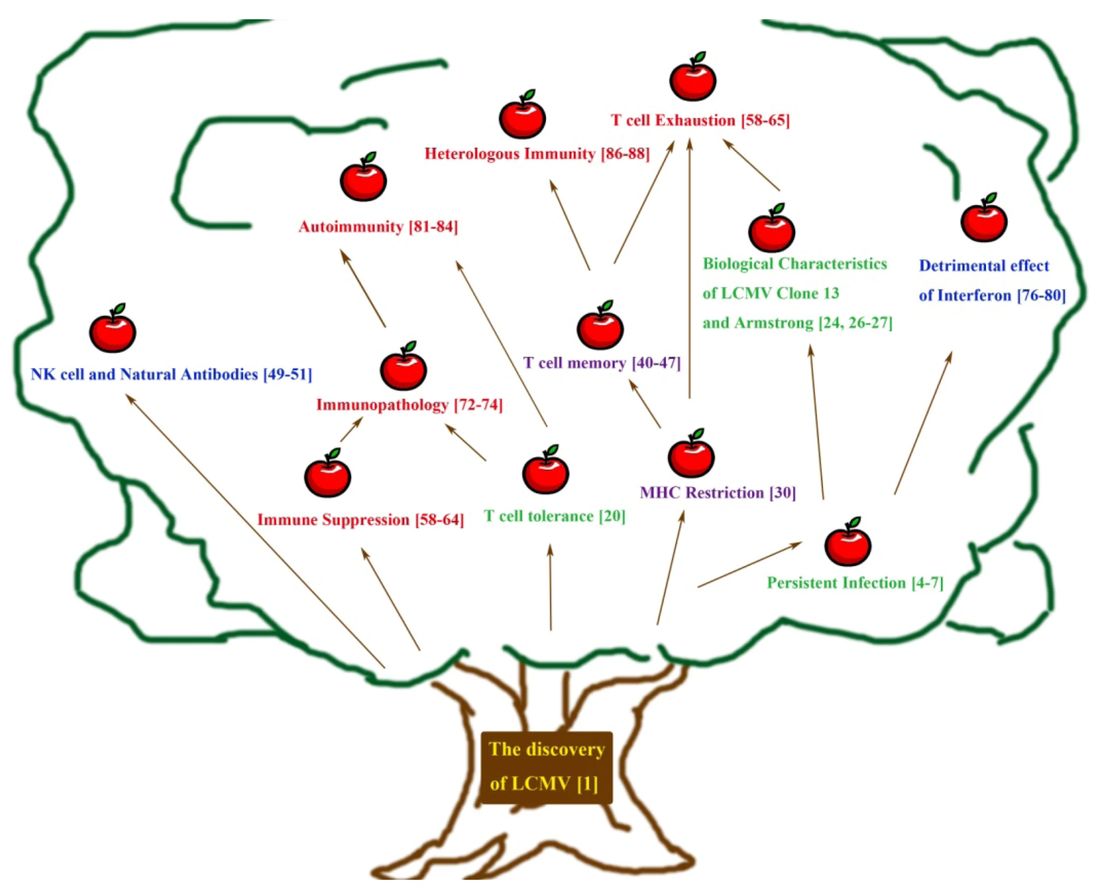 Figure 1. Tree of knowledge as disseminated by the lymphocytic choriomeningitis virus (LCMV) model system. This tree depicts a partial history of significant research milestones with the LCMV model system. The conceptual and/or experimental relationship between different discoveries is represented by uni-directional arrows. Green font is used to represent the first part of this review, concepts in persistent viral infection. Purple is used to highlight the second section, T cell immunity. Blue is used to represent the third section, innate immunity. Lastly, red represents the fourth and final section of immune dysfunction.1
LCMV is a negative-sense arenavirus with the ability to infect a broad range of different cell types, including dendritic cells, tumor cells, neural cells, etc., by binding to the α-dystroglycan receptor. This characteristic of LCMV can be developed for the tropism improvement of gene therapy.
Pseudotyping of Lentiviral Vector by LCMV
Pseudotyping is a favorable glycoprotein optimization method to improve the transduction efficiency and stability of lentiviral vector by combining the foreign viral envelope proteins with the lentiviral vector. Pseudotyping lentiviral vectors using arenavirus, commonly glycoprotein of LCMV, have been demonstrated to infect several cell types, including hepatoma cells, neuronal cells, glioma cells, epithelial cells, etc. Additionally, LCMV pseudotyped lentiviral vectors are much safer due to non-cell toxicity of LCMV envelope glycoproteins. Furthermore, the LCMV enters cells by binding to α-dystroglycan, an extracellular matrix protein receptor that mainly expressed on dendritic cells, which makes LCMV pseudo-lentiviral vectors more easily recognized by the immune system.
LCMV Glycoprotein (LCMV-GP) and Cell Entry Mechanism
The LCMV-GP is synthesized as a precursor (GP-C) that is proteolytically cleaved by the cellular protease SKI-1/S1P into two subunits:
- GP1: Responsible for receptor binding.
- GP2: A class I fusion protein that mediates pH-dependent membrane fusion within the endosome.
The primary cellular receptor for most LCMV strains is alpha-Dystroglycan (alpha-DG), a highly conserved component of the extracellular matrix linkage. The distribution of alpha-DG—highly expressed in the central nervous system (CNS), skeletal muscle, and specific immune subsets—dictates the unique tropism of LCMV-pseudotyped LVs.
Applications of LCMV-pseudotyped Lentiviral Vectors
Many studies have reported the use of LCMV-pseudotyped lentiviral vectors. Lentiviral vectors tend to infect cancer cells after pseudotyping with LCMV glycoproteins. It has been reported that LCMV-pseudotyped lentiviral vectors can efficiently transduce solid glioma cells and specifically target infiltrating tumor cells. LCMV-pseudotyped lentiviral vectors also exhibit potential for targeting neural stem/progenitor cells in vivo. Besides, alternative pseudotyping of lentiviral vectors with LCMV can minimize adverse vector effects, such as hepatic and systemic injury.
Our Core LCMV Pseudotyping Strategy
LCMV Glycoprotein Selection & Engineering
We provide expression constructs for wild-type GP from various LCMV strains. More importantly, we offer GP engineering services. Through site-directed mutagenesis of the GP1 receptor-binding domain or the GP2 fusion domain, we can fine-tune its affinity for α-DG, alter tropism, or even enhance its stability under different pH conditions, thereby systematically optimizing vector transduction efficiency and targeting specificity.
Lentiviral Vector Packaging Optimization
The assembly efficiency of LCMV GP with the lentiviral core particle is critical for determining the final viral titer. Our platform optimizes the ratio of the GP expression plasmid to lentiviral packaging plasmids, employs high-efficiency promoters, and refines the culture conditions of producer cell lines to produce high-titer, highly stable LCMV-pseudotyped lentiviral particles, ensuring batch-to-batch consistency.
Why Choose LCMV-Pseudotyped Lentiviral Vectors?
Compared to the commonly used VSV-G pseudotype, LCMV-pseudotyped vectors offer distinct advantages:
- Significantly Reduced Cytotoxicity: VSV-G exhibits marked cytotoxicity across many cell types, whereas LCMV GP-mediated infection is gentler. This favors the long-term survival and functional study of transduced cells, particularly crucial for primary cells and stem cells.
- Unique Cell Tropism Profile: LCMV pseudotypes exhibit superior transduction efficiency in α-DG-expressing cells, including dendritic cells, macrophages, endothelial cells, and various neurons and glial cells. They are also effective for some difficult-to-transduce tumor cell lines.
- Enhanced Biosafety Profile: VSV-G pseudovirions may be recognized by neutralizing antibodies present in serum. Pre-existing antibodies against LCMV GP are less common in the human population, reducing the risk of neutralization during in vivo applications or when using serum-containing media.
- Ideal for Delicate Studies: For experiments requiring avoidance of VSV-G's substantial cytotoxic interference or targeting cell populations with high α-DG expression, LCMV pseudotyping is the superior choice.
Service At Creative Biolabs
We understand the diversity of research needs and offer flexible customization:
Specific Cell/Tissue Targeting Optimization
Tailoring LCMV GP sequences or combining them with other targeting moieties based on your target cell type.
Combined Gene Expression Strategy
Integrating LCMV-pseudotyped vectors with tissue-specific promoters for spatiotemporally controlled gene expression.
Pseudotype Comparison Studies
Parallel preparation and testing of various pseudotyped vectors to provide data-driven selection of the optimal option.
Integrated Project Development
Incorporating LCMV-pseudotyped vector construction into your larger-scale projects, such as gene therapy development, gene editing, or in vivo gene therapy, providing end-to-end technical support.
Functional Analysis of LCMV-Pseudotyped Vectors
We provide a comprehensive in vitro validation data package:
- In Vitro Transduction Efficiency Analysis: Transduction is performed on client-specified target cells (e.g., primary T cells, dendritic cells, neural stem cells, tumor cell lines). Transgene (e.g., GFP) expression levels are quantified via flow cytometry or fluorescence microscopy.
- Cell Tropism and Receptor Dependency Validation: Receptor blockade experiments (e.g., using anti-α-DG antibodies or soluble α-DG) confirm whether transduction is α-DG pathway-dependent. We can also provide tropism profiling data across a panel of cell lines.
- Safety and Cytotoxicity Assessment: Cell viability post-infection with LCMV versus VSV-G pseudotyped viruses is quantitatively compared using methods like CCK-8 or MTT assays, confirming the low-toxicity advantage.
Advantages of Our Services
Deep Technical Expertise
Years of project experience in lentiviral systems, viral envelope engineering, and pseudotyping technologies.
Mature LCMV GP Platform
A well-established and validated system for LCMV GP expression, optimization, and quality control.
One-Stop Solution
Seamless service from molecular design, virus packaging, and titer determination to comprehensive functional validation.
Support Across the R&D Cycle
We provide matched technical services from early proof-of-concept and preclinical research to translational medicine applications.
Customer Reviews

Frequently Asked Questions
Q: Are LCMV-pseudotyped lentiviruses safe?
A: Yes. LCMV itself is a BSL-2 agent. Lentiviral vectors pseudotyped with their glycoprotein do not carry the genetic material necessary for viral replication, and we employ a third-generation self-inactivating lentiviral system, ensuring high biosafety.
Q: Are they suitable for primary immune or neural cells?
A: Yes. This is one of the core strengths of LCMV pseudotyping. It exhibits high transduction efficiency and very low cytotoxicity in primary T cells, DCs, and various neurons and glial cells.
Q: What are the main advantages compared to VSV-G pseudotyping?
A: The core advantages are lower cytotoxicity and efficient transduction of specific cell types (high α-DG expressors). It avoids the substantial toxic interference of VSV-G, making it more suitable for experiments requiring long-term cell survival and functional maintenance.
Q: Do you support in vivo application studies?
A: Yes. Due to their lower pre-existing immunity and lower toxicity, LCMV-pseudotyped vectors are feasible for in vivo studies in models such as mice, particularly for local delivery to the nervous or immune systems.
Q: Can this be combined with other vector optimization schemes?
A: Absolutely. Our service can be flexibly combined with other custom services, such as promoter optimization, reporter gene exchange, or CRISPR component packaging, to meet your complex requirements.
Connect with Us Anytime!
Creative Biolabs has successfully completed many lentiviral vector-based gene therapy projects. Based on this abundant experience and advanced technology platform, we are excited to offer our tailored lentiviral vector pseudotyping services to help you get landmark development. If you are interested in the optimization of lentiviral vectors for gene therapy, you can directly contact us for more detailed information.
Reference
- Zhou X, Ramachandran S, Mann M, et al. Role of lymphocytic choriomeningitis virus (LCMV) in understanding viral immunology: past, present and future. Viruses, 2012, 4(11): 2650-2669. https://doi.org/10.3390/v4112650 (Distributed under Open Access license CC BY 4.0, without modification.)
