
Tumor Tropism Enhancement Service
Introduction
Many face challenges like nonspecific delivery, off-target toxicity, and narrow therapeutic windows in oncolytic virus and gene therapy development. Our OncoVirapy™ Platform addresses these via the Oncolytic Adenovirus Enhancement Service, leveraging advanced viral engineering, targeted modification strategies, and proprietary protocols to overcome delivery barriers, maximize therapeutic impact, and reduce systemic side effects.
Strategic enhancement of tumor tropism is critical for viral vector-based therapeutics. By precisely targeting malignant cells while sparing healthy tissue, our approach unlocks their full therapeutic potential, minimizing off-target effects, improving safety, and advancing precision viral therapies through our extensive R&D expertise.
[Discover How We Can Help - Request a Consultation]
Workflow
| Required Starting Materials | Project Scoping & Design |
|---|---|
|
We start with an in-depth discussion to understand your goals and data. Creative Biolabs experts design a customized viral engineering strategy using tropism enhancement techniques like receptor retargeting. Outcome: a detailed project plan with modifications and validation steps. |
| Viral Engineering & Optimization | In Vitro Validation |
| Through the use of advanced molecular biology to implement designed modifications into viral vectors, yielding optimized constructs for preliminary testing. | Modified vectors undergo rigorous in vitro testing in cancer models to evaluate infection efficiency, specificity, cytotoxicity, transgene expression, and oncolytic effects, generating quantifiable data on enhanced tropism and activity. |
| In Vivo Efficacy Assessment | Data Analysis and Reporting |
| Promising constructs advance to in vivo studies via preclinical animal models. Engineered vectors are systemic/locally administered, with tumor regression, biodistribution, and off-target accumulation monitored via imaging/molecular techniques to provide complex biological system performance data. | Our bioinformatics and scientific teams analyze all data from design to in vivo results, offer interpretations, identify findings, suggest next steps, and deliver a data-driven report. |
| Final Deliverables | Estimated Timeframe |
|
The typical timeframe for this service ranges from 10 to 15 weeks, depending on the complexity of the engineering, the number of constructs to be tested, and the scope of in vivo validation required. Factors influencing duration include the availability of specific cell lines, the extent of iterative optimization, and the chosen animal models. |
[Discover How We Can Help - Request a Consultation]
What We Can Offer
Customized Vector Design
Tailored design and engineering of oncolytic adenoviruses or gene therapy vectors to achieve optimal tumor targeting based on your specific project requirements and target cell characteristics.
Precision Capsid Engineering
Advanced modification of viral capsid proteins to enable highly selective binding to tumor-specific receptors, significantly reducing off-target interactions.
Enhanced Transcriptional Control
Integration of proprietary tumor-specific promoters to ensure gene expression and viral replication is exclusively confined to malignant cells, maximizing therapeutic impact.
Robust In Vitro & In Vivo Validation
Comprehensive evaluation of engineered vectors for tropism, efficacy, and safety across a range of relevant preclinical models, providing robust data to support your pipeline.
Strategic Immune Evasion/Modulation
Development of viral constructs designed to navigate the host immune response effectively, ensuring sustained therapeutic activity and minimizing neutralizing antibody formation.
Scalable Solutions for Preclinical and Clinical Needs
While focused on preclinical development, our strategies are designed with future scalability in mind, facilitating a smooth transition from research to clinical applications.
Expert Consultation and Project Management
Dedicated scientific support from initial concept through final data delivery, ensuring clear communication and efficient project progression.
[Experience the Creative Biolabs Advantage - Get a Quote Today]
One-Stop Oncolytic Adenovirus Enhancement Service
The efficacy of OAd therapies hinges on their ability to selectively target, infect, and replicate within tumor cells while minimizing off-target effects in healthy tissues. Creative Biolabs offers a comprehensive service for engineering OAds with enhanced tumor tropism, employing advanced molecular strategies to achieve superior therapeutic precision.
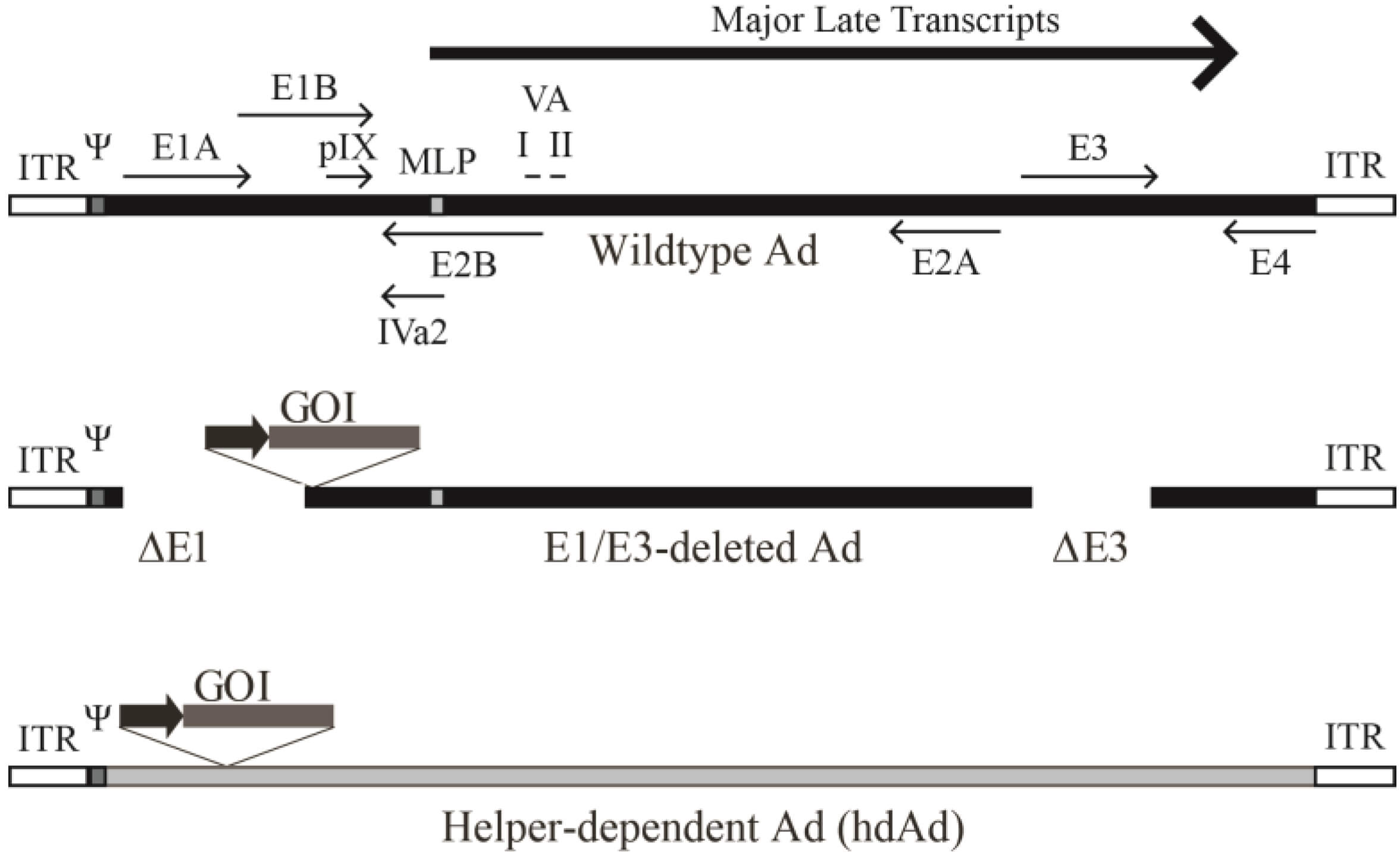 Fig.1 Schematic representation of the adenovirus genome and various adenovirus vectors.1
Key technical approaches include:
- Receptor Retargeting: Modify viral capsid (e.g., fiber knob) to bind tumor-specific receptors (e.g., αvβ3/αvβ5 integrins), redirecting infection from native receptors to cancer cells.
- Transcriptional Targeting: Integrate tumor-specific promoters to restrict viral replication/transgene expression to the tumor microenvironment.
- MicroRNA (miRNA) Detargeting: Incorporate miRNA binding sites (high in healthy cells) to block replication in non-tumor tissues while enabling it in tumors.
- Genetic Arming: Introduce therapeutic genes (e.g., pro-apoptotic/immune-stimulating factors) under tumor-promoter control to amplify oncolysis.
- Conditional Replication Control: Engineer gene mutations (e.g., E1B/E3) to exploit cancer cell pathway defects, limiting replication to tumors.
Tab.1 Enhancing tumor tropism of oncolytic adenoviruses by genetic modification.
| Oncolytic Virus | Modification | Application |
|---|---|---|
| OncoAd-P28-E1A-ΔE1B | p28 regulated the E1A region of the adenovirus genome, the E1B region is deleted completely, expression TRIAL | The oncolytic adenovirus can not only specifically target and kill hepatocellular carcinoma cells, but also express TRAIL in hepatocellular carcinoma cells to play a dual role of targeting and promoting apoptosis of hepatocellular carcinoma cells |
| Delta-24-RGD | It has a 24-base-pair deletion in the E1A region and RGD-4C modification in the viral fiber | It selectively replicates in tumor cells with abnormalities in the p16/RB/E2F pathway |
| oAd/DCN/LRP-PEG-NT | Neurotensin peptide conjugate polyethylene glycol is chemically cross-linked to the surface of oncolytic viruses | It can improve the therapeutic effect of pancreatic tumors by degrading the extracellular matrix (ECM) and disrupting Wnt signaling |
| OAd-TNF-α-IL2+CAR-T | Mesothelial redirected chimeric antigen receptor T cells (meso-CAR T cells) were combined with oncolytic adenovirus expressing TNF-α and IL-2 (OAd-TNFa-IL2) | Significantly improved the efficacy of anti-pancreatic ductal adenocarcinoma, increased tumor-infiltrating lymphocytes (TIL), enhanced T cell function, prevented tumor metastasis, and induced tumor regression |
| Ad5/3-D24-GMCSF | Incorporation of the GM-CSF transgene into the adenovirus genome improved dendritic cell activity and enhanced tumor antigen presentation to T cells | Effective eradication of human melanoma cells and complete tumor regression are achieved in a nude mouse xenograft model |
By applying advanced engineering principles, Creative Biolabs develops oncolytic adenoviruses (OAds) with significantly improved tumor tropism. As a leader in viral vector innovation, we offer expertise in tumor tropism enhancement for OAds and gene therapies, providing end-to-end solutions from custom engineering to rigorous validation. Partner with us to overcome targeted delivery challenges and unlock the full potential of next-gen cancer treatments.
[Contact Our Team for More Information and to Discuss Your Project]
Related Sections
 Distributed under Unsplash License, from Unsplash. Enhancing Safety and Tumor Selectivity
 Distributed under Unsplash License, from Unsplash. Enhancing Efficacy
Reference
- Saha, Bratati, Carmen M. Wong, and Robin J. Parks. "The adenovirus genome contributes to the structural stability of the virion." Viruses 6.9 (2014): 3563-3583. DOI: 10.3390/v6093563. Distributed under Open Access license CC BY 4.0, without modification.