
Creative Biolabs is offering the most comprehensive services for antibody development projects. With strict regulation and effective execution, we are dedicated to providing the most valuable solutions to complete your projects.
HighlightsCreative Biolabs is offering the most comprehensive services for antibody development projects. With strict regulation and effective execution, we are dedicated to providing the most valuable solutions to complete your projects.
HighlightsCreative Biolabs has established a broad range of platforms for developing novel antibodies or equivalents. These cutting-edge technologies enable our scientists to meet your demands from different aspects and tailor the most appropriate solution that contributes to the success of your projects.
HighlightsWith deep understanding in antibody-related realms and extensive project experience, Creative Biolabs offers a variety of references to help you learn more about our capacities and achievements, including infographic, flyer, case study, peer-reviewed publications, and all kinds of knowledge that can assist your projects. You are also welcome to contact us directly for more specific solutions.
HighlightsGet a real taste of Creative Biolabs, one of the most professional custom service providers in the world. We are committed to providing highly customized comprehensive solutions with the best quality to advance your projects.
Highlights Loading...
All listed services and products are For Research Use Only. Do Not use in any diagnostic or therapeutic applications.
Glycoprotein VI (GP6), also known as GPVI 1, GPIV, platelet glycoprotein VI or platelet collagen receptor is a 339-amino acid type I transmembrane glycoprotein of the immunoglobulin superfamily with an estimated molecular weight of ~37.5 kDa and apparent m.w..of platelets in SDS-PAGE being between58-65kD due to extensive N-linked glycosylation. The activated GP6 forms a signaling complex with two copies of the non-covalently bound Fc receptor gamma-chain (FcRγ) in platelets via complementary charged residues present at their respective transmembrane domains, where an arginine existed in position 60 of GP6 and aspartic acid appeared for position 65 in FCyR. The FcRγ chain, which is linked to the receptor and carries an immunoreceptor tyrosine-based activation motif (ITAM) that undergoes phosphorylation upon engagement with ligand (data not shown), has a key role in signal transduction by initiating downstream signaling events through Src family kinases (Fyn/Lyn), Syk, LAT as well as phospholipase Cγ2(PLCγ2) followed by PI3K. With GP6 expression at a moderate density, pharmacological saturation is possible. Although the receptor itself is not directly involved in non-immunoglubulin-like cell adhesion, it does recognize collagen via its D1 domain using Gly-Pro-Hyp (GPO) peptide repeats within a triple-helical structure found in fibrillar collagens such as types I and III [21], both of which are enriched at sites of human advanced plaque development or injury-related vascular subendothelium. Beyond simple collagen, GP6 has now been defined as a more universal receptor with similar multi-ligand specificity including fibrin(ogen), laminin, fibronectin and vitronectin positioning it as an example of a pattern recognition receptor that connects the tissue factor-coagulation cascade activated by thrombogenic pathways during thrombus growth/stabilization. GP6 mutations are responsible for the autosomal-dominant bleeding disorder-11 (BDPLT11), which is characterized by defective collagen-induced platelet aggregation and a mild bleeding diathesis, while GP6 deficiency paradoxically protects against arterial thrombosis without clinically significant impairment of physiological hemostasis— an attractive safety profile that has propelled GP6 to prominence in antithrombotic drug development.
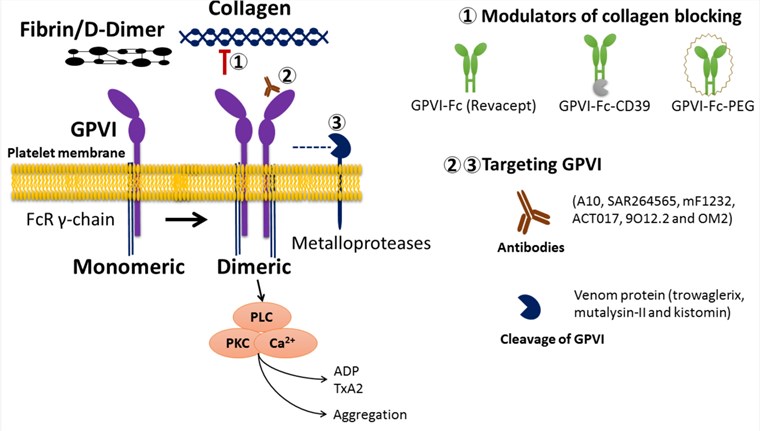 Fig.1 Antiplatelet activity through differential modulation of glycoprotein VI and its collagen binding.1
GP6 functional contributions span the full range of platelet biology from initial adhesion to thrombus consolidation:
Creative Biolabs offers an extensive range of premium GP6 membrane protein products for the structural and functional analysis of this platelet specific immunoglobulin superfamily receptor. Using our proprietary Membrane Protein technology, we can produce GP6 across a range of expression systems. These rigorously validated proteins are available for use as ELISA standards, immunoassay development tools, antibody generation and characterization reagents, binding assays to collagen molecules/models/purified adhesins/in situ tissues/cell lines; experimental links between mechanisms of functional platelet activation biology. These tools allow researchers to discriminate GP6 interactions with collagen, fibrin(ogen), laminin and the FcRγ signaling complex.
Not finding the membrane protein product you need? Contact us to start your one-stop custom service!
Creative Biolabs manufactures proprietary GP6 membrane protein stable cell lines that consistently produce high target GP6 expression levels. These stable cell lines are excellent systems for drug screening, ligand binding studies and platelet activation assays as well as modelling of thrombus formation that can be readily developed to high throughput including the study of GP6 biology and pharmacology in a highly reproducible model system. With our knowledge, we guarantee you the best expression and cell integrity in order to speed up your research pipeline. We provide GP6-overexpressing lines useful for the elucidation of collagen and fibrin(ogen) binding mechanisms, and also GP6-knockdown lines facilitating loss-of-function studies with validated expression verified by flow cytometry, Western blotting or functional assays based on activation upon collagen-mediated stimulation. These ITAM-dependent luciferase readouts, in conjunction with specialized reporter systems cell lines to track GP6 signaling dynamics over time, will be useful when synergetically used during thrombosis and hemostasis models for basic mechanisms of therapeutic screening.
Not finding the stable cell line product you need? Contact us to start your one-stop custom service!
We offer a significant array of high-affinity recombinant antibodies specific for GP6 to support the needs of your most demanding research applications. These antibodies, developed utilizing emerging recombinant technologies, provide advantages of increased specificity and sensitivity with more reproducible batch-to-batch consistency over traditional polyclonal antibodies. Our range of GP6 recombinant antibodies are rigorously validated for Western Blotting (WB), ELISA, Flow Cytometry (FCM), Immunofluorescence (IF),Immunocytochemistry(ICC), immunohistochemistry(IHC) and Immunoprecipitation(IP). These reagents enable precise detection and quantification of GP6 in a variety of sample types including platelet lysates as well as megakaryocyte cultures; plasma samples ::plasma::and serum samples. We provide antibodies for the monomeric AND dimeric forms of GP6, supporting receptor state profiling and assessment of its competence to form dimers. Further reagents against the D1 collagen-binding domain, the D2 dimerization interface and FcRγ association site bolster detailed structure-function studies on GP6 with pharmacological modulation.
Not finding the recombinant antibody product you need? Contact us to start your one-stop custom service!
In addition to our catalog products, Creative Biolabs also provides customized services for membrane protein and antibody discovery & development. With our vast expertise and advanced platforms we can help you with:
No, all Creative Biolabs GP6 products/services are laboratory research use only (RUO), not for clinical diagnosis, prevention or treatment of any disease.
We have a wide variety of products to support GP6 research, including recombinant GP6 membrane proteins in different formats (VLPs, mammalian membrane extracts, ECD-Fc fusions, monomeric/dimeric variants), stable cell lines expressing GP6 for overexpression and ITAM reporter functionality studies, high-affinity anti-GP6 antibodies targeting distinct epitopes.
Yes, the immunogen is derived from a highly conserved region of all mammalian species assuring a consistent detection in mouse and rat platelet & megakaryocyte preparations without huge amounts of need for different primary (species-specific) antibodies.
Yes, we provide recombinant proteins as well as stable cell lines that express characterized pathogenic substitutions in the immunoglobulin-like domain or transmembrane region leading to either disrupted collagen recognition (e.g., R75W) or partial loss of FcRγ coupling (S87C). These reagents allow direct comparison of ligand-binding kinetics, tyrosine kinase recruitment efficiency and granule secretion magnitude relative to wild-type benchmarks in defined cellular environments.








