Creative Biolabs is offering the most comprehensive services for antibody development projects. With strict regulation and effective execution, we are dedicated to providing the most valuable solutions to complete your projects.
HighlightsCreative Biolabs is offering the most comprehensive services for antibody development projects. With strict regulation and effective execution, we are dedicated to providing the most valuable solutions to complete your projects.
HighlightsCreative Biolabs has established a broad range of platforms for developing novel antibodies or equivalents. These cutting-edge technologies enable our scientists to meet your demands from different aspects and tailor the most appropriate solution that contributes to the success of your projects.
HighlightsWith deep understanding in antibody-related realms and extensive project experience, Creative Biolabs offers a variety of references to help you learn more about our capacities and achievements, including infographic, flyer, case study, peer-reviewed publications, and all kinds of knowledge that can assist your projects. You are also welcome to contact us directly for more specific solutions.
HighlightsGet a real taste of Creative Biolabs, one of the most professional custom service providers in the world. We are committed to providing highly customized comprehensive solutions with the best quality to advance your projects.
Highlights Loading...
All listed services and products are For Research Use Only. Do Not use in any diagnostic or therapeutic applications.
Podoplanin (PDPN) is a highly O-glycosylated type I transmembrane glycoprotein encoded by PDPN gene, selectively expressed on lymphatic endothelial cells, mesothelial lining cells and multiple invasive carcinoma subpopulations, carrying unique sialylated extracellular glycan motifs that mediate specific binding to platelet CLEC-2 C-type lectin receptors. Under embryonic developmental states, PDPN expression exclusively distinguishes lymphatic endothelial progenitors from blood vessel endothelial lineages, driving lymphatic capillary sprouting, vessel maturation and separation of lymphatic and blood vascular networks via CLEC-2 dependent platelet aggregation signaling that prevents abnormal lymphatic-blood vessel anastomosis. Within mature tissue microenvironments, physiological PDPN maintains lymphatic endothelial barrier integrity and interstitial fluid drainage function to sustain tissue fluid homeostasis. In malignant lesions, de novo PDPN expression on tumor cell surfaces reshapes cell-matrix adhesive properties to enhance invasive migratory capacity, while tumor-derived PDPN engages circulating platelet CLEC-2 receptors to trigger platelet aggregate formation, generating protective tumor cell-platelet complexes that shield malignant cells from immune clearance during lymphatic metastatic dissemination. Distinct from pan-endothelial surface markers shared by blood and lymphatic vessels, PDPN represents a definitive lineage biomarker specific to lymphatic endothelium and invasive tumor clones, with no functionally equivalent glycoprotein capable of replacing its CLEC-2 binding and lymphangiogenic regulatory activity. Suppressed PDPN expression impairs embryonic lymphatic vessel formation and blocks tumor lymphatic metastasis potential, while sustained high PDPN surface abundance correlates with increased lymphatic spread and advanced tumor staging, establishing PDPN as a core research target for lymphatic vascular biology and metastatic tumor mechanism exploration.
PDPN executes dual developmental and oncogenic regulatory function via heavily sialylated extracellular glycan domains that form high-affinity binding complexes with platelet CLEC-2 lectin receptors upon cell-cell contact. Its short cytoplasmic intracellular tail recruits actin cytoskeletal adaptor proteins to remodel cell-matrix adhesion complexes, lowering cell substrate attachment strength to promote single-cell migratory and invasive phenotypes in transformed cell populations. Conserved extracellular glycosylation sites generate negatively charged sialic acid motifs that serve as the sole recognition epitope for CLEC-2, enabling specific platelet-lymphatic or platelet-tumor cell signaling crosstalk without cross-recognition of other vascular surface glycoproteins. PDPN-mediated CLEC-2 signaling sustains balanced vascular developmental homeostasis, covering ordered lymphatic vessel patterning and controlled malignant cell lymphatic dissemination. PDPN participates in extensive physiological and pathological processes including embryonic lymphangiogenesis, interstitial fluid transport, platelet-tumor crosstalk and lymphatic metastatic progression. Aberrant tumor PDPN upregulation disrupts normal tissue adhesive balance and accelerates regional lymphatic tumor spread. Therefore, PDPN represents a pivotal research target for lymphatic glycoprotein biology and anti-metastatic compound screening.
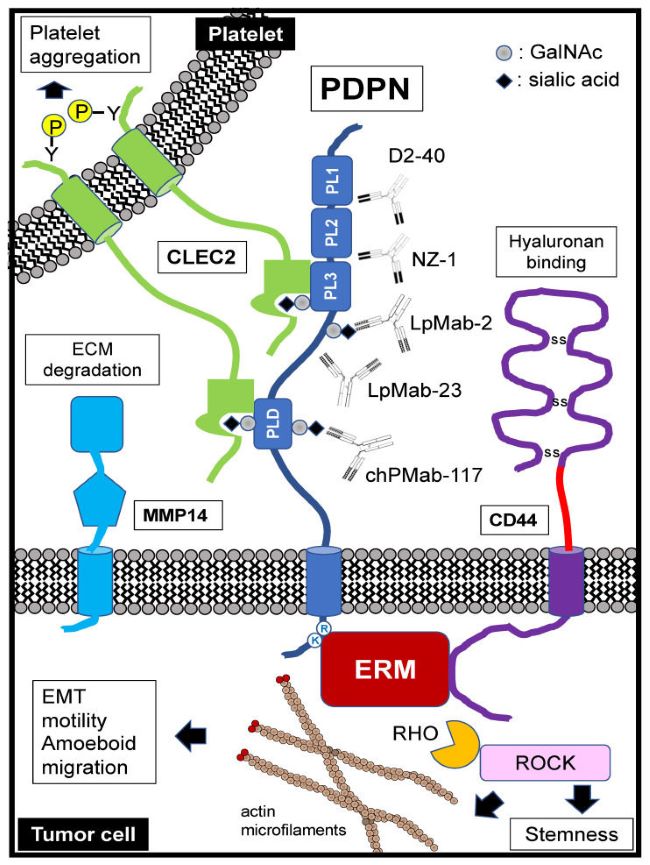 Fig. 1 PDPN intermolecular interactions drive platelet aggregation, tumor migration and cancer stemness phenotypes.1
The biological functions of PDPN are focused on lymphatic endothelial lineage marking, sialoglycan CLEC-2 ligand binding and invasive migratory remodeling:
Creative Biolabs offers high-quality PDPN proteins through optimized expression systems, including full-length glycosylated membrane PDPN. These products retain native conformational characteristics and CLEC-2 ligand-binding biological activity, suitable for glycoprotein receptor interaction assays and anti-metastatic tumor compound screening. All PDPN proteins undergo strict quality control to ensure consistent performance and reliable application across diverse research platforms.
Not finding the membrane protein product you need? Contact us to start your one-stop custom service!
Creative Biolabs provides custom-engineered PDPN stable cell lines, including overexpression and blank control models. These cell lines are optimized for lymphatic endothelial differentiation research and tumor invasive migratory functional analysis. Each cell line undergoes stringent validation to ensure stable expression profiles and consistent functional performance in diverse experimental contexts.
Not finding the stable cell line product you need? Contact us to start your one-stop custom service!
High-specificity recombinant antibodies targeting PDPN are developed via advanced antibody engineering technologies, with no cross-reactivity with other vascular transmembrane glycoproteins. These antibodies are validated for lymphatic vessel tissue staining and invasive tumor cell surface localization detection, and can be combined with CLEC-2 detection reagents to quantify glycoprotein-receptor binding interactions in vascular and metastatic tumor research models.
Not finding the recombinant antibody product you need? Contact us to start your one-stop custom service!
Beyond catalog products, Creative Biolabs offers specialized custom services for PDPN research:
PDPN is a sialylated transmembrane glycoprotein that binds platelet CLEC-2 receptors to drive lymphatic vessel development and promote tumor lymphatic metastasis.
Exclusive lymphatic endothelial expression plus tumor-specific induction makes PDPN a core biomarker and therapeutic target for lymphatic metastasis disorders.
No, all PDPN products and services are strictly for research use only, not intended for clinical diagnosis or treatment.
Offerings include glycosylated PDPN membrane proteins, high-specificity recombinant antibodies and custom stable cell lines for lymphatic and metastatic tumor research.
PDPN proteins are validated via CLEC-2 lectin receptor binding interaction testing.