
Aptamer-Protein Conjugates
Conjugation of aptamers with recombinant proteins, toxins, cytokines, growth factors, binding proteins, or other functional proteins for targeted delivery or dual-function molecular systems.


Creative Biolabs develops aptamer-protein and aptamer-peptide conjugates for researchers who need to combine the molecular recognition of an aptamer with the biological activity, delivery properties, catalytic function, immune activity, or structural features of a protein or peptide. We support conjugate design, site-selective chemistry, linker optimization, purification, analytical characterization, and fit-for-purpose functional validation.
Discuss Your Aptamer-Protein/Peptide ProjectOur service is built for programs in which a nucleic acid aptamer must be physically linked to a functional protein or peptide without compromising either component. Typical needs include targeted delivery of enzymes or toxins, bispecific aptamer-antibody constructs, peptide-assisted cellular uptake, affinity enhancement, immune-cell engagement, biosensor labeling, and development of multifunctional research reagents.
Projects may begin with a customer-supplied aptamer and payload or be integrated with our aptamer development service. When a suitable sequence has not yet been established, our one-stop aptamer in vitro selection service can be incorporated before conjugation development.
The payload class determines the most important development risks. We therefore select chemistry, purification, and validation methods according to the size, stability, reactive groups, and mechanism of the protein or peptide.
Conjugation of aptamers with recombinant proteins, toxins, cytokines, growth factors, binding proteins, or other functional proteins for targeted delivery or dual-function molecular systems.
Hybrid constructs that combine an aptamer-defined target with antibody recognition or Fc-mediated biology. Programs can examine conjugation orientation, aptamer-to-antibody ratio, retained binding, and cell-based activity.
Enzyme labeling or enzyme-payload formats for biosensing, signal generation, catalytic delivery, and mechanistic studies, with evaluation of enzyme activity after conjugation.
Direct coupling of bioactive peptides to an aptamer to introduce a second binding interface, modulate target function, improve localization, or enable targeted peptide delivery.
CPP-linked aptamers designed to improve cellular entry, intracellular trafficking, or endosomal escape while retaining target recognition and controlling nonspecific uptake.
Project-specific combinations involving proteins, peptides, aptamers, imaging labels, cleavable motifs, or secondary payloads can be developed when each component has a defined mechanistic role.
We can compare architecture options against the required mechanism and downstream assays.
A conjugation reaction can be chemically successful and still produce a poor biological reagent. Our development strategy therefore considers aptamer folding, payload orientation, reactive-site accessibility, linker behavior, stoichiometry, purification, and the intended biological environment together.
| Design Variable | Options | Key Development Question | Representative Evidence |
|---|---|---|---|
| Aptamer modification | 5′/3′ amine, thiol, azide, alkyne, biotin, spacer-equipped or other project-defined handle | Can the aptamer be functionalized without disturbing its binding fold? | Binding before/after modification and conjugation |
| Protein reactive site | Native lysines/cysteines, introduced cysteine, glycan-directed or affinity-assisted approaches | Can conjugation be controlled sufficiently to preserve protein function? | Conjugation ratio, intact-mass or electrophoretic analysis |
| Peptide attachment | N- or C-terminal coupling, side-chain attachment, solid-phase compatible conjugation | Which orientation keeps both aptamer and peptide pharmacophores accessible? | Identity, purity, binding and activity comparison |
| Linker architecture | PEG, disulfide, protease-cleavable, acid-labile, noncleavable or custom spacers | Should the payload remain tethered or be released in a defined environment? | Stability, cleavage profile, functional response |
| Stoichiometry | Defined 1:1 format or controlled multivalent ratios | Does added valency improve function or create steric and aggregation risk? | Ratio determination, binding, size and activity |
Useful when a defined thiol is available on the aptamer, peptide, or engineered protein. Reaction pH, competing thiols, hydrolysis, and conjugate stability are optimized as part of feasibility work.
Suitable for amino-functionalized aptamers or accessible protein amines, with careful control of reagent ratio and reaction conditions to reduce over-modification and heterogeneity.
Azide-alkyne approaches support selective coupling and can be useful for peptides, proteins, and multicomponent systems when compatible handles can be installed.
Redox-sensitive linkages can be considered for intracellular release or for protein payloads where a reducible connection is mechanistically useful.
Noncovalent or semi-modular assembly can be useful for rapid feasibility studies, biosensor development, or systems requiring interchangeable components.
Alternative site-selective methods can be evaluated when random amine or cysteine modification is unacceptable because of payload activity, heterogeneity, or downstream analytical requirements.
Start with a focused conjugation feasibility study comparing one or more chemistry and linker options.
Electrophoresis, chromatography, mass-based analysis, or orthogonal confirmation selected according to construct size and chemistry.
Assessment of residual free aptamer, protein, peptide, linker, or reaction by-products after purification.
Estimation or determination of aptamer-to-protein ratio, degree of labeling, or defined product stoichiometry.
Storage, dilution, serum or matrix challenge, nuclease exposure, freeze-thaw, and linker-specific stability as relevant.
Assays are selected to show that conjugation has not simply created the expected molecular mass, but has retained the biological roles needed for the proposed mechanism. Broader aptamer testing can be connected with our aptamer characterization services and aptamer in vitro analysis services.
Programs can be configured as a compact feasibility package or an integrated development sequence. Decision gates are used to avoid carrying poorly characterized conjugates into expensive biological studies.
Align target, aptamer, protein/peptide role, required linkage behavior, controls, and success criteria.
Review or generate functional handles and establish quality criteria for the aptamer and payload.
Compare chemistry, linker, ratios, buffer, time, temperature, and purification conditions.
Confirm identity, purity, ratio, stability, and retained activity of both functional components.
Test target-dependent binding, uptake, catalytic, signaling, cytotoxic, or immune response as appropriate.
Sequence discovery, modification, conjugation, and biological validation can be coordinated in one program.
Use aptamer recognition to enrich a toxin, enzyme, cytokine, or other protein payload at a target cell or molecular compartment.
Direct bioactive, inhibitory, signaling, or cell-penetrating peptides toward a defined target while reducing nonspecific exposure.
Combine aptamer recognition with antibody or protein binding to bridge two molecular targets or cellular populations.
Extend the aptamer recognition interface with a rationally selected peptide to alter affinity or functional activity.
Attach enzymes or reporter proteins while preserving aptamer recognition for analytical and diagnostic assay development.
Develop conjugates directed to complement proteins, regulators, receptors, or disease-relevant cell markers and connect them with complement component inhibitor development.
These open-access original studies illustrate three different development questions: how peptide sequence can extend aptamer function, how a bispecific aptamer-antibody conjugate can retain both binding activities, and how enzyme labeling can be integrated into an aptamer detection system.
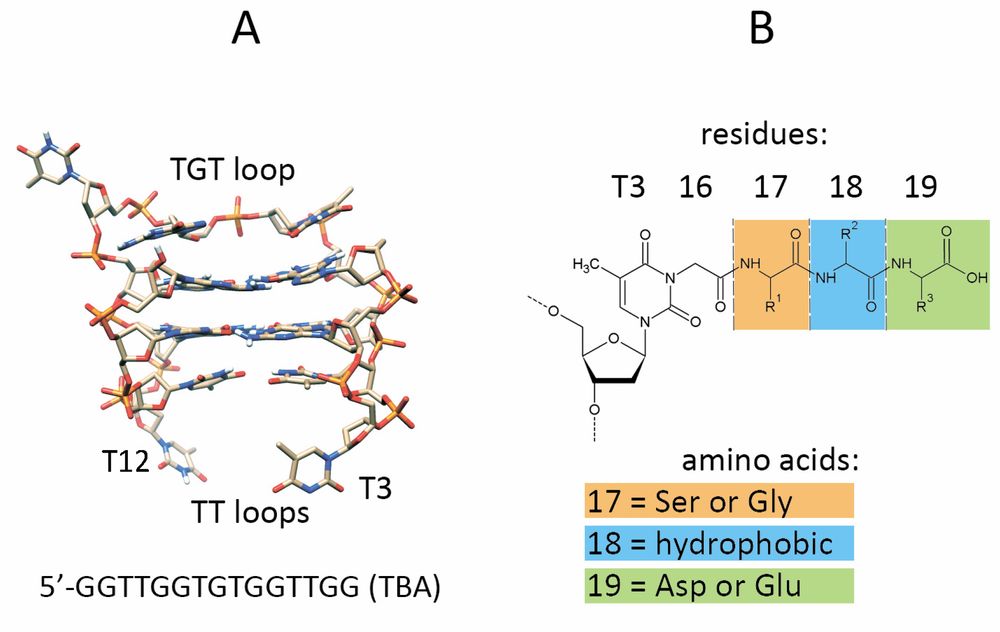
Varizhuk and colleagues optimized a tripeptide extension on a 15-nt thrombin aptamer and reported substantially improved anticoagulant activity, illustrating how peptide identity and attachment position can alter functional performance.
View research via DOI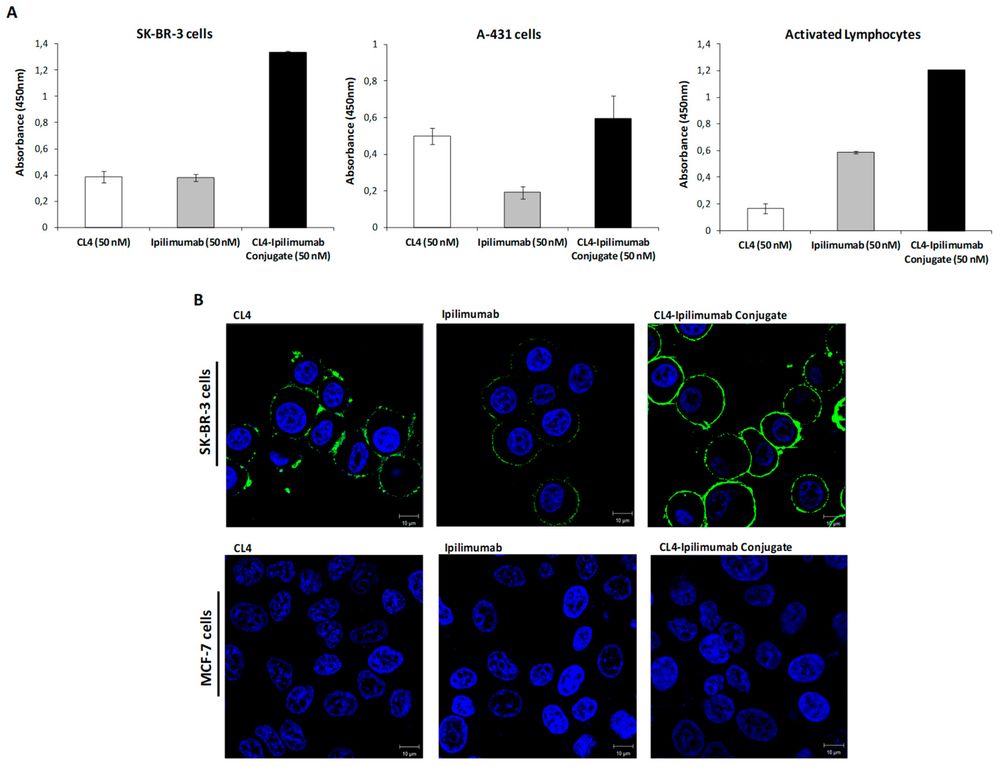
Passariello and colleagues chemically linked an EGFR-targeting RNA aptamer with ipilimumab and showed that the conjugate retained parental target binding while supporting enhanced immune-cell activity against cancer cells.
View research via DOI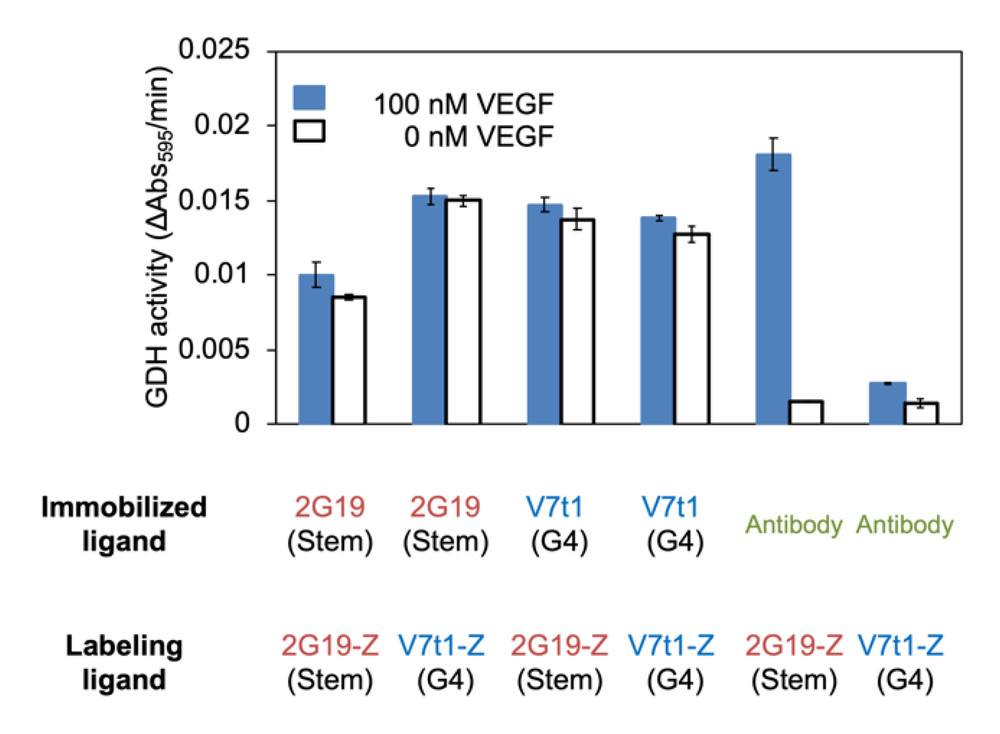
Lee and colleagues used a glucose dehydrogenase fusion protein as a functional labeling element in a DNA aptamer electrochemical system, demonstrating how aptamer recognition can be integrated with protein-based catalytic signal generation.
View research via DOIProjects may involve recombinant proteins, antibodies or antibody-derived formats, enzymes, toxins, cytokines, binding proteins, therapeutic peptides, cell-penetrating peptides, signaling peptides, or customer-defined research payloads. Feasibility depends on available conjugation handles, payload stability, required orientation, and the assays needed to confirm retained function.
Yes. We can begin with customer-supplied components and review sequence, modifications, purity, available reactive groups, target-binding data, payload activity, and material quantities before recommending a conjugation strategy.
The chemistry is selected from the molecular constraints of both components. Common considerations include the aptamer terminal handle, accessible protein cysteines or amines, peptide termini or side chains, desired site selectivity, linker stability, purification route, and whether the payload should remain attached or be released.
Depending on the payload and chemistry, development can aim for a defined 1:1 product or a controlled degree of labeling. Analytical methods are selected to assess conjugation ratio and product heterogeneity before functional testing.
We combine analytical confirmation with fit-for-purpose functional tests. These can compare aptamer binding before and after conjugation and separately evaluate protein binding, enzyme activity, peptide bioactivity, target-selective uptake, immune-cell response, or another mechanism-specific endpoint.
Yes. Redox-sensitive, protease-cleavable, acid-labile, or other project-defined linkers can be considered when payload release is part of the intended mechanism. Stability and cleavage testing can be incorporated where suitable methods are available.
Please provide the target and research objective, aptamer sequence and modifications, protein or peptide identity, available reactive groups, known binding or activity data, preferred conjugate format, required material quantity, biological model, controls, and the decision the final data should support.

Complement Activity/Function Assay Products
Learn More
Complement Testing Services
Learn More
Complement Therapeutics Featured Products
Learn More
Complement Therapeutics Services Brochure
Learn More
Aptamer Development PLATFORM
Learn More
ComPLETTM Hemolysis Assay Solutions
Learn More