

The exosome mediated cell proliferation enhancement assay service at Creative Biolabs is developed to support in vitro research focused on how exosomes influence cell growth dynamics. Cell proliferation reflects coordinated regulation of cell cycle progression, metabolic activity, and intracellular signaling. Measuring these changes in response to exosome treatment provides important insight into how vesicle mediated communication shapes cellular behavior. Creative Biolabs designs proliferation assays that capture both short term and time dependent growth responses. Experimental setups are adjusted based on cell type, baseline growth rate, and expected responsiveness to exosome exposure. Careful control of culture conditions ensures that observed proliferation changes are directly associated with exosome mediated effects rather than external variability.
| Step | Detail |
|---|---|
| Step 1. Experimental Planning and Growth Model Selection | Creative Biolabs begins by reviewing the biological question, selecting appropriate cell models, and determining whether a short term or extended proliferation assessment is required. Growth characteristics of the selected cells are evaluated to guide assay timing. |
| Step 2. Cell Seeding and Baseline Stabilization | Cells are seeded at densities that allow measurable growth without reaching overconfluence during the assay period. Pre incubation conditions are standardized to establish consistent baseline proliferation rates. |
| Step 3. Exosome Treatment Design | Exosomes are applied across defined concentration ranges or as a single treatment condition, depending on study goals. Treatment duration is carefully aligned with expected proliferation kinetics. |
| Step 4. Proliferation Measurement Strategy | Cell growth is assessed using validated approaches such as DNA synthesis incorporation assays, metabolic activity based methods, or direct cell counting. Selection of method depends on sensitivity requirements and cell type characteristics. |
| Step 5. Time Course Monitoring and Data Collection | Measurements are taken at multiple time points when required to capture growth trends over time. This allows identification of early versus sustained proliferation effects. |
| Step 6. Data Processing and Interpretation | Creative Biolabs normalizes proliferation data against appropriate controls and provides statistical evaluation of differences between treatment groups. Graphical outputs support clear comparison and interpretation. |
| Step 7. Result Compilation and Delivery | Final reports include raw data, processed results, and methodological details. Data formats are structured to support publication preparation and integration into broader studies. |
To refine experimental design or discuss specific growth models, clients are welcome to connect with Creative Biolabs technical support team.
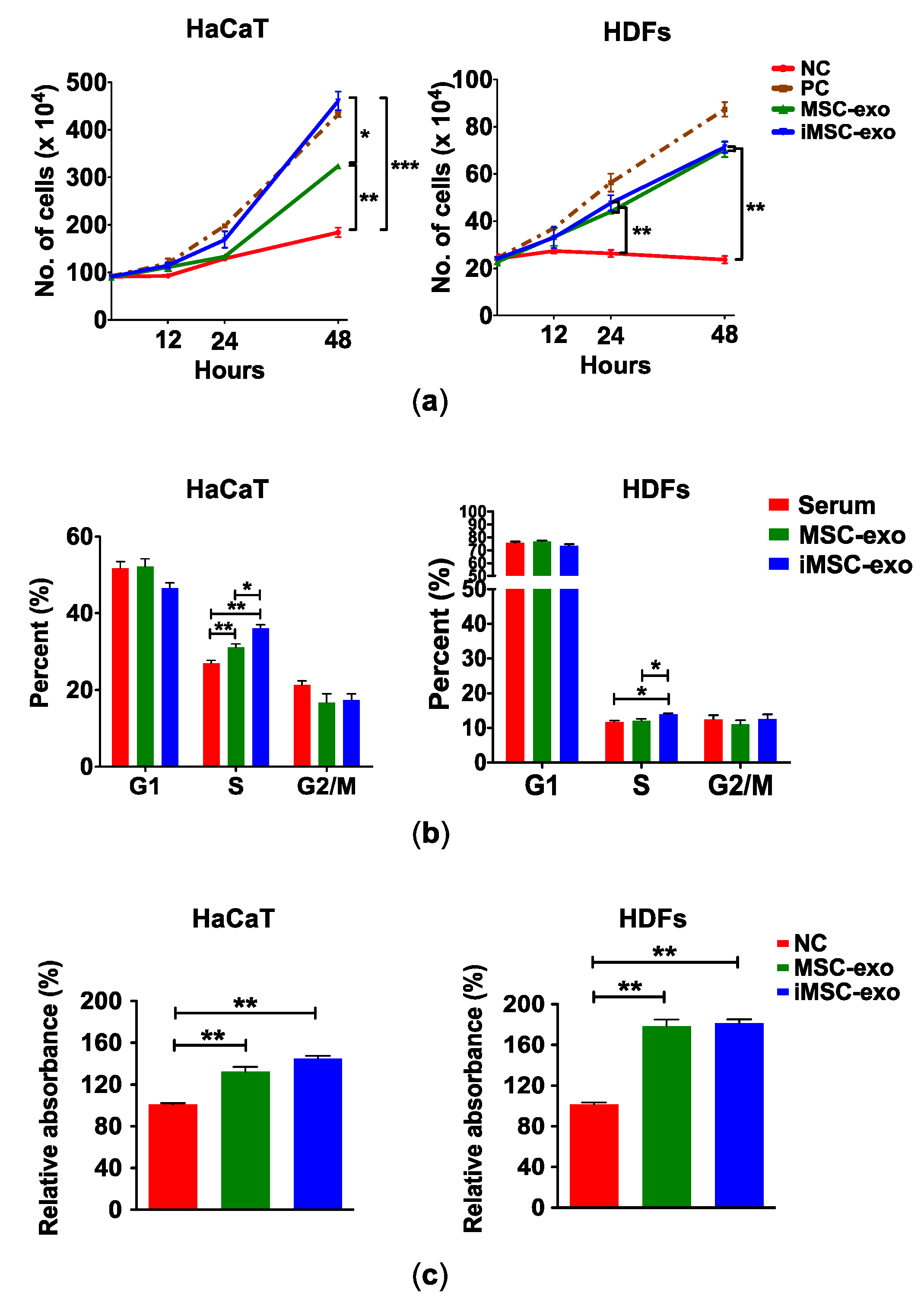 Fig.1 Analysis of growth kinetics, cell cycle progression, and survival of skin cells following treatment with exosomes.1




Researchers interested in integrating proliferation assays into broader functional studies may reach out to Creative Biolabs for technical discussion.
Multiple assay formats are available to match sensitivity requirements and experimental design, including endpoint and kinetic measurement approaches.
Sequential measurements enable tracking of proliferation trends rather than relying solely on single time point data.
Protocols are optimized for different growth rates and adherence properties, supporting both fast dividing and slower proliferating cells.
Standardized normalization allows accurate comparison between control and treated groups.
Proliferation data can be integrated with cell cycle analysis, signaling pathway evaluation, or gene expression profiling.
For guidance on selecting the most appropriate assay configuration, Creative Biolabs specialists are available for consultation.
For similar project support and data quality, Creative Biolabs encourages direct engagement with our scientific team.
Accurate measurement of cell proliferation provides a key link between exosome exposure and functional cellular outcomes. Through carefully controlled experimental design and reliable detection strategies, Creative Biolabs delivers data that support deeper understanding of growth related mechanisms in vitro. Researchers seeking a trusted partner for proliferation studies are encouraged to reach out to Creative Biolabs for tailored technical support and collaborative project planning.
A: The selection depends on cell type, expected signal strength, and experimental duration. For rapidly dividing cells, metabolic assays may provide efficient readouts, while slower growing cells may benefit from DNA synthesis based detection. Creative Biolabs evaluates these factors during project planning to ensure appropriate sensitivity and accuracy.
A: In some cases, parallel measurements can be incorporated if assay compatibility allows. This approach provides complementary information, distinguishing between increased cell number due to proliferation and changes related to survival. Creative Biolabs advises on feasible combinations based on the study design.
A: Yes. The assay design supports detection of both increased and decreased proliferation relative to controls. Data analysis highlights directional changes and statistical significance across treatment groups.
Reference