

The exosome induced cell viability promotion assay service at Creative Biolabs supports in vitro investigations focused on how exosomes influence cell survival under defined laboratory conditions. Changes in cellular viability often reflect protective signaling, metabolic adaptation, or resistance to environmental stress. Accurate measurement of these responses is essential for understanding the biological activity of exosome preparations in basic research settings.
Creative Biolabs designs viability assays that evaluate cellular metabolic activity, membrane integrity, and survival rates following exosome exposure. Experimental parameters such as exosome concentration, incubation time, and stress induction models are adjusted to match specific research objectives. By maintaining strict control over assay variables, Creative Biolabs ensures that observed viability changes are attributable to exosome treatment rather than procedural variability.
| Step | Detail |
|---|---|
| Step 1. Study Design and Parameter Alignment | Creative Biolabs initiates each project with a detailed discussion of the biological hypothesis, recipient cell model, and desired readouts. Considerations include baseline viability levels, stress conditions if applicable, and expected magnitude of response. |
| Step 2. Cell Model Preparation and Standardization | Recipient cells are cultured under optimized and consistent conditions. Cell density, passage number, and serum conditions are carefully controlled to minimize experimental variability and ensure reproducible baseline viability. |
| Step 3. Exosome Treatment Strategy | Exosomes are introduced at defined concentrations, either as single dose exposure or across a concentration gradient. Where relevant, stressors such as oxidative agents or nutrient limitation can be incorporated to assess protective effects under challenging conditions. |
| Step 4. Viability Measurement | Cell viability is quantified using validated detection platforms. Depending on study goals, metabolic activity assays, ATP quantification, or membrane integrity measurements may be applied. Time point selection is aligned with expected cellular responses. |
| Step 5. Data Normalization and Statistical Evaluation | Raw signals are normalized to appropriate controls to account for baseline variation. Replicates are analyzed to determine statistical significance and consistency across experimental groups. |
| Step 6. Reporting and Data Delivery | Creative Biolabs provides organized datasets, graphical summaries, and methodological documentation. This structured output facilitates downstream interpretation and integration into broader functional studies. |
To tailor the workflow to your experimental system, Creative Biolabs scientists are available for direct consultation.
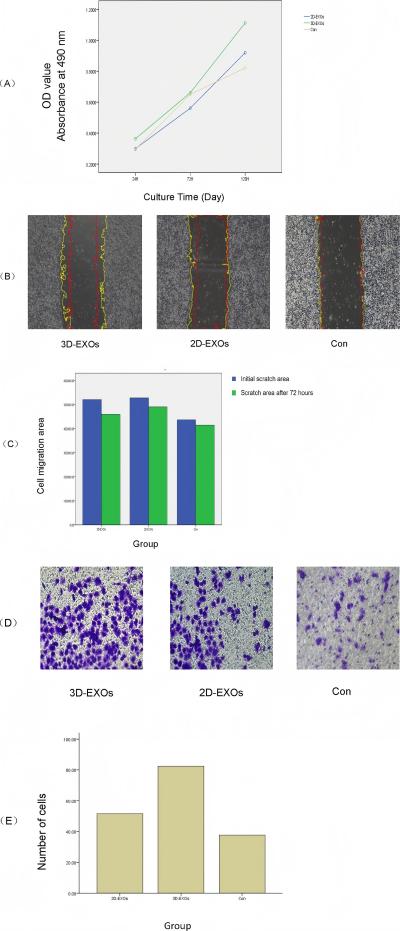 Fig.1 Biological effects of exosomes derived from 2D and 3D culture cells on cell proliferation and migration.1
Enhanced viability following exosome exposure may indicate activation of intracellular pathways that support cell survival under stress.
Comparative viability analysis allows researchers to evaluate differences between exosome sources or isolation methods.
When combined with uptake assays, viability measurements clarify whether internalization translates into measurable biological effects.
Stress induced systems provide insight into how exosomes influence resilience to oxidative or metabolic challenges.
Investigators seeking to align viability analysis with specific mechanistic questions may contact Creative Biolabs.
 Multiple Viability Readout Options
Different detection systems allow evaluation of metabolic activity, cellular energy levels, or membrane stability depending on research needs.
Flexible Stress Modeling
Viability can be assessed under basal culture conditions or in the presence of defined stressors to investigate protective mechanisms.
Quantitative Dose Response Design
Concentration dependent effects can be measured to characterize functional potency within a research context.
Reproducible Culture Conditions
Strict cell handling protocols reduce experimental noise and strengthen data consistency.
For protocol customization or guidance on model selection, Creative Biolabs support team welcomes inquiries.
"The Creative Biolabs team helped us optimize cell density and incubation timing, which significantly improved signal consistency. The viability data aligned well with our pathway activation results."
"We needed a controlled oxidative stress model to evaluate cytoprotective effects. Creative Biolabs designed the experiment carefully and delivered clear quantitative comparisons between treatment groups."
"The structured reporting format made it straightforward to integrate viability results into our manuscript preparation. Communication throughout the project was professional and technically precise."
Carefully controlled evaluation of cell viability provides essential insight into how exosomes influence survival related pathways in vitro. Through optimized assay design and consistent technical execution, Creative Biolabs delivers reliable quantitative data that strengthen mechanistic research. For investigators seeking dependable support in exosome functional analysis, Creative Biolabs remains ready to assist with customized experimental planning and collaborative technical communication.
A: A wide range of immortalized cell lines and selected primary cells can be used, provided they maintain stable growth and measurable baseline viability. During project planning, Creative Biolabs evaluates culture requirements and expected sensitivity to ensure reliable outcomes.
A: Yes. By incorporating sufficient replicates and optimized detection platforms, small but biologically relevant differences can be identified. Statistical analysis is structured to highlight consistent trends while accounting for experimental variability.
A: Extended incubation designs can be implemented when cell type stability permits. Time points are selected to balance cell health with experimental duration, allowing evaluation of sustained viability responses.
A: Exosome concentration and input parameters are standardized prior to treatment. Where necessary, normalization based on particle count or protein content can be incorporated to improve comparability across groups.
A: No. The assay is intended solely for laboratory based research. Data generated through this service should be interpreted within the context of in vitro mechanistic investigation and are not suitable for clinical or therapeutic assessment.
Reference