

Cellular differentiation determines how unspecialized cells acquire distinct phenotypes and functional properties. This process is guided by tightly regulated signaling networks, many of which can be influenced by exosomes carrying regulatory RNAs, proteins, and lipids. These vesicles are increasingly recognized for their role in directing lineage commitment and modulating differentiation efficiency in vitro.
Creative Biolabs provides the exosome enhanced cellular differentiation assay service to support studies investigating how exosomes influence cell fate decisions. The assay evaluates phenotypic transitions, lineage specific marker expression, and morphological changes following exosome treatment.
| Step | Detail |
|---|---|
| Step 1. Project Planning and Cell Model Selection | Creative Biolabs discusses the intended differentiation pathway and recommends suitable progenitor or stem cell models. |
| Step 2. Baseline Culture and Pre Conditioning | Cells are cultured under standardized conditions to ensure uniform starting states before induction. |
| Step 3. Differentiation Induction Setup | Appropriate induction media or conditions are introduced to initiate lineage commitment. |
| Step 4. Exosome Treatment Strategy | Exosomes are applied at defined stages to evaluate their influence on early or late differentiation events. |
| Step 5. Marker Detection and Staining | Cells are analyzed using lineage specific markers through staining or molecular detection methods. |
| Step 6. Morphological Observation | Imaging is conducted to monitor structural changes that accompany differentiation. |
| Step 7. Quantitative Evaluation | Creative Biolabs measures marker expression levels and calculates differentiation efficiency across groups. |
| Step 8. Data Compilation and Reporting | All results are organized into clear datasets with supporting images and interpretation notes. |
If you have specific differentiation targets in mind, Creative Biolabs can help refine each step accordingly.
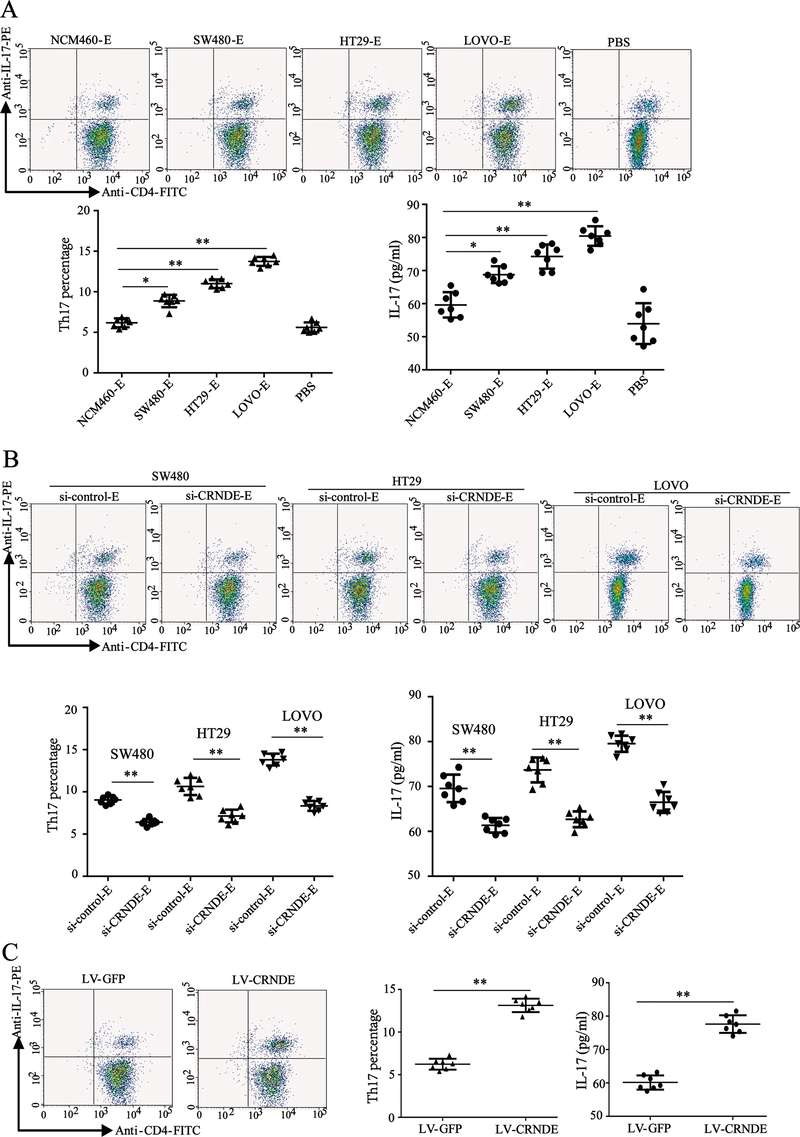 Fig.1 CRC cell exosomes promote Th17 cell differentiation via CRNDE-h transmission.1
Provides insight into how extracellular vesicles influence differentiation pathways.
Supports evaluation of how different exosome sources affect lineage outcomes.
Helps refine in vitro systems for studying differentiation processes.
Connects signaling changes with observable cellular transformation.
For further application ideas, you may reach out to Creative Biolabs for discussion.
 Multiple Differentiation Models Supported
Suitable for various cell types including stem cells and progenitor cells.
Integrated Molecular and Imaging Analysis
Combines marker detection with visual confirmation of phenotypic changes.
Flexible Treatment Design
Allows adjustment of exosome timing and dosage for different study needs.
Reliable Quantification Methods
Ensures consistent comparison across experimental groups.
To discuss feature customization for your project, Creative Biolabs technical support is ready to respond.
If you are planning a similar study, connecting with Creative Biolabs can help streamline your workflow.
Cellular differentiation is central to understanding how cells acquire specialized functions in vitro. With carefully designed experiments and reliable analytical approaches, Creative Biolabs supports meaningful investigation into exosome mediated differentiation processes. For customized assay development or to initiate your project, contacting Creative Biolabs is strongly recommended.
A: The assay supports a wide range of cell types including stem cells and progenitor cells. Selection depends on the differentiation pathway being studied.
A: Outcomes are evaluated through lineage specific marker expression and morphological changes observed through imaging.
A: Yes. Treatment timing can be adjusted to study early commitment or later maturation phases.
A: Parallel group design allows comparison of different exosome samples or treatment conditions.
A: Culture conditions, induction protocols, and exosome characteristics can all impact results. Creative Biolabs carefully controls these variables.
A: Additional analyses can be incorporated depending on project requirements and research goals.
Reference