Human Kidney Cell A498 based Proliferation Assay Service
Creative Biolabs' service is meticulously designed to provide the specific, actionable data required to advance your renal cell carcinoma (RCC) drug candidate. We go beyond simple cell counting to deliver a complete picture of your compound's mechanism of action (MOA). Our platform provides quantitative evidence distinguishing between growth inhibition concentration 50% (GI50) and lethal concentration 50% (LC50), confirms cell cycle arrest patterns, and identifies the induction of apoptosis (e.g., via caspase activation). This comprehensive data package ensures you have the therapeutic potential insights necessary to confidently de-risk your RCC development pipeline.
The A498 Cell Line: A Critical Model for RCC
The A498 cell line is a gold-standard in vitro model for clear cell RCC (ccRCC), critically reflecting the disease's hallmark disrupted von Hippel-Lindau (VHL) function. Its robust, reproducible growth is ideal for reliable IC50 determination. The model is instrumental for deep mechanistic insight, capable of measuring diverse cell death (apoptosis/necrosis) and pathway modulation, including the Akt-mTOR cascade. Its sensitivity to combination and synergy testing (e.g., Amygdalin/SFN), coupled with its ability to induce distinct G0/G1 or G2/M cell cycle blocks, ensures high therapeutic predictability.
Specific Deliverables and Solutions
Precise Efficacy Quantification
We deliver accurate GI50 and LC50 values for your compound, clearly distinguishing between agents that merely halt growth (GI50) and those that actively kill cancer cells (LC50). This is crucial for pipeline prioritization.
Confidence in Data
Every result is validated against a gold-standard reference inhibitor (staurosporine), ensuring the biological responsiveness and high fidelity of your data package.
Mechanism of Action Confirmation
By leveraging the A498 line's known genetics (VHL disruption), we provide context for how your drug affects fundamental RCC pathways (e.g., Akt/mTOR signaling or cell cycle modulation).
Synergy and Combination Testing
Our platform is optimized to test drug combinations, confirming synergistic activity with statistical rigor (e.g., bliss independence model), which is essential for next-generation multi-therapy approaches.
Contact our expert team today to design a customized assay package that meets your precise preclinical needs and accelerates your journey towards clinical translation.
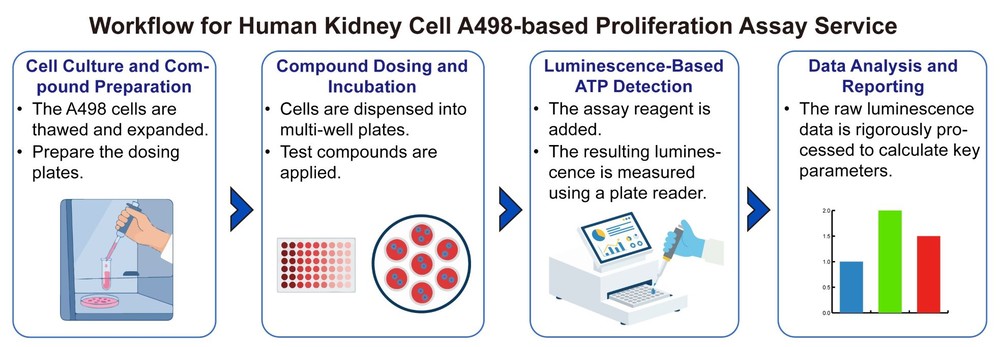
Workflow: Clear Steps for Reliable Proliferation Data
Our systematic, methodical workflow ensures full transparency and delivers the reproducible, high-quality data you need—providing the precision you can trust for critical decisions in your oncology program.
Publication
This study investigates Shikonin, a natural naphthoquinone, as a potent therapeutic agent against RCC using A-498 and CAKI-2 cell lines. Shikonin significantly inhibits proliferation and colony formation with superior potency compared to Sunitinib. Its cytotoxic effect is primarily mediated by apoptosis induction, evidenced by caspase-3/7 activation and PARP cleavage. Mechanistically, shikonin acts through multifaceted signaling modulation, including Ras/MAPK and PI3 K/AKT activation, NF-κB downregulation, and Bcl-2/PTEN alteration, highlighting its potential to overcome drug resistance in RCC.
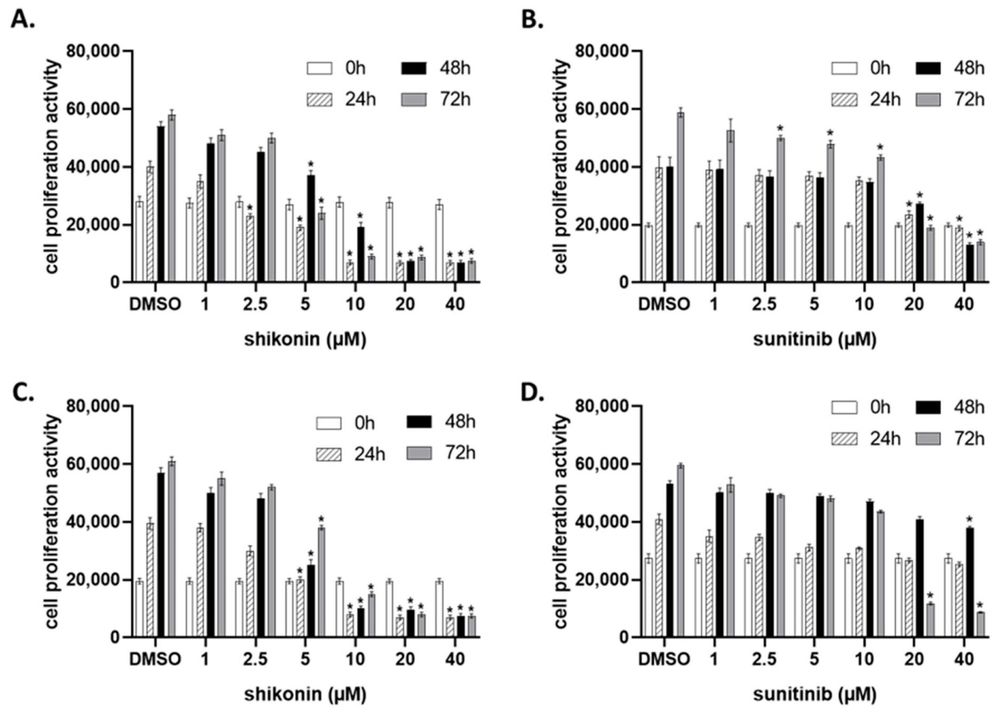 Fig.1 Shikonin or sunitinib inhibits the proliferation of A-498 and CAKI-2 human renal cancer cells. 1
Why Choose Us
Creative Biolabs guarantees highly predictive and scientifically sound data for your RCC project by combining technical proficiency with deep scientific understanding. We utilize superior luminescence ATP technology for enhanced sensitivity and a wider dynamic range, minimizing signal variability. Our validated RCC model expertise leverages A498's specific VHL-disruption to correctly interpret data against ccRCC biology. We provide essential cytostatic/cytotoxic differentiation via the GI50, TGI, LC50 triad, and maintain reliable quality control by benchmarking every assay against gold-standard inhibitors like staurosporine.
Experience the Creative Biolabs Advantage - Get a Quote Today
FAQs
Q: Why use the A498 line over other RCC models like Caki-1 or 786-O?
A: While Creative Biolabs can adapt protocols for other lines, A498 is specifically favored for its disrupted VHL function, which mimics the genetic signature of the most common RCC subtype (ccRCC). This makes the results highly relevant to clinical translation.
Q: Is the luminescence detection method prone to compound interference?
A: Our scientists employ rigorous counter-screens and controls during assay validation to identify and mitigate any compound interference with the luminescence signal. We always ensure the signal we measure is directly due to viable cellular ATP, guaranteeing the fidelity of your final data.
Q: Can I combine this assay with a metastatic potential screening?
A: Yes, for a complete profile, we highly recommend complementing this service with our transwell invasion assays. You can achieve a comprehensive mechanism of action profile by evaluating both proliferation and invasive potential.
Customer Review
-
Synergy Insight
They accurately confirmed that our new Akt-inhibitor worked additively with a VHL-pathway modulator, providing the precise mechanistic evidence we needed to justify moving to the next preclinical phase. - P. L* -
Speed and Throughput
Using Creative Biolabs' service in our research has significantly facilitated our high-throughput screening of a 500-compound library. The rapid turnaround and the low requirement for test material were critical advantages compared to our internal capabilities, saving us valuable time and resources. - J. K*
Related Services
To achieve a complete and predictive profile for your RCC therapeutic candidate, Creative Biolabs recommends pairing the human kidney cell A498 based proliferation assay service with these highly complementary offerings:
Cell Migration Assay Services
Creative Biolabs offers specialized cell migration assay services, including the EGF-induced HaCaT cell migration assay, providing precise, high-throughput solutions for studying keratinocyte motility and dynamics.
Learn More →Permeability Analysis Service
The Caco-2 cell model, mimicking the human small intestine, is crucial for predicting drug permeability. Creative Biolabs offers Caco-2 assays with HPLC-MS/MS detection for high-throughput and tailored permeability screening.
Learn More →Contact Us
The Creative Biolabs' A498 based proliferation assay service offers a foundational, high-quality platform for the preclinical evaluation of RCC therapeutics. By delivering precise efficacy metrics and deep mechanistic insight into VHL-disrupted pathways, we ensure your development process is driven by predictive and robust data.
Contact Our Team for More Information and to Discuss Your Project
Reference
- Király, József, et al. "Shikonin Causes an Apoptotic Effect on Human Kidney Cancer Cells through Ras/MAPK and PI3K/AKT Pathways." Molecules 28.18 (2023). Distributed under Open Access license CC BY 4.0, without modification. https://doi.org/10.3390/molecules28186725
 Download our brochure