Aptamer Conjugation Solutions
Creative Biolabs offers a comprehensive suite of aptamer conjugation solutions. By chemically linking aptamers with various functional moieties (therapeutic oligonucleotides, antibodies, drugs, nanoparticles, and biosensors), we provide our global clients with "next-generation" tools for complement-related disease research and drug development.
Submit Your Request Now
Why Aptamer Conjugation Matters
Aptamers, often referred to as "chemical antibodies," are short, single-stranded DNA or RNA oligonucleotides that fold into unique three-dimensional structures, enabling them to bind to specific targets (such as proteins, small molecules, or cell surfaces) with high affinity and specificity. Binding alone is not enough. In real systems, aptamers must navigate nuclease exposure, circulation time, tissue penetration, intracellular routing, and signal transduction. Conjugation enables:
-
Functional translation: converting target recognition into payload delivery or signal generation.
-
PK/PD control: tuning half-life, biodistribution, and clearance.
-
Multimodality: integrating aptamers with biologics, small molecules, lipids, and materials.
-
Manufacturability: reproducible synthesis, defined stoichiometry, and analytical traceability.
Great Minds Choose Creative Biolabs
Creative Biolabs integrates linker chemistry, structural modeling, and bioassays to ensure conjugates perform as designed
Partner with Us
Our Integrated Conjugation Platform
Creative Biolabs has integrated multi-disciplinary expertise in nucleic acid chemistry, protein engineering, and pharmacology to offer the following specialized conjugation services.
Discuss Your Needs
Technology Comparison
To help our clients make informed decisions, we provide a detailed comparison between Aptamer-based conjugates and traditional Antibody-based conjugates (ADCs/Ab-Oligo).
|
Feature
|
Aptamer-Drug/Oligo Conjugates (ApDCs/AsOCs)
|
Antibody-Drug/Oligo Conjugates (ADCs/AbOCs)
|
|
Size
|
Small (8-15 kDa), better tissue penetration
|
Large (~150 kDa), limited penetration
|
|
Immunogenicity
|
Generally non-immunogenic
|
Potential for HAMA (Human Anti-Mouse Antibodies)
|
|
Production
|
Chemical synthesis (Batch-to-batch consistency)
|
Cell culture (Complex, risk of contamination)
|
|
Thermal Stability
|
High (Regenerable after denaturation)
|
Low (Sensitive to heat and pH)
|
|
Targeting Affinity
|
Equivalent to antibodies (pM to nM range)
|
High (pM to nM range)
|
|
Modification
|
Site-specific modification is easy and precise
|
Site-specific conjugation is complex
|
|
Cost
|
Relatively low in the long term
|
High (R&D and manufacturing)
|
Design Your Workflow
Case Studies
Case 1
Aptamer-Modified Au Nanoparticles
The conjugation of a dopamine-binding aptamer (DBA) to the pA-AuNPs yields aptananozyme structures catalyzing simultaneously the H2O2-mediated oxidation of dopamine to aminochrome through the aerobic oxidation of glucose. A set of aptananozymes consisting of DBA conjugated through the 5′- or 3′-end directly or spacer bridges to pA-AuNPs were synthesized. The set of aptananozymes revealed enhanced catalytic activities toward the H2O2-catalyzed oxidation of dopamine to dopachrome, as compared to the separated pA-AuNPs and DBA constituents, and structure–function relationships within the series of aptananozymes were demonstrated.
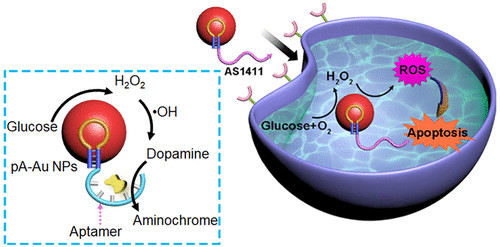 Fig.1 Schematic synthesis of DBA-functionalized pA-AuNPs acting as aptananozymes.1,2
References
-
Ouyang, Yu, et al. "Aptamer-modified Au nanoparticles: Functional nanozyme bioreactors for cascaded catalysis and catalysts for chemodynamic treatment of cancer cells." ACS nano 16.11 (2022): 18232-18243. https://doi.org/10.1021/acsnano.2c05710
-
Distributed under Open Access license CC BY 4.0, without modification.
FAQs
What types of aptamer conjugates can you develop?
We support a broad range of aptamer conjugation formats, including aptamer-therapeutic oligonucleotide conjugates, aptamer-antibody conjugates, aptamer-drug conjugates, lipid- or cholesterol-modified aptamers, nanoparticle-linked aptamers, bivalent or multivalent constructs, and aptamer-based biosensors. Each format is designed based on the intended biological or analytical application rather than a fixed template.
How do you choose the most suitable conjugation chemistry?
Conjugation chemistry is selected based on aptamer structure, payload sensitivity, required stability, and downstream application. We evaluate covalent and non-covalent strategies, cleavable versus non-cleavable linkers, and attachment sites to minimize interference with aptamer folding and functional domains.
Can you help optimize linker length and composition?
Yes. Linker optimization is a core part of our service. We assess linker length, flexibility, and chemical properties to balance steric accessibility, stability, and controlled release. Comparative designs are often evaluated experimentally to identify the optimal configuration.
Do you support cleavable or stimuli-responsive conjugates?
Absolutely. We offer cleavable linkers responsive to pH changes, redox environments, or enzymatic activity. These are particularly useful for controlled drug release or intracellular activation strategies.
What level of characterization is provided with the final conjugates?
Each project includes comprehensive analytical characterization, such as conjugation efficiency, purity, molecular integrity, and stability profiling. Functional validation is performed according to the intended application, whether for delivery, targeting, or signal generation.
How customizable are the deliverables?
Deliverables are tailored to project goals and may include multiple conjugate variants, comparative performance data, analytical reports, and design rationale. This flexibility allows clients to make informed decisions for downstream development.
How do you support projects involving multiple conjugation strategies?
For complex projects, we can design parallel conjugation pathways and evaluate them side by side. This comparative approach helps identify the most robust and scalable solution while reducing development risk.