The Role of Complement Autoantibodies in Complement Activity
Complement autoantibodies are increasingly recognized as important contributors to disease heterogeneity. In some settings, they act as direct pathogenic drivers. In others, they serve as biomarkers that indicate immune dysregulation, pathway bias, disease activity, or therapeutic responsiveness. Autoantibodies may target individual complement components, such as C1q, C3, C4, Factor B, Factor H, Factor I, C5, or properdin. They may also recognize neoepitopes exposed during activation, bind assembled convertases, or interact with complement-regulatory domains in a way that changes functional activity.
Key questions addressed by complement autoantibody testing include:
-
Does a patient-derived or experimental sample contain autoantibodies against a defined complement component?
-
Are the detected antibodies merely binding events, or do they alter pathway activity?
-
Do autoantibodies stabilize C3 or C5 convertases and prolong complement activation?
-
Do they block regulatory proteins such as Factor H, Factor I, C1 inhibitor, CD46, CD55, or CD59?
-
Are autoantibody levels associated with complement activation products, hemolytic activity, tissue deposition, or disease phenotype?
-
Can complement autoantibody testing support biomarker selection, patient stratification, or therapeutic mechanism-of-action studies?
Creative Biolabs addresses these questions through integrated assay design.
Great Minds Choose Creative Biolabs
Assay Formats Available at Creative Biolabs
Complement autoantibody testing often requires multiple assay layers. A binding assay may confirm that an antibody recognizes a complement target, while a functional assay determines whether the antibody activates, blocks, stabilizes, or dysregulates the cascade. Creative Biolabs offers both standard and customized assay formats to match the biological question.

ELISA-Based Autoantibody Detection
A robust and scalable format for detecting autoantibodies

Multiplex Complement Autoantibody Panels
Design multiplex panels using bead-based, array-based, or other compatible detection platforms

Functional Complement Autoantibody Assays
Functional assays are essential when autoantibodies are suspected to alter complement activity

Cell-Based Complement Autoantibody Assays
Build cell-based assays using customized cell models
Our Typical Workflow
Creative Biolabs develops complement autoantibody testing workflows according to project goals, sample availability, target specificity, and required level of interpretation. A typical project may include the following stages.
|
Workflow
|
Descriptions
|
|
Project Consultation and Assay Strategy
|
Our scientists discuss the client's research question, suspected autoantibody target, disease context, sample type, species, cohort size, available controls, and desired readouts. We then recommend a testing strategy that may include binding assays, functional assays, confirmatory assays, or integrated complement panels.
|
|
Assay Feasibility and Design
|
For established targets, Creative Biolabs can proceed with optimized platforms. For custom targets, we evaluate antigen source, antigen format, epitope preservation, detection reagents, matrix compatibility, and control availability.
|
|
Sample Receipt and Quality Review
|
Client samples are received, logged, and inspected according to agreed requirements. We document sample condition, volume, labeling, storage temperature, freeze-thaw status when provided, and any deviations that may affect interpretation.
|
|
Binding Autoantibody Detection
|
Samples are tested for target-specific autoantibody binding using ELISA, chemiluminescent, fluorescent, multiplex, or customized immunoassay formats.
|
|
Functional Characterization
|
When functional relevance is required, positive or selected samples can be evaluated in pathway-specific complement assays.
|
|
Data Analysis and Interpretation
|
Creative Biolabs provides processed data, figures, QC summaries, and interpretive comments. Where appropriate, results are normalized to controls, reference samples, calibrators, or baseline activity. We can also provide recommendations for follow-up testing.
|
|
Final Report and Project Discussion
|
At closeout, clients receive a comprehensive report including study design, materials, methods, assay conditions, raw and processed results, figures, QC outcomes, limitations, and scientific interpretation.
|
Design Your Workflow
Add-On Assays That Sharpen Interpretation
Complement autoantibody results often become more informative when integrated with additional complement readouts. Creative Biolabs offers a broad set of complementary assays that can be added to complement autoantibody testing projects.
|
Add-On Assays
|
Descriptions
|
|
Complement Activity Tests
|
-
CH50 total classical pathway activity
-
AH50 alternative pathway activity
-
Lectin pathway activity
-
Individual component functional tests
-
C1q, C2, C3, C4, C5, Factor B, Factor D, Factor H, Factor I, and properdin-related assays
|
|
Complement Activation Product Tests
|
|
|
Cell-Based Functional Assays
|
-
Complement-dependent cytotoxicity assay
-
Cell-surface C3b deposition
-
MAC deposition analysis
-
Flow cytometry-based opsonization assay
-
Endothelial or epithelial cell complement activation models
-
Immune complex-mediated complement activation assays
|
|
Mechanistic Add-Ons
|
-
Antigen domain mapping
-
Antibody isotyping and subclass analysis
-
IgG purification and re-testing
-
Convertase stabilization assays
-
Regulator binding inhibition
-
Pathway-specific blocking studies
-
Complement inhibitor rescue experiments
|
Design Your Customization
Case Studies
Case 1
Anti-FH titers and their functional characterization
Of 781 patients <18-year-old of aHUS in the nationwide database from 2007 to 2018, 436 (55.8%) had anti-FH antibodies. In plasma samples of 44 aHUS patients, levels of serial circulating FH immune complexes (CIC), free FH, soluble terminal complement complex (sC5b-9), sheep red blood cell (SRBC) lysis and epitope specificity were examined.
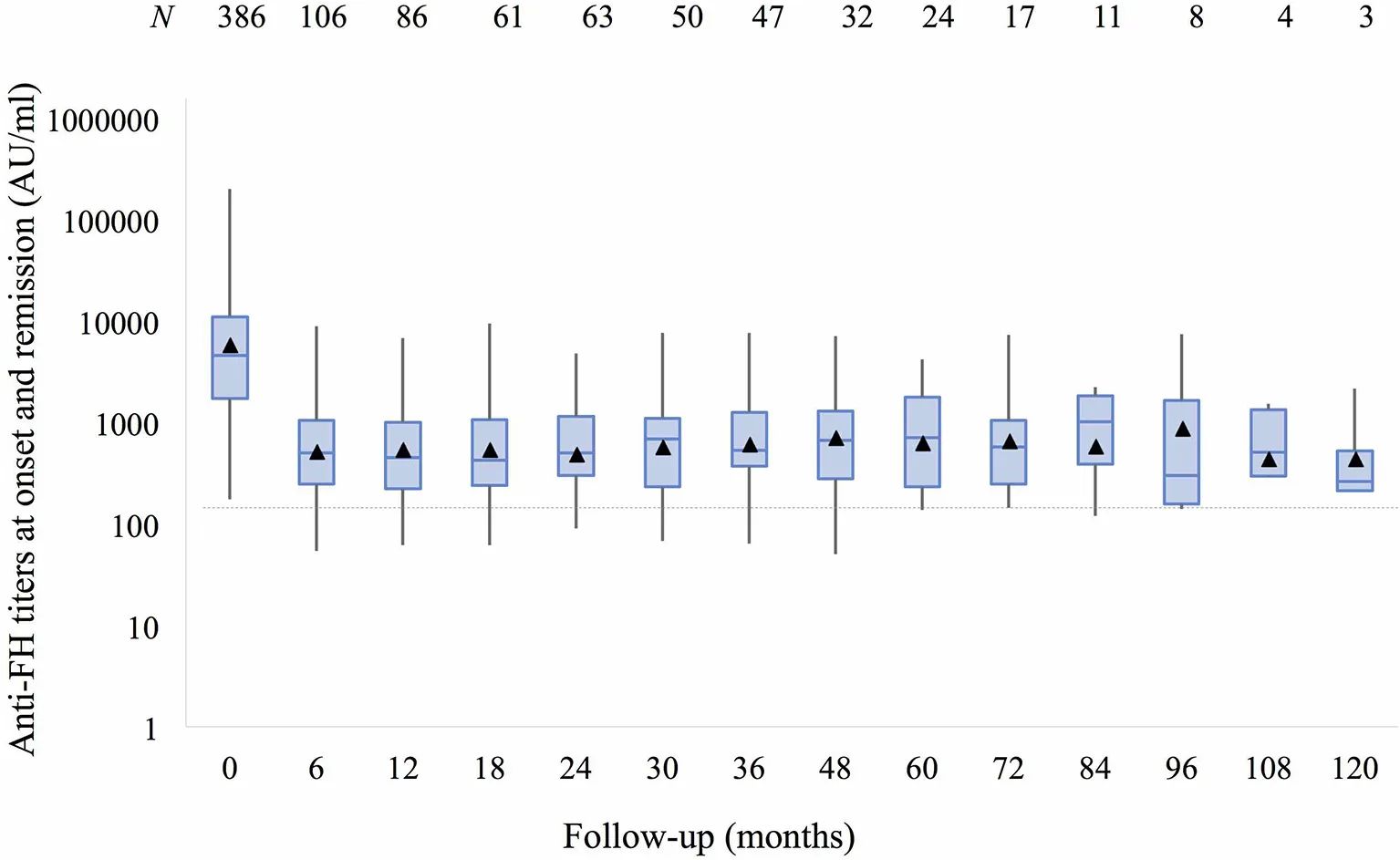 Fig. 1 Anti-FH titers remained detectable during remission.1,2
References
-
Puraswani, Mamta, et al. "Clinical and immunological profile of anti-factor H antibody associated atypical hemolytic uremic syndrome: a nationwide database." Frontiers in Immunology 10 (2019): 1282. https://doi.org/10.3389/fimmu.2019.01282
-
Distributed under Open Access license CC BY 4.0, without modification.
Frequently Asked Questions
Can you distinguish binding autoantibodies from functionally active autoantibodies?
Yes. Binding assays such as ELISA or multiplex immunoassays can identify target reactivity, while functional assays evaluate whether the detected autoantibodies affect complement activity. Creative Biolabs can combine both assay types to help clients determine biological relevance.
What sample type is best for complement autoantibody testing?
The optimal sample type depends on the intended assay. Serum is often preferred for functional complement assays. EDTA plasma may be acceptable for binding-only assays but is generally not suitable for complement activation readouts. Citrate plasma can be used in selected workflows with appropriate controls. Purified IgG can be useful for confirming antibody-mediated function.
Can complement autoantibody testing be combined with C3b deposition or CH50/AH50 assays?
Absolutely. Many projects benefit from a cascade-level testing strategy. Complement autoantibody detection can be paired with C3b deposition, C5b-9 deposition, CH50, AH50, C3a, C5a, sC5b-9, and individual component activity assays to better understand pathway consequences.
Can you develop a custom assay for a new complement autoantibody target?
Yes. Creative Biolabs supports custom assay development for novel or less common complement autoantibody targets. We can help evaluate antigen format, detection reagents, assay conditions, controls, and feasibility before scaling to larger sample sets.
How many samples can you process?
Creative Biolabs supports small pilot studies, medium-scale research projects, and larger cohort testing. Throughput depends on assay format, number of targets, sample matrix, replication requirements, and whether functional testing is included.
What will I receive at the end of the project?
Clients typically receive a final report including study design, assay methods, sample information, raw and processed data, figures, QC summaries, observations, and interpretation. Additional deliverables such as plate maps, flow cytometry files, statistical summaries, or assay transfer documents can be provided upon request.