Why Complement Genetic Testing Matters
Complement testing has traditionally relied on functional assays, antigen quantification, hemolysis assays, deposition assays, and complement activation product measurements. These tools remain indispensable because complement biology is dynamic, concentration-dependent, and influenced by sample handling. However, functional readouts do not always reveal why a pathway is abnormal, whether a defect is inherited, whether family members may carry a related risk, or whether a variant may affect response to complement-targeted therapy.
By identifying sequence variants, copy number changes, structural rearrangements, and risk-associated haplotypes in complement-related genes, genetic analysis can clarify the molecular basis behind abnormal complement function. Our complement genetic test service is designed for investigators, biotechnology companies, academic medical centers, and therapeutic developers. When requested, genetic findings can be correlated with complement activity testing, C3b deposition assays, C5b-9 quantification, C1-INH functional analysis, C1q binding assays, CH50/AH50 testing, autoantibody profiling, or cell-based complement assays.
Great Minds Choose Creative Biolabs
Genes Commonly Included in Complement Genetic Test Panels
Creative Biolabs can customize gene content according to each project. Commonly analyzed genes include:
-
Classical Pathway Genes - C1QA, C1QB, C1QC, C1R, C1S, C2, C4A, C4B
These genes are relevant to classical pathway activation, immune complex handling, and early complement deficiency research. Variants may be investigated in recurrent infection, autoimmune-like phenotypes, and abnormal CH50 results.
-
Lectin Pathway Genes - MBL2, MASP1, MASP2, FCN1, FCN2, FCN3, COLEC10, COLEC11
Lectin pathway genes may be included for projects focused on microbial recognition, mannose-binding lectin deficiency, inflammatory susceptibility, or MASP-targeted therapeutic development.
-
Alternative Pathway Genes - C3, CFB, CFD, CFP
Alternative pathway genes are central to amplification loop activity. Activating or regulatory-impact variants may be studied in aHUS, C3 glomerulopathy, renal disease, complement-mediated inflammation, or therapeutic response research.
-
Complement Regulatory Genes - CFH, CFI, CD46, CD55, CD59, CR1, CFHR1, CFHR2, CFHR3, CFHR4, CFHR5
Regulatory genes are essential for preventing uncontrolled complement activation on host tissue. Variants, deletions, duplications, hybrid genes, or haplotypes in these loci can be highly relevant to alternative pathway dysregulation research.
-
Terminal Pathway Genes - C5, C6, C7, C8A, C8B, C8G, C9
Terminal pathway genes are relevant to membrane attack complex formation. Genetic testing may be paired with C5b-9 functional assays, CH50 testing, or infection susceptibility studies.
-
Angioedema-Related Genes - SERPING1, F12, PLG, ANGPT1, KNG1, MYOF, HS3ST6, and project-specific candidates
These genes can be used for hereditary angioedema research, especially when C1-INH antigen or activity assays are inconclusive or when normal-C1-INH angioedema is being investigated.
Design Your Test Panels
Add-On Assays That Strengthen Interpretation
Genetic findings are most powerful when connected to function. Creative Biolabs offers a broad range of complementary assays to help determine whether a detected variant has biological significance.
|
Assays
|
Descriptions
|
|
Complement Function/Activity Tests
|
CH50, AH50, and pathway-specific functional assays can identify classical, alternative, or terminal pathway impairment. These assays help determine whether a genetic variant corresponds to measurable pathway dysfunction.
|
|
Individual Component Activity Tests
|
Component-specific assays for C2, C3, C5, Factor B, Factor D, Factor H, Factor I, properdin, C1 inhibitor, C1 complex, and C5b-9 can help validate the functional consequence of variants.
|
|
Complement Activation Product Tests
|
C3a, C3b, iC3b, C3d, C4d, C5a, and sC5b-9 measurements provide insight into active pathway engagement and complement turnover.
|
|
C3b Deposition Assay
|
C3b deposition assays can determine whether variants alter complement opsonization, alternative pathway amplification, convertase activity, or inhibitor responsiveness.
|
|
C1-INH Functional Assay
|
For hereditary angioedema research, C1-INH functional analysis can be paired with SERPING1 genetic testing to evaluate whether a variant affects protein function.
|
|
Autoantibody Testing
|
Factor H autoantibodies, C3 nephritic factor, C4 nephritic factor, C5 nephritic factor, and other complement autoantibodies can be measured to distinguish genetic predisposition from acquired dysregulation.
|
Design Your Customization
Case Studies
Case 1
CFH and CFHR structural variants in atypical Hemolytic Uremic Syndrome
Atypical hemolytic uremic syndrome (aHUS) is a rare disease that manifests with microangiopathic hemolytic anemia, thrombocytopenia, and acute renal failure, and is associated with dysregulation of the alternative complement pathway. The chromosomal region including CFH and CFHR1-5 is rich in repeated sequences, favoring genomic rearrangements that have been reported in several patients with aHUS. In this study, the researchers reported the results of CFH-CFHR Copy Number Variation (CNV) analysis and the characterization of resulting structural variants (SVs) in a large cohort of patients. These data highlight that uncommon CFH-CFHR SVs are frequent in primary aHUS and quite rare in secondary forms.
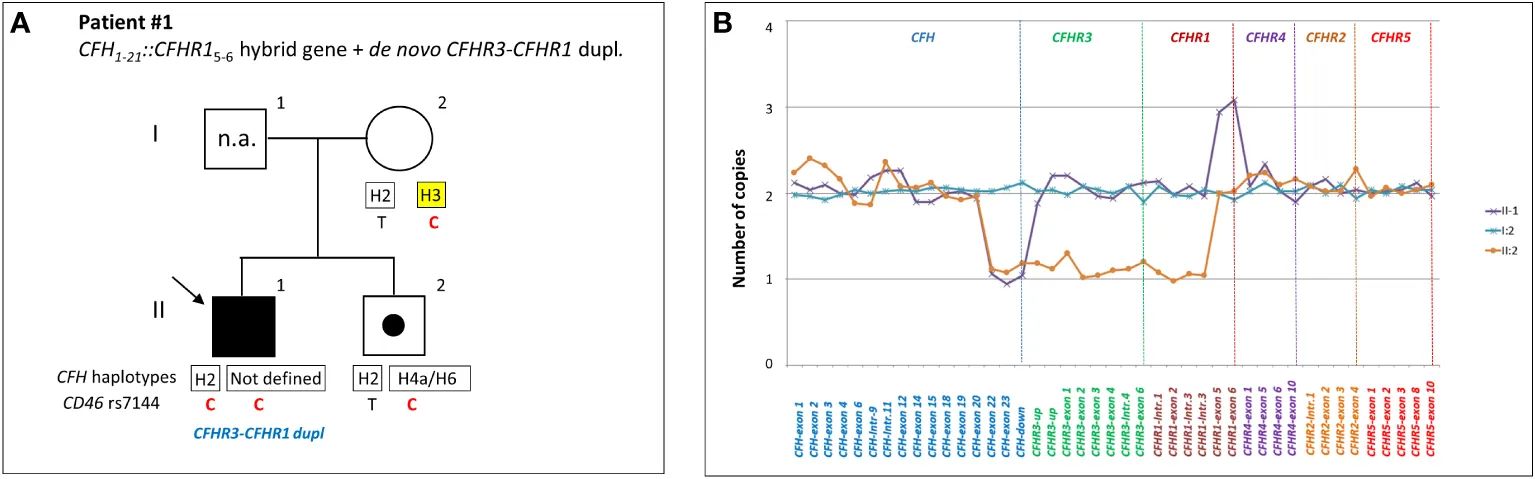 Fig. 1 Patient with a hybrid CFH1-21::CFHR15-6 gene and a de novo CFHR3-CFHR1 duplication.1,2
References
-
Piras, Rossella, et al. "CFH and CFHR structural variants in atypical Hemolytic Uremic Syndrome: Prevalence, genomic characterization and impact on outcome." Frontiers in immunology 13 (2023): 1011580. https://doi.org/10.3389/fimmu.2022.1011580
-
Distributed under Open Access license CC BY 4.0, without modification.
Frequently Asked Questions
Can you customize the gene list?
Yes. Creative Biolabs can design a single-gene test, focused disease panel, full complement pathway panel, renal complement panel, angioedema panel, thrombotic microangiopathy panel, expanded immune dysregulation panel, WES, or WGS strategy. We can also include client-specified genes and regions.
Can you analyze CFH and CFHR genes?
Yes. CFH and CFHR genes are commonly included in alternative pathway dysregulation, aHUS, C3 glomerulopathy, and renal complement panels. Because this region is complex, project-specific assay design and confirmatory methods may be recommended.
Can you test SERPING1 for hereditary angioedema?
Yes. Creative Biolabs supports SERPING1 sequencing, deletion/duplication analysis, and known familial variant testing. Expanded angioedema panels can also be designed when C1-INH findings are normal or when broader research questions are being explored.
What sample types do you accept?
Common sample types include EDTA whole blood, genomic DNA, saliva, buccal swabs, cell pellets, cultured cells, and selected tissue-derived DNA. Sample requirements depend on test type, sequencing depth, and whether CNV or structural variant analysis is needed.
What do you deliver at closeout?
You will receive a comprehensive report including methods, sample QC, sequencing metrics, coverage summary, detected variants, interpretation, gene-level relevance, limitations, and optional recommendations for confirmatory or functional studies. Raw data, processed tables, and customized deliverables can be provided upon request.
Can you combine complement genetic test with complement inhibitor screening?
Yes. Genetic results can be paired with complement inhibitor validation, C3b deposition, sC5b-9 quantification, CH50/AH50 testing, C5a measurement, hemolysis inhibition, or cell-based complement activity assays. This is useful for complement therapeutic discovery and translational biomarker development.