Aptamer Modifications Solutions
Creative Biolabs provides a comprehensive suite of aptamer modification solutions. Our modification platform is designed to overcome the inherent limitations of natural nucleic acids, ensuring that your aptamer candidates possess the necessary stability, affinity, and pharmacokinetic profiles for success.
Submit Your Request Now
Why Aptamer Modification Matters
Aptamer performance is governed not only by sequence but by chemical architecture. Without modification, even high-affinity aptamers may fail in real biological systems. Chemical modifications directly address these bottlenecks:
-
Enhanced nuclease resistance for serum, plasma, and cellular environments
-
Improved binding affinity and structural stability
-
Extended circulation half-life
-
Expanded compatibility with detection platforms and delivery systems
-
Controlled pharmacokinetics and biodistribution
Great Minds Choose Creative Biolabs
Our Aptamer Modifications Solutions are designed to optimize these parameters without compromising target recognition.
Partner with Us
Our Aptamer Modification Portfolio
Our platform covers a full spectrum of chemical and functional aptamer modifications, including the following dedicated service modules.
Discuss Your Needs
Our Aptamer Modification Strategy: Precision by Design
We apply a structure-guided and application-specific modification philosophy, rather than one-size-fits-all chemistry. This strategy ensures that modified aptamers remain functional, reproducible, and scalable.

Preserve binding motifs while reinforcing structural regions

Balance chemical stability and folding fidelity

Align modification density with downstream use

Validate performance experimentally, not theoretically
Start Your Project
Case Studies
Case 1
Graphene Oxide and Fluorescent-Aptamer-Based Novel Aptasensors
W3 is an aptamer that can specifically bind to mCRC cells with high affinity. Graphene oxide (GO) is a two-dimensional graphitic carbon nanomaterial, which has widely used in constructing biosensors. The researchers have developed a no-wash fluorescent aptasensor for one-step and sensitive detection of mCRC LoVo cells. GO can quench the green fluorescence of the FAM-labeled W3 (FAM-W3). In the presence of the target cells, FAM-W3 preferentially binds the target cells and detaches from the surface of GO, leading to the fluorescence of FAM recovery.
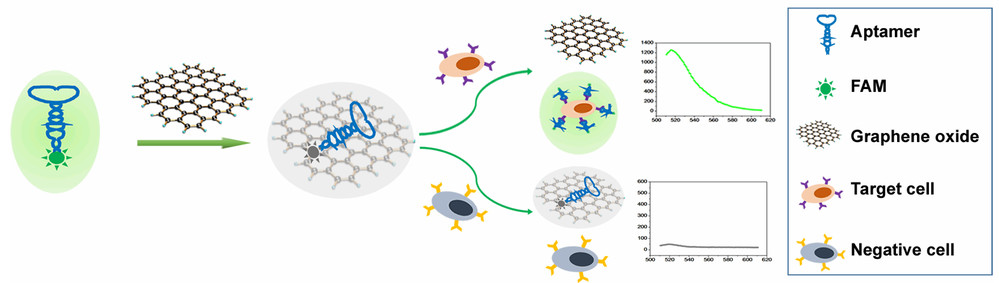 Fig.1 Schematic illustration represents the working principle of the GO-based fluorescent aptasensor assay.1,2
References
-
Chen, Hang, et al. "Graphene oxide and fluorescent-aptamer-based novel aptasensors for detection of metastatic colorectal cancer cells." Polymers 14.15 (2022): 3040. https://doi.org/10.3390/polym14153040
-
Distributed under Open Access license CC BY 4.0, without modification.
FAQs
What types of aptamers can be modified through this service?
We support chemical modification of both DNA and RNA aptamers, including sequences generated through in-house discovery, published literature, or client-provided SELEX campaigns. Modification strategies are selected based on sequence composition, structural features, and intended application.
How do you ensure that chemical modifications do not compromise target binding?
Our design process prioritizes preservation of known or predicted binding regions. Modifications are preferentially introduced at terminal positions or structurally permissive regions, and optional binding validation can be performed to confirm functional integrity after modification.
Can you combine multiple modifications within a single aptamer?
Yes. We routinely design aptamers incorporating combinatorial modifications, such as nuclease-resistant backbones together with fluorescent or biotin labels. Each combination is evaluated for compatibility to balance stability, affinity, and assay performance.
Do you provide guidance on selecting the most appropriate modification strategy?
Scientific consultation is an integral part of this service. Our team works with clients to evaluate experimental conditions, assay duration, detection method, and downstream plans in order to recommend a modification strategy aligned with practical research needs.
Can modified aptamers be integrated into downstream assays upon delivery?
Yes. Aptamers are delivered in a research-ready format, accompanied by handling and storage recommendations. This allows clients to proceed directly to binding studies, functional assays, or platform integration without additional preparation steps.
How customizable is the service for non-standard applications?
The service is highly flexible. For projects with unique assay formats, conjugation requirements, or platform constraints, we can design customized modification schemes and discuss feasibility during the consultation phase.
What information should be prepared before initiating a project?
Providing the aptamer sequence, target information, and intended application is helpful. If some details are still under development, our scientists can assist in refining requirements and defining a practical modification pathway.