Introduction Application What Can We Offer? Workflow Published Data Why Choose Us? FAQs Featured Services Feature Products
Complement Component Inhibitors Development: Accelerate Your Drug Discovery Process!
Are you currently facing long drug development cycles, difficulty in achieving precise pathway modulation, or challenges in balancing systemic immunity with targeted inhibition? Our Complement Component Inhibitors Development Service helps you obtain high-quality, specialized therapeutic candidates through our advanced high-throughput screening platforms and innovative protein engineering techniques. We specialize in transforming complex biological challenges into streamlined, clinical-ready solutions.
Contact our team to get an inquiry now!
Introduction of Complement Component Inhibitors
The complement system is a sophisticated biochemical cascade consisting of over 30 plasma and membrane-bound proteins that serve as a bridge between innate and adaptive immunity. While essential for host defense and cellular homeostasis, literature consistently highlights that uncontrolled activation, often termed "complement dysregulation", is a primary driver of pathology in various autoimmune and inflammatory diseases. This pathological activation can trigger a massive inflammatory response, leading to bystander tissue damage and chronic degenerative conditions.
To address these pathological mechanisms, diverse classes of molecular inhibitors are utilized based on their specific biophysical properties:
-
Compstatin Modulation: Peptides derived from the Compstatin family are engineered to bind specifically to native C3 and its activation fragment C3b. By utilizing structure-based design, these inhibitors achieve high binding potency and plasma stability, effectively preventing the cleavage of C3 into its pro-inflammatory active forms.
-
Nucleic Acid Aptamer Regulation: High-affinity nucleic acid aptamers can be selected to target specific complement proteins. These molecules offer low immunogenicity and high tissue penetration, making them ideal candidates for modulating ocular and systemic complement disorders through precise structural recognition.
Mechanisms of Cascade Interruption
Current research focuses on intercepting the cascade at pivotal, rate-limiting points to restore immunological balance:
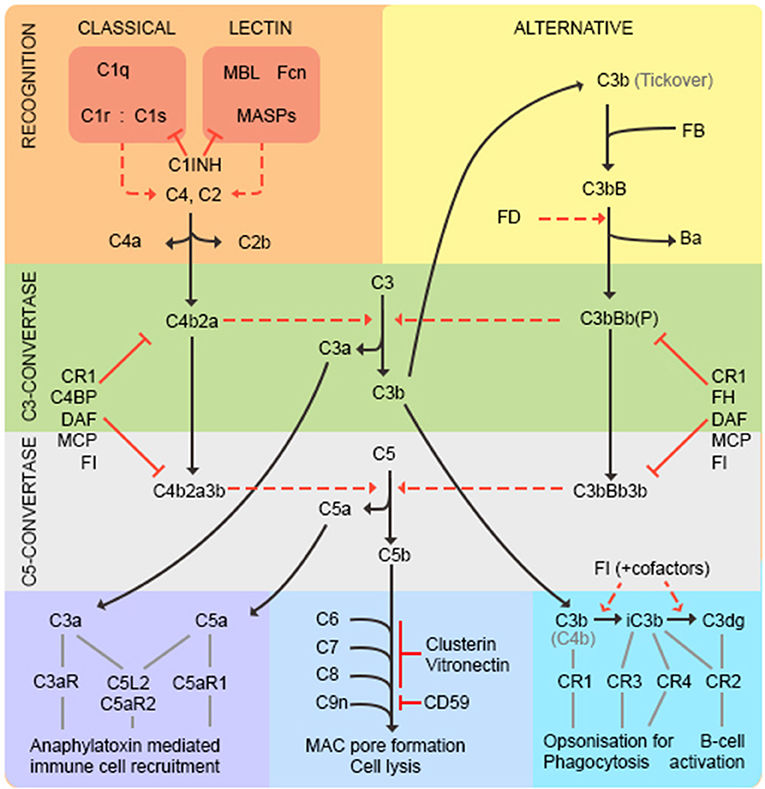 Fig.1 The complement pathway.1,3
-
C3 Level Interception: As the convergence point for the classical, lectin, and alternative pathways, targeting C3 provides a broad-spectrum inhibitory effect. Modulating C3 is particularly effective in halting the downstream generation of both anaphylatoxins (C3a, C5a) and the Membrane Attack Complex (MAC), thereby providing comprehensive protection against complement-mediated injury.
-
C5 and Terminal Pathway Blockade: Modern therapeutic strategies prioritize blocking the cleavage of C5 to prevent the formation of the terminal MAC and the release of C5a, a potent chemoattractant. This targeted approach is central to treating conditions where excessive cell lysis and leukocyte recruitment are the primary drivers of disease, such as PNH and aHUS.
-
Soluble Regulatory Proteins: Strategies involve utilizing soluble versions of endogenous regulators, such as sCR1 (TP10) or Factor H derivatives. These engineered proteins mimic natural inhibitory mechanisms, acting as decay-accelerating factors or cofactors to dampen activation specifically on host cell surfaces, thereby minimizing systemic side effects.
Application
Complement inhibitors developed at Creative Biolabs have diverse therapeutic applications, addressing high unmet needs across several medical specialties:
Hematology:
Providing curative-intent strategies for PNH by completely preventing complement-mediated intravascular hemolysis and reducing the frequency of blood transfusions.
Nephrology:
Offering precision management for aHUS, C3 glomerulopathy, and lupus nephritis, where chronic complement activation leads to irreversible glomerular basement membrane damage and renal failure.
Ophthalmology:
Halting the progressive cellular atrophy in Geographic Atrophy (GA) and Age-related Macular Degeneration (AMD) by inhibiting local complement-mediated inflammation and lipid-rich deposit formation in the retina.
Neurology:
Mitigating acute and chronic tissue damage in Myasthenia Gravis (gMG) and Neuromyelitis Optica, where complement-mediated destruction of the neuromuscular junction or astrocyte surfaces causes severe neurological deficits.
Transplant Medicine & Surgery:
Reducing the incidence of ischemia-reperfusion injury (IRI) and antibody-mediated rejection (AMR). By pre-emptively modulating the complement response, these inhibitors enhance graft survival rates and minimize acute post-operative complications.
What Can We Offer?
We provide a comprehensive portfolio of products and services to support every stage of your research:
-
Monoclonal & Bispecific Antibody Development: Targeted against C1q, C3, C5, and Factor D.
-
Soluble Complement Regulator Engineering: Development of sCR1 (TP10), sCD59, and Factor H fusion proteins.
-
Small Molecule & Peptide Screening: High-throughput identification of C3-binding compstatin analogs.
-
Functional Assays: Pathway-specific (Classical, Lectin, Alternative) activity assays and MAC formation inhibition tests.
-
Custom Protein Production: High-purity recombinant complement components and mutant variants for structural studies.
Workflow
01
Target Analysis & Strategy Design: We conduct an in-depth structural analysis of the target component (e.g., C3b or C5) to identify optimal binding pockets or interaction interfaces.
02
Library Construction & Screening: Utilizing phage display or hybridoma technologies, we generate vast libraries to identify high-affinity binders.
03
Functional Characterization: Leads are subjected to hemolysis assays and ELISA-based pathway activation tests to confirm inhibitory potency.
04
Optimization & Engineering: Candidates undergo affinity maturation and humanization to ensure safety and efficacy for clinical transition.
05
Pre-clinical Validation: Rigorous in vitro and in vivo modeling to assess the inhibitor's impact on disease-relevant signaling.
Published Data
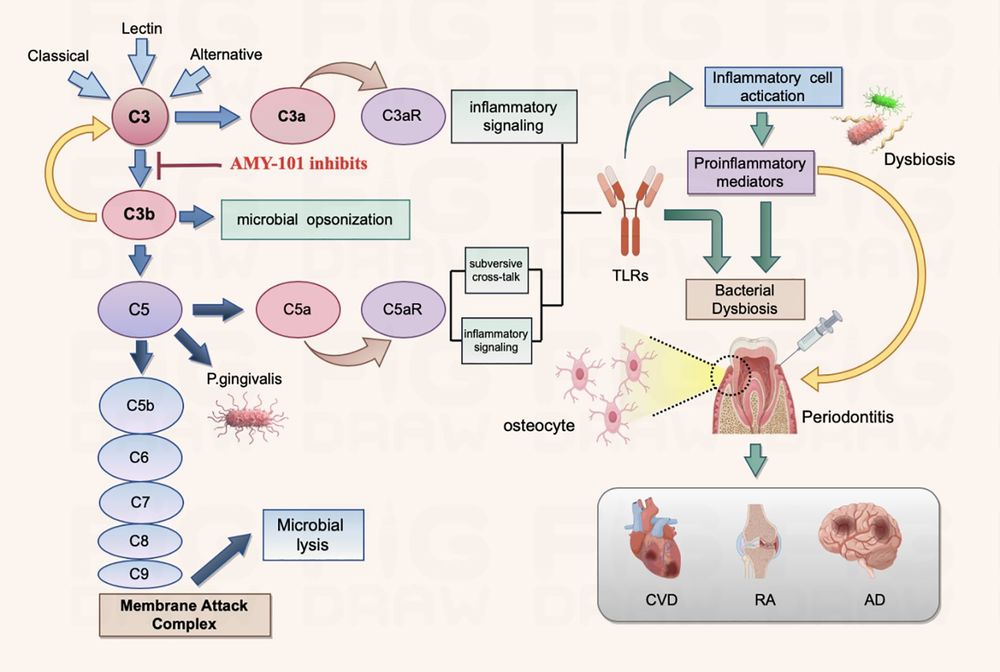 Fig.2 The mechanisms involved in the regulation of periodontitis and other diseases by C3 complement and AMY-101.2,3
Scientific evidence confirms that the central complement component C3 is a critical driver of the inflammatory "vicious cycle" in periodontal disease. Research utilizing non-human primate models shows that the C3 inhibitor AMY-101 (Cp40) can achieve a sustained reduction in clinical attachment loss and bone resorption by suppressing the recruitment of neutrophils and the release of matrix metalloproteinases. In human clinical studies, weekly local administration of AMY-101 resulted in a statistically significant improvement in the gingival index and a decrease in pro-inflammatory cytokines within the gingival crevicular fluid. These findings establish that targeted C3 inhibition not only mitigates local inflammation but also preserves structural bone integrity, positioning C3 as a validated target for drug development in complement-mediated oral and systemic pathologies.
Why Choose Us?
Creative Biolabs stands at the forefront of complement research with several distinct advantages:
-
Deep Domain Expertise: Our scientists have decades of experience navigating the complexities of the complement cascade.
-
Customized Platforms: We offer "turn-key" solutions tailored specifically to the unique turnover rates and concentrations of complement proteins.
-
Superior Affinity: Our engineered antibodies often reach picomolar affinity, ensuring effectiveness even in high-concentration serum environments.
-
Unrivaled Screening Precision: Leveraging our proprietary high-throughput platforms, we can screen thousands of candidates simultaneously under physiological conditions.
FAQs
Q: How can the high physiological concentration of C3 be effectively overcome in inhibitor design?
A: Effective neutralization of C3 requires molecules with exceptionally high binding affinity. Utilizing affinity maturation to achieve rapid association and slow dissociation rates ensures that inhibitors can maintain target occupancy despite the high micromolar concentrations of C3 found in human serum.
Q: Is it scientifically feasible to inhibit the Alternative Pathway without affecting the Classical or Lectin pathways?
A: Yes. By specifically targeting unique components of the Alternative Pathway, such as Factor B or Factor D, it is possible to block this specific amplification loop. This strategy preserves the upstream functions of the Classical and Lectin pathways, maintaining critical host defense mechanisms.
Q: Which expression systems are most suitable for producing complex recombinant complement regulators?
A: Recombinant complement regulators often require complex post-translational modifications for stability and function. Mammalian systems like CHO or HEK293 are generally preferred to ensure authentic glycosylation, though insect or yeast systems can be utilized depending on the specific structural requirements of the protein.
Q: Why is cross-reactivity testing essential for complement inhibitor candidates?
A: Complement components vary significantly across species. Cross-reactivity testing ensures that a candidate molecule can effectively bind and inhibit the target in relevant animal models (such as non-human primates or rodents), which is vital for validating safety and pharmacological efficacy during preclinical development.
Q: What are the biological implications of targeting only the terminal pathway?
A: Inhibiting terminal components like C5 or the C5b-9 complex (MAC) prevents direct cell lysis and the pro-inflammatory effects of C5a. This approach is highly effective for treating diseases driven by terminal pathway activation while leaving C3-mediated opsonization and immune clearance functions intact.
Creative Biolabs is dedicated to providing the biopharmaceutical industry with high-precision tools to modulate the complement system. From initial target validation to the delivery of optimized therapeutic leads, our expertise ensures your project moves forward with scientific rigor and clinical potential.
Featured Services
Feature Products
References
-
Carpanini, Sarah M et al. "Therapeutic Inhibition of the Complement System in Diseases of the Central Nervous System." Frontiers in immunology vol. 10 362. 4 Mar. 2019, https://doi.org/10.3389/fimmu.2019.00362
-
Li, Jialun et al. "AMY-101 as complement C3 inhibitor for periodontitis therapy: mechanisms, efficacy, and clinical translation." Frontiers in immunology vol. 16 1587126. 29 Apr. 2025, https://doi.org/10.3389/fimmu.2025.1587126
-
Distributed under Open Access license CC BY 4.0, without modification.
For Research Use Only.
Related Sections: