Introduction What We Can Offer Workflow Published Data Why Choose Us? Applications FAQs Featured Services Featured Products
Creative Biolabs provides industry-leading aptamer optimization services designed to refine raw SELEX sequences into high-performance molecular tools. We help researchers overcome binding instability and low sensitivity, ensuring your candidate is perfectly tailored for diagnostic, environmental, or industrial applications.
Contact our team to get an inquiry now!
Aptamer and Aptamer Optimization
Aptamers are single-stranded oligonucleotides, DNA or RNA, capable of folding into intricate three-dimensional architectures to bind targets with high specificity. While the SELEX process identifies functional binders, raw aptamers often suffer from nuclease sensitivity and suboptimal affinity in complex matrices. Aptamer optimization is the critical engineering phase that follows discovery. It involves modifying the chemical backbone and refining the primary sequence to enhance thermal stability and binding kinetics. By integrating structural truncation with advanced chemical engineering, we transform discovery-stage sequences into robust, stable reagents capable of maintaining peak performance in challenging physiological or industrial environments, effectively bridging the gap between a library hit and a functional product.
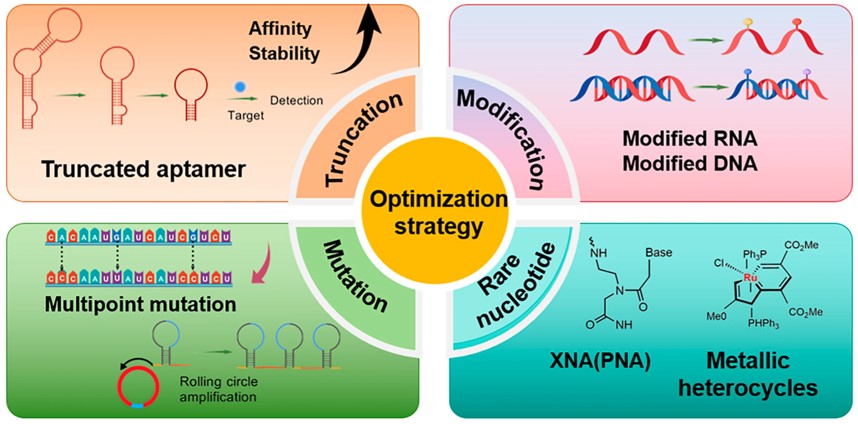 Fig.1 Optimization strategies of aptamer.1,3
What We Can Offer
We provide a comprehensive suite of post-SELEX engineering strategies to maximize the utility of your oligonucleotide binders. Our team evaluates your sequence's secondary structure to implement precise modifications that enhance affinity, durability, and target selectivity.
Our Core Service Offerings:
Aptamer Basic Sequence Optimization & Truncation
We utilize systematic deletion analysis and secondary structure modeling to identify the essential binding domain. By removing non-functional "flanking" sequences, we reduce synthesis costs and minimize non-specific interactions without compromising target affinity.
Structure Stabilization & "Buffer-Switch" Adaptation
Many aptamers lose function when moved from selection buffers to real-world environments. We utilize massively parallel screening (MPS) to identify rare mutations that stabilize the aptamer's fold in the presence of varying salt concentrations and temperatures.
Hydrophobic & Hydrophilic Portions Optimization
To improve binding to hydrophobic protein pockets, we introduce non-natural base modifications. This "chemical vocabulary" expansion allows our engineered aptamers to achieve specificity levels that traditional four-base oligonucleotides cannot reach.
Advanced Chemical Modifications
We fortify your candidates against degradation using 2'-ribose modifications (2'-F, 2'-OMe) and Phosphorothioate (PS) linkages. We also offer Locked Nucleic Acids (LNA) to significantly increase the melting temperature (Tm) of the binding complex.
Aptamer Conjugations
We provide site-specific conjugation of functional groups, including PEGylation for half-life extension, cholesterol for membrane permeability, or fluorophores and biotin for diagnostic assay integration.
Post-SELEX Refinement
Beyond simple sequence tweaks, we perform bivalent or multivalent construction. By linking multiple aptamer units, we increase the functional avidity, allowing for the detection of targets at picomolar concentrations.
Workflow
01
Technical Consultation: You provide the initial aptamer sequence and its known target affinity.
02
Feasibility Assessment: We analyze the sequence in silico to predict folding and potential truncation sites.
03
Strategy Design: A custom optimization roadmap is created, selecting specific chemical modifications or truncation patterns.
04
Synthesis & Modification: Our laboratory synthesizes the modified variants using high-fidelity phosphoramidite chemistry.
05
Affinity Validation: We verify the Kd and specificity of the optimized variants using liquid-phase assays or surface plasmon resonance (SPR).
06
Data Delivery: You receive a comprehensive report containing the optimized sequence, binding kinetics data, and the final purified product.
Published Data
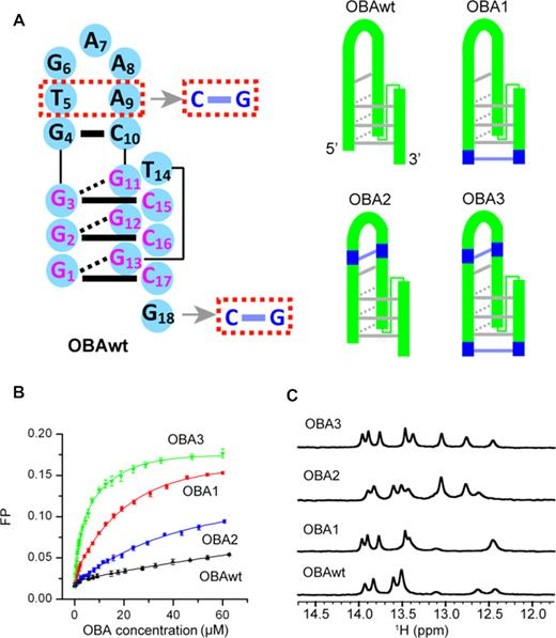 Fig.2 Secondary structures and function of the original OTA aptamer and its variants.2,3
In this study on Ochratoxin A (OTA) detection, researchers used NMR spectroscopy to resolve the structure of the OTA aptamer. By identifying the G-quadruplex and duplex motifs critical for target recognition, they performed precision sequence refinement. The resulting "super-aptamer," featuring a single-base mutation and a truncated sequence, demonstrated a 100-fold increase in binding affinity. This optimization also enhanced thermal stability and structural rigidity, significantly boosting performance in high-sensitivity biosensors. This case proves that structure-guided engineering, not just simple truncation, is essential to unlocking an aptamer's full therapeutic and diagnostic potential.
Why Choose Us?
-
High-Throughput Platforms: We utilize MPS to analyze millions of sequence variants simultaneously for rapid optimization.
-
Custom Chemical Toolbox: Access to rare nucleotides, metal-organic bases, and LNA modifications not available through standard vendors.
-
Physiological Focus: We optimize binders specifically for performance in human serum and complex industrial buffers.
-
Predictive AI Modeling: Our machine learning algorithms guide sequence mutations to maximize specificity and minimize off-target binding.
-
End-to-End Support: From the initial sequence consultation to final validation, we provide a seamless transition to high-performance aptamers.
Applications
-
High-Precision Diagnostics: Optimized aptamers function as superior recognition elements in ELONA assays, lateral flow devices, and electrochemical biosensors. Engineering ensures these tools maintain picomolar sensitivity when detecting circulating biomarkers in complex matrices like whole blood or undiluted urine.
-
Food Safety & Industrial Monitoring: Our stabilization techniques ensure aptamers remain functional in high-acid, high-salt, or thermally stressed environments. This is essential for the real-time detection of mycotoxins, pesticide residues, and pathogenic bacteria during aggressive food processing cycles.
-
Environmental Surveillance: Optimized sequences enable the robust, field-based detection of heavy metals, endocrine disruptors, and aquatic toxins. Engineering for environmental resilience allows these sensors to operate reliably in the field without the need for strict cold-chain logistics.
-
Targeted Delivery & Intracellular Imaging: We refine aptamers to act as high-affinity "homing devices" for therapeutics. By optimizing for cellular internalization and conjugating them to nanoparticles or siRNA, we facilitate high-specificity delivery while minimizing off-target toxicity in non-target tissues.
FAQs
Q: How does truncation improve my aptamer's performance?
A: Shortening the sequence eliminates non-essential nucleotides that may fold into "decoy" structures. By focusing on the binding core, we reduce non-specific interactions and lower the cost of large-scale chemical synthesis.
Q: Can you optimize an aptamer that I discovered using a different service provider?
A: Absolutely. We frequently take sequences discovered via standard SELEX and apply our advanced optimization pillars to improve their stability, affinity, and specificity for specific end uses.
Q: How do you ensure the optimized aptamer won't bind to similar analogs?
A: We employ specificity screening against closely related molecules. Our high-throughput platforms allow us to measure binding across a panel of analogs simultaneously to ensure "lock-and-key" precision.
Q: Is it possible to optimize aptamers for use in high-temperature industrial processes?
A: Yes, we utilize LNAs and specific backbone modifications that significantly increase the thermal melting point, allowing the aptamer to function at elevated temperatures.
Q: Can you optimize RNA aptamers, or do you only work with DNA?
A: We optimize both DNA and RNA sequences. For RNA, we focus heavily on 2'-position modifications to ensure the resulting candidate is resistant to ubiquitous RNase enzymes.
As a pioneer and the undisputed global leader in novel drug discovery and manufacturing, Creative Biolabs has won a good reputation in providing support for aptamer development and optimization. Our professional scientists are confident in offering domestic and international customers a range of tailored strategies and services for the optimization of aptamers.
All you need to do is contact us directly and communicate with us about your specific demands or ideas. Our seasoned scientists will reply to you with a custom solution as soon as possible.
Featured Services
Featured Products
References
-
Qin, Xinna, et al. "Aptamer Sequence Optimization and Its Application in Food Safety Analysis." Foods 14.15 (2025): 2622. https://doi.org/10.3390/foods14152622
-
Xu, Guohua, et al. "Structure-guided post-SELEX optimization of an ochratoxin A aptamer." Nucleic Acids Research 47.11 (2019): 5963-5972. https://doi.org/10.1093/nar/gkz336
-
Distributed under Open Access license CC BY 4.0, without modification.
For Research Use Only.
Related Sections: