Introduction What Can We Offer? Workflow Published Data Why Choose Us? FAQs Featured Services Featured Products
Macroglobulins: Precision Protease Inhibition for Next-Generation Therapeutics Accelerate Your Drug Discovery Process!
Are you currently facing challenges such as uncontrolled extracellular proteolysis, complex inflammatory cascades, or difficulties in developing stable protein-based inhibitors? Our Macroglobulin Development & Analysis Service helps you obtain high-quality, biologically active macroglobulins and related antibody tools through advanced recombinant DNA technology and high-throughput protein engineering platforms. We specialize in transforming these "pan-protease inhibitors" into powerful assets for your biopharmaceutical pipeline.
Contact our team to get an inquiry now!
Introduction to Macroglobulins
Macroglobulins, particularly α2-Macroglobulin (α2M), are high-molecular-weight glycoproteins that serve as the versatile "sentinels" of the innate immune system. Unlike traditional small-molecule inhibitors that rely on highly specific, lock-and-key binding to block enzymatic active sites, α2M utilizes a unique and sophisticated "Venus Flytrap" mechanism. This inhibitory process begins within a specialized 35-amino acid "bait region" located on the surface of the protein. When this region is recognized and cleaved by virtually any endopeptidase, regardless of its catalytic class, it triggers an immediate and massive conformational collapse of the entire molecule. This irreversible structural shift physically entraps the protease within the hollow core of the macroglobulin tetramer, caging the enzyme so that while its active site remains technically functional, it is sterically hindered from interacting with large physiological substrates.
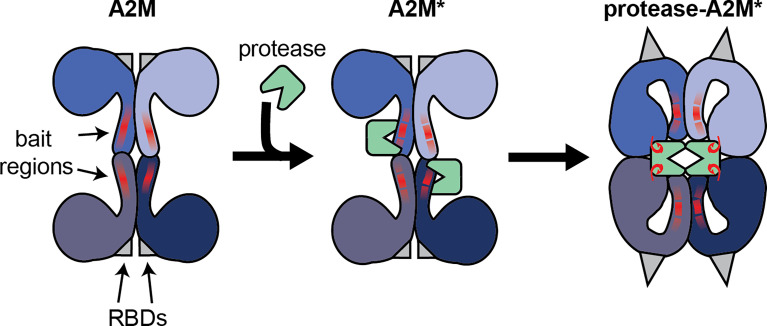 Fig.1 The interaction between the α2M tetramer and active endopeptidases.1,3
α2M and the Complement System
In addition to its role as a pan-protease inhibitor, α2M serves as a critical regulator within the complement system. Structurally and evolutionarily related to complement components C3, C4, and C5, α2M shares the characteristic internal thioester bond that is essential for its function. Within the complement cascade, α2M acts as a fluid-phase regulator that can neutralize "tick-over" activation or unintended proteolytic triggers from serine proteases like MASPs or C1r/C1s. By modulating these early-stage enzymes, macroglobulins help maintain homeostasis and prevent the systemic damage associated with complement overactivation.
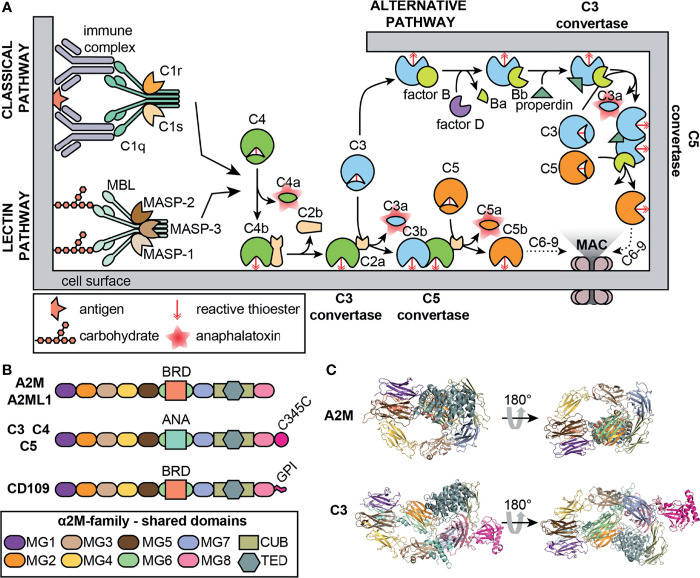 Fig.2 The complement system and α2M.1,3
Literature indicates that the activated form (α2M) also acts as a signaling molecule by binding to the Low-density Lipoprotein Receptor-related Protein 1 (LRP1/CD91). This interaction facilitates the rapid endocytosis and lysosomal degradation of the entrapped protease-inhibitor complex. Beyond protease regulation, macroglobulins are recognized as extracellular chaperones that prevent the aggregation of misfolded proteins, such as Amyloid-β in Alzheimer’s Disease, making them critical targets in neurodegenerative and inflammatory research.
Application Areas
The versatility of Macroglobulins allows for applications across multiple therapeutic and diagnostic fields:
Orthobiologics
Concentration of autologous or recombinant α2M to treat Osteoarthritis by neutralizing cartilage-degrading metalloproteinases.
Inflammatory Diseases
Modulation of cytokine signaling (TNF-α, IL-1β) and suppression of systemic inflammatory cascades.
Neurodegeneration
Facilitating the clearance of neurotoxic protein aggregates and protecting neurons from protease-mediated damage.
Diagnostic Biomarkers
Utilizing serum α2M levels as a predictive marker for Type 2 Diabetes, obesity-related metabolic imbalance, and renal fibrosis.
Drug Delivery
Engineering macroglobulins as carriers for targeted delivery, leveraging the LRP1-mediated endocytosis pathway.
What Can We Offer?
We offer a diverse portfolio of products and services to support your macroglobulin research:
-
Custom Recombinant Macroglobulin Expression: Tailored production in mammalian or insect cell lines.
-
Monoclonal & Polyclonal Antibodies: Specific to the bait region, thioester domain, or the receptor-binding domain (RBD).
-
Bioactivity Assays: Standardized kits for measuring protease entrapment efficiency and thioester stability.
-
LRP1 Binding & Internalization Studies: Cell-based assays to quantify receptor-mediated endocytosis.
-
Clinical Sample Analysis: High-sensitivity ELISA and MS/MS services for biomarker quantification.
Workflow
01
Consultation & Strategic Design: Our team evaluates your target protease data and clinical requirements to select the optimal mammalian expression system for proper protein glycosylation.
02
Recombinant Expression & Optimization: We perform high-efficiency gene synthesis and vector construction followed by pilot-scale expression to identify the highest-yielding clones.
03
Multi-Stage Purification: The 720 kDa tetramer is isolated to over 95% purity using a sophisticated combination of Ion-Exchange and Gel Filtration chromatography.
04
Functional Characterization: Comprehensive bioassays are conducted to verify bait-region cleavage, thioester reactivity, and LRP1 receptor-binding affinity.
05
Quality Control & Delivery: Final deliverables include the purified active protein accompanied by a detailed analytical report featuring SDS-PAGE, HPLC, and MS/MS validation data.
Published Data
In a clinical proteomic study (investigating biomarkers for metabolic disorders, researchers utilized two-dimensional gel electrophoresis (2-DE) and LC-MS/MS to analyze serum protein profiles across three groups: healthy controls, obese individuals, and patients with T2DM combined with obesity. The experiment identified α2-Macroglobulin (α2M) as a significantly up-regulated protein in both the obesity and T2DM+obesity cohorts compared to healthy controls. ELISA verification confirmed that α2M levels were markedly higher in the T2DM+obesity group (3.261±0.400 g/L) and the obesity group (2.746±0.391 g/L) than in the control group (1.376±0.229 g/L). Receiver operating characteristic (ROC) curve analysis further demonstrated that α2M serves as a strong diagnostic predictor for obesity and T2DM, with Area Under the Curve (AUC) values of 0.873 and 0.601, respectively. These results suggest that elevated α2M levels are closely linked to insulin resistance and metabolic imbalance, highlighting its potential as a highly sensitive clinical biomarker for the early detection and monitoring of Type 2 Diabetes.2,3
Why Choose Us?
Creative Biolabs is recognized for its commitment to advancing complement and protease research, leveraging technical expertise to address complex biopharmaceutical challenges.
-
Advanced Protein Enrichment Expertise: Our approach emphasizes the retention of native biological activity through specialized purification methodologies. By focusing on the structural integrity of large glycoproteins, we aim to minimize dissociation and ensure the stability of high-molecular-weight complexes.
-
Integrated Structural Characterization: We utilize a suite of analytical tools, including high-resolution imaging and structural proteomics, to provide clarity on protein conformation. This allows for a better understanding of transition states between native and activated forms, which may be beneficial for precise therapeutic design.
-
Translational Insight: Our experience includes the development of engineered macroglobulins that may offer functional advantages over traditional therapeutic options in certain pathological contexts. Published Data suggest that these molecules can be effectively tailored to modulate complex inflammatory environments.
-
Receptor-Mediated Signaling Knowledge: We maintain a focused interest in the α2M/LRP1 axis. By analyzing the interaction between macroglobulins and their primary receptors, we help ensure that experimental candidates are designed to engage appropriate physiological clearance and signaling pathways.
FAQs
Q: How does the "bait-and-trap" mechanism differ from traditional competitive inhibitors?
A: Traditional inhibitors bind directly to the protease active site. Macroglobulins present a decoy "bait" sequence; when the protease cleaves it, the macroglobulin undergoes a structural collapse that physically cages the protease. This allows it to inhibit a vastly broader range of proteases regardless of their specific active site geometry.
Q: Can macroglobulins be used to target specific cytokines?
A: Yes. While primarily protease inhibitors, macroglobulins act as carriers for various cytokines and growth factors. Engineered versions can be designed to capture specific proinflammatory cytokines like TNF-α and facilitate their degradation via the LRP1 pathway.
Q: What is the significance of the "activated" form (α2M)?
A: The activated form occurs after the internal thioester bond is broken or the bait region is cleaved. This form exposes a previously hidden C-terminal domain that binds with high affinity to the LRP1 receptor, signaling for the complex to be removed from circulation.
Q: Is it necessary to use mammalian expression systems for recombinant α2M?
A: Due to its large size (tetrameric 720 kDa) and extensive glycosylation requirements for stability and receptor binding, mammalian systems (like CHO or HEK293) are highly recommended to ensure proper folding and biological activity.
Q: Are there specific precautions for handling purified macroglobulins?
A: Because macroglobulins are sensitive to oxidative stress (which can cause dissociation into dimers) and spontaneous thioester hydrolysis, they should be stored in specific buffers and kept at low temperatures to maintain the "native" inhibitory state.
Creative Biolabs provides a specialized platform for the development, purification, and functional analysis of Macroglobulins. By combining high-purity protein production with advanced signaling assays, we empower your research in inflammation, orthopedics, and beyond.
Featured Services
Featured Products
References
-
Vandooren, Jennifer, and Yoshifumi Itoh. "Alpha-2-Macroglobulin in Inflammation, Immunity and Infections." Frontiers in immunology vol. 12 803244. 14 Dec. 2021, https://doi.org/10.3389/fimmu.2021.803244
-
Wang, Mingjie et al. "Identification of α2-macroglobulin as a biomarker for type 2 diabetes in human serum." Frontiers in endocrinology vol. 16 1534490. 23 May. 2025, https://doi.org/10.3389/fendo.2025.1534490
-
Distributed under Open Access license CC BY 4.0, without modification.
For Research Use Only.
Related Sections: