Why CFH Activity Assay Matters
The alternative complement pathway is continuously primed for activation through spontaneous C3 hydrolysis and amplification of C3b deposition. This feature allows the complement system to respond rapidly to microbial surfaces, immune complexes, damaged cells, and other danger-associated structures. However, the same amplification loop must be tightly controlled to avoid uncontrolled complement activation on host tissues. CFH provides this control by recognizing C3b and host-associated surface markers, thereby directing regulatory activity to appropriate sites.
CFH activity is not a single biochemical event. It involves several coordinated functional properties:
-
CFH binds C3b and related C3 fragments.
-
CFH competes with Factor B for C3b binding and limits formation of the alternative pathway C3 convertase.
-
CFH accelerates the decay of C3bBb by promoting dissociation of Bb from the convertase complex.
-
CFH acts as a cofactor for Factor I-mediated cleavage of C3b to inactive fragments such as iC3b.
-
CFH recognizes host-like polyanionic surfaces and helps distinguish self from non-self.
-
CFH can modulate complement activation on cell membranes, extracellular matrix, biomaterials, immune complexes, and disease-associated surfaces.
Because CFH function depends on both molecular interaction and biological context, different assay designs may answer different questions. Creative Biolabs designs CFH activity assays to match the scientific question behind each project. Whether the goal is to evaluate a disease-associated CFH mutation, compare recombinant CFH lots, characterize engineered CFH fragments, screen CFH-enhancing compounds, assess anti-CFH autoantibody interference, or benchmark complement inhibitors, our team can help select a suitable assay strategy and establish a robust testing workflow.
Great Minds Choose Creative Biolabs
What We Test
Creative Biolabs' CFH activity assay service can be adapted to a wide range of research materials and development needs.

Recombinant and Native CFH, CFH Variants and Mutants
Assay panels can be tailored to characterize individual variants.

CFH-Related Proteins and Engineered Regulators
Evaluate CFH-related molecules, engineered regulators, fusion proteins, and domain-swapped constructs.

Small Molecules, Peptides, and Aptamers
Support hit identification, lead ranking, concentration-response analysis, and mechanism-of-action studies.
Workflow of CFH Activity Assay
Creative Biolabs follows a structured workflow to ensure that each CFH activity assay is aligned with the client's scientific goals and sample requirements.
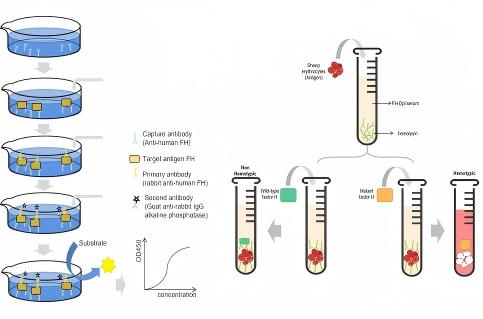 Fig. 1 CFH ELISA workflow (left) and CFH-mediated hemolysis inhibition assay (right).
Design Your Workflow
Featured Service Packages
|
Service Packages
|
Description
|
Typical deliverables
|
|
CFH Basic Binding Package
|
This package is designed for projects that need to evaluate the interaction between CFH and C3b or other ligands. Recommended for:
-
Recombinant CFH quality assessment
-
CFH variant screening
-
Antibody competition studies
-
Ligand recognition studies
|
-
Binding signal comparison
-
Concentration-response profile
-
Relative binding activity
-
Summary of binding performance
|
|
CFH Cofactor Activity Package
|
This package evaluates the ability of CFH to support Factor I-mediated C3b cleavage. Recommended for:
-
CFH variant functional analysis
-
Engineered CFH characterization
-
Anti-CFH antibody interference studies
-
Mechanism-of-action research
|
-
C3b cleavage profile
-
iC3b or fragment generation analysis
-
Relative cofactor activity
-
Control-normalized activity comparison
|
|
CFH Decay-Acceleration Package
|
This package measures the ability of CFH to destabilize the alternative pathway C3 convertase. Recommended for:
-
Alternative pathway regulatory studies
-
Convertase-targeted therapeutic development
-
CFH structure-function analysis
-
Functional comparison of CFH constructs
|
-
Convertase decay profile
-
Bb dissociation or activity loss readout
-
Relative decay-accelerating activity
-
Dose-response analysis when applicable
|
|
CFH Surface Protection Package
|
This package assesses CFH activity on host-like or disease-relevant surfaces. Recommended for:
-
Surface recognition studies
-
Cell-based complement regulation
-
Disease-associated variant evaluation
-
Therapeutic candidate assessment
|
-
Surface C3 deposition
-
Terminal complement complex deposition
-
Cell lysis or viability readout
-
Protection index or relative activity score
|
|
CFH Comprehensive Functional Panel
|
This package integrates multiple assay formats to build a complete functional profile. Recommended for:
-
Lead candidate selection
-
CFH variant deep characterization
-
Translational research studies
-
Preclinical complement therapeutic programs
|
-
Binding activity
-
Cofactor activity
-
Decay-accelerating activity
-
Alternative pathway regulation
-
Surface protection
-
Integrated functional interpretation
|
Design Your Customization
Case Studies
Case 1
Measurement of the Kd of C3b for Different Factor H Sites
Ten different recombinant Factor H protein fragments were analyzed by SPR for their affinity for C3b. The method used to measure these interactions relied on the attachment of the recombinant Factor H fragments to the Ni-NTA-coated surface of sensor chips. A similar experimental approach was used to measure the affinity of the C3b binding site at the C-terminal of Factor H.
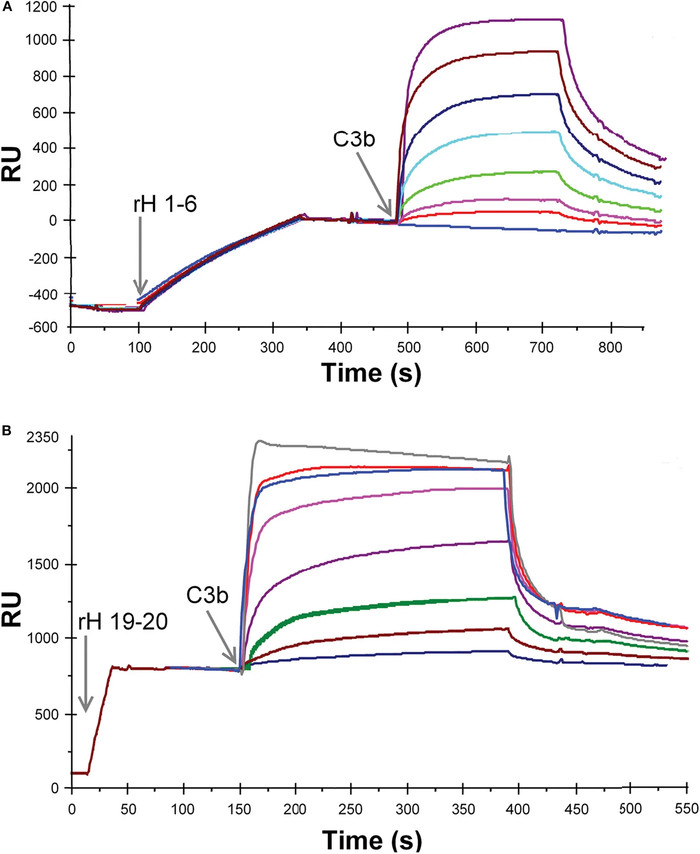 Fig. 2 SPR analysis of the binding of recombinant Factor H to C3b.1,2
References
-
Haque, Aftabul, et al. "Characterization of binding properties of individual functional sites of human complement factor H." Frontiers in immunology 11 (2020): 1728. https://doi.org/10.3389/fimmu.2020.01728
-
Distributed under Open Access license CC BY 4.0, without modification.
Frequently Asked Questions
What is the difference between a Factor H binding assay and a Factor H activity assay?
A Factor H binding assay usually measures whether Factor H interacts with a ligand such as C3b, C3d, heparin-like molecules, host-like surface components, or other relevant binding partners. This type of assay is useful for studying recognition and competition. A Factor H activity assay, however, evaluates whether Factor H performs a functional regulatory role, such as acting as a Factor I cofactor, accelerating C3 convertase decay, suppressing alternative pathway amplification, or protecting cells from complement deposition. In many projects, binding and activity assays are complementary because normal binding does not always guarantee normal regulatory function.
Can the assay determine whether a Factor H variant has lost function?
Yes. Creative Biolabs can design a functional assay panel to evaluate whether a Factor H variant shows reduced, retained, enhanced, or context-dependent activity. Depending on the suspected mechanism, the panel may include C3b binding, Factor I cofactor activity, decay-accelerating activity, serum-based alternative pathway inhibition, and surface protection assays. This multi-readout strategy helps distinguish different types of functional defects.
Can Creative Biolabs test recombinant Factor H produced in different expression systems?
Yes. We can compare recombinant Factor H proteins produced in different expression systems, purification workflows, formulations, or storage conditions. Functional testing can be used to assess whether differences in production or handling affect binding, cofactor activity, convertase regulation, or pathway inhibition. This is especially useful for protein engineering, process development, lot comparison, formulation optimization, and stability studies. In addition to activity readouts, assays can be designed with appropriate reference standards and controls to support relative activity comparison across multiple recombinant Factor H preparations.
What readouts can be included in a Factor H activity assay?
Available readouts may include C3b binding, C3d binding, Factor I-mediated C3b cleavage, iC3b generation, Bb dissociation, reduction of alternative pathway C3 convertase activity, C3 fragment deposition, Ba generation, C3a release, C5a release, C5b-9 formation, hemolysis inhibition, cell viability, and surface protection. Readout selection depends on the assay format and scientific goal.
What controls are commonly used in Factor H activity assays?
Common controls may include blank controls, no-Factor H controls, wild-type Factor H controls, heat-inactivated serum controls, complement-depleted serum controls, Factor I controls, C3b-only controls, known complement inhibitors, isotype controls, vehicle controls, positive activation controls, negative surface controls, and matrix-matched controls. For antibody interference studies, additional controls may include non-specific antibodies, blocking controls, or competition conditions. Creative Biolabs selects controls based on assay type, sample matrix, complement source, and project objective.