Antibodies are crucial for research and therapy, but sometimes lack sufficient affinity. Affinity maturation, a natural process involving somatic hypermutation and antigen-binding selection, improves antibody affinity. This iterative process, occurring in germinal centers, results in highly mutated antibodies with significantly increased affinity.
Learn More →Antibody Humanization Service
Overview Workflow Publication Why Choose Us FAQs Customer Review Related Services Contact Us
Overview
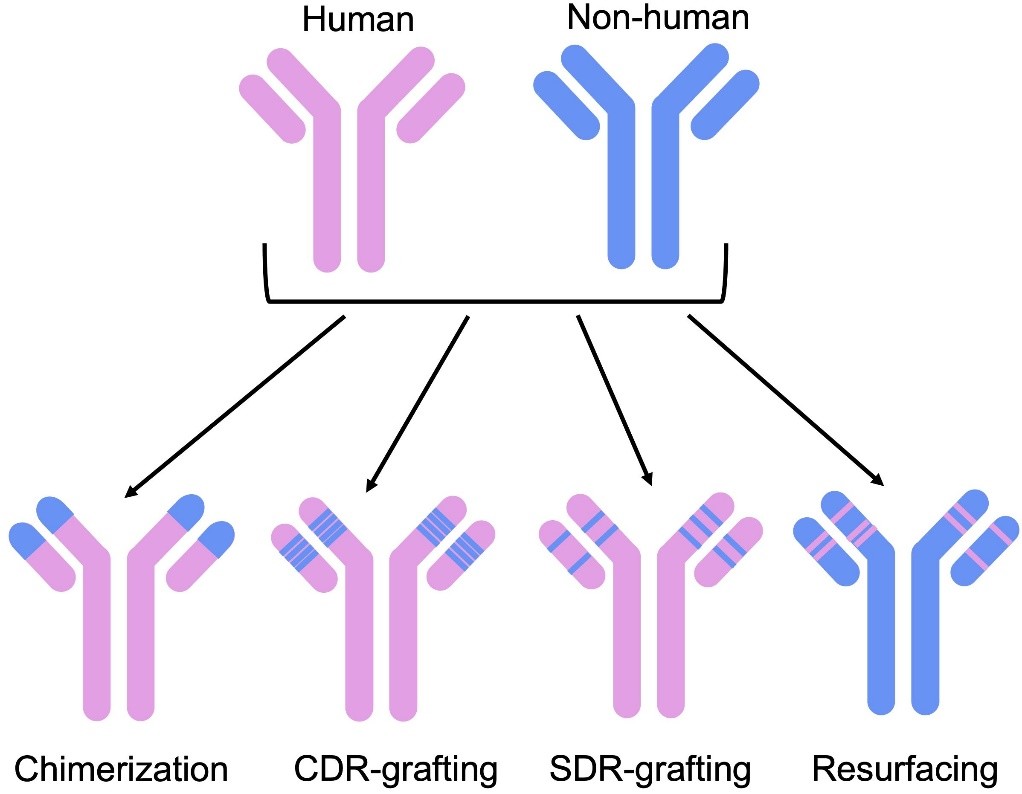 Fig.1 Humanized antibody.1, 3
The humanized antibodies are a type of antibodies derived from non-human species, whose protein sequences have been modified to improve their similarity with human natural antibody variants. Currently, antibody humanization is acknowledged to play a fundamental role in the remarkable progress of antibodies as therapeutic agents.
Recombinant antibody technology is rapidly becoming available and displaying considerable success in clinical practices. However, the immunogenicity of murine monoclonal antibodies is observed to be restrictive in cancer immunotherapy. To reduce the chance of immunogenicity, humanized antibodies are created to address immunogenic response and thus they are considered to be a promising alternative reagent in the clinic. In Creative Biolabs, we possess a variety of methods and toolkits used in the antibody humanization process and provide customized antibody humanization services.
Antibody Humanization Services at Creative Biolabs
➢ Process
Creative Biolabs has launched the GHA Platform to develop humanized antibodies as well as Hi-Affi™ Platform to develop human monoclonal antibodies from non-human primates. The steps for designing humanized antibodies are as follows.
 Fig.2 A humanized process in Creative Biolabs.
➢ Our Capability
i. Universal antibody humanization service or one-stop, customized antibody service for special needs.
ii. 30 days guaranteed services for the whole project, once clients' VH and VK sequences received.
iii. High-quality service. We deliver humanized candidates and ensure their epitope specificity and binding affinity.
iv. If clients are satisfied with humanized antibody variants, we can provide the stable cell line further optimized for high yield expression and validated for scale-up.
➢ Humanization Toolkits
- CDR grafting - Antibody variables are termed complementarity-determining regions (CDRs) determining where antibodies bind to a specific antigen, are combined with human constants. In CDR grafting, antigen affinity and antibody specificity are maintained by utilizing residues related to antigen binding and it is common to select an appropriate human acceptor framework.
- SDR grafting - Humanized antibodies from CDR grafting may still elicit an anti-idiotypic (anti-id) immune response in organisms. To minimize anti-V region responses, the antibody can be humanized only by grafting the specificity determining residues (SDRs) upon the human frameworks.
- Phage display - It is a process using bacteriophages to display antibodies which are fused to the phage coat protein. Through repeated cycles of antigen-guided selection, bacteriophages are genetically designed to generate a human phage display library, then screened for binding affinity to a particular antigen.
- Transgenic animals - Model animals (e.g. mouse) are genetically engineered by introducing human antibody light/heavy chain gene sequences, as well as targeted modification of endogenous animal antibody genes to suppress their expressions. The result is transgenic animals can produce complete human antibody repertoires.
- Resurfacing - This approach is based on the identification of accessible, protruding residues in the non-human antibody which need to change human sequences without affecting the conformation of CDR loops to create humanized antibodies with reduced immunogenicity.
- Superhumanization - The superhumanization is based on structural homologies between human and mouse CDRs in which a framework homology is uncorrelated. By this method, the best superhumanized form of antibody shows a better affinity (6-fold loss) than that with the CDR grafted variant (70-fold loss).
- HSC optimization - The immunologically relevant metric of antibody humanness named human string content (HSC) is a new strategy for antibody humanization. Through maximizing HSC quantity, the humanization of target sequence is to create multiple diverse humanized variants, whose variable domains are less immunogenic, more binding affinities.
Publication
This publication introduces a novel computational tool called Hu-mAb. Developed using machine learning classifiers trained on a large dataset of antibody sequences, Hu-mAb is designed to distinguish between human and non-human antibody variable domain sequences. The tool suggests specific mutations to an input sequence to systematically reduce its immunogenicity and produce a more "human-like" antibody.
The paper highlights that Hu-mAb's output scores show a negative correlation with the experimental immunogenicity of existing antibody therapeutics. The mutations suggested by the tool for a set of therapeutic antibodies with known precursor sequences show a substantial overlap with those deduced experimentally, demonstrating its effectiveness. This tool offers an automated, rapid, and effective alternative to the time-consuming, trial-and-error approach of traditional humanization experiments, without the need for a 3D structure.
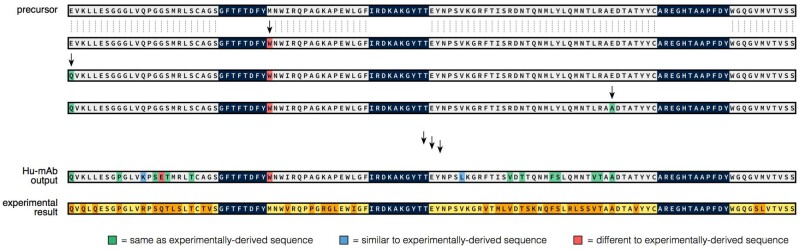 Fig.3 A step-by-step guide to antibody humanization using the heavy chain sequence.2, 3
Why Choose Us?
Creative Biolabs' deep scientific expertise and state-of-the-art platforms set us apart, enabling us to deliver humanized antibodies with superior efficacy and developability. Our diverse array of humanization platforms ensures we can tailor the perfect strategy for your specific needs. Our decades of experience in antibody engineering, supported by rich published data, gives us a competitive edge that translates directly to your project's success. We understand the need to simultaneously optimize humanness alongside other drug-like properties, a key challenge noted in the field. Our comprehensive approach addresses this by leveraging computational tools and extensive structural data to predict and mitigate potential developability issues.
Rich experience
Creative Biolabs has extensive experience in antibody engineering for diagnostics and therapeutics, and they have accomplished more than 15 murine humanization projects have been accomplished successfully.
Strategy diversity
We have multiple toolkits for humanized antibodies, including CDR back mutation library screening, human framework selection.

Species diversity
Our humanization services to antibodies can be applied to any species, such as non-human primate (NHP), rabbit, llama, dog, and chicken.
Guaranteed quality
The optimized antibody with minimal immunogenicity, almost equivalent to a mature human antibody, is guaranteed to retain parental affinity and specificity. The affinity maturation can improve the affinity by at least 10-fold.
Experience the Creative Biolabs Advantage - Get a Quote Today!
FAQs
Q1: How do you ensure the humanized antibody retains its binding affinity?
A1: Our process includes a careful selection of the human framework, strategic back mutations to preserve the critical structural integrity of the CDRs, and subsequent affinity maturation to ensure your antibody's binding performance is maintained or enhanced.
Q2: What is the difference between humanization and de-immunization?
A2: Humanization aims to increase the overall humanness of the antibody, while de-immunization specifically focuses on identifying and mutating T-cell epitopes. Our advanced service incorporates both strategies to create an antibody with minimal immunogenicity.
Q3: Can your service be applied to antibodies from species other than mice?
A3: Absolutely. Our expertise is species-agnostic. We have successfully humanized antibodies derived from a wide range of species, including rabbits, llamas, and non-human primates, all with the same high standards of quality.
Customer Review
-
Improved PK Profile
Using Creative Biolabs' antibody humanization service in our research has significantly improved the pharmacokinetic profile of our antibody candidates, allowing for less frequent dosing and a better patient experience. Our phase I trials were completed much faster than anticipated. - Dr. Ke S*h
-
Affinity Retention
We were concerned about losing binding affinity during the humanization process, but the final antibody from Creative Biolabs retained the parental antibody's high specificity. This was critical for our in vivo studies. - Prof. Na J*s
Related Services
To further accelerate your drug discovery and development, we recommend exploring our complementary services:
Antibody Maturation
TSLP Assay Portfolio Service
The TSLP/TSLP (thymic stromal lymphopoietin) receptor axis is a vital regulator in various cancers, including leukemia and solid tumors. Creative Biolabs, with its advanced technologies and experienced scientists, offers a TSLP assay portfolio service to aid in targeted cancer therapy and diagnosis.
Learn More →Contact Us
With the flourish of antibody drugs, the demand for humanized antibodies is rapidly growing. Due to strict ethical and moral principles, it is impossible to immunize humans directly with interested antigens. Here, Creative Biolabs sets up two reliable platforms for humanized antibodies with high-affinity, low immunogenicity, and has extensive experience in providing multiple diverse antibody humanization services for both laboratory and therapeutic purposes. If there are any questions, please contact us for more information.
References
- Gordon, G. L., et al. "Prospects for the Computational Humanization of Antibodies and Nanobodies." Front Immunol 15 (2024): 1399438. DOI: https://doi.org/10.3389/fimmu.2024.1399438
- Marks, C., et al. "Humanization of Antibodies Using a Machine Learning Approach on Large-Scale Repertoire Data." Bioinformatics 37.22 (2021): 4041-47. DOI: https://doi.org/10.1093/bioinformatics/btab434.
- Distributed under Open Access license CC BY 4.0, without modification.
 Download our brochure
Loading case studies...
Online Inquiry